
UnitedHealth Group
Section 1 — Business Overview, Operations & Competitive Positioning
1.1 The Business
sources UnitedHealth Group earns its money in two economically distinct ways that management deliberately runs as one system: it collects fixed premiums to bear the medical-cost risk of roughly the entire spectrum of U.S. health coverage (UnitedHealthcare), and it sells the care delivery, pharmacy management and data-and-technology services that manage that same cost (Optum) — to itself and to competing payers. The core economic engine is therefore a spread business: the company prices a premium today against its best estimate of the medical costs it will incur over the coverage period, and it keeps the difference. Because that premium is fixed for the period, the entire enterprise lives or dies on the accuracy of one forecast — expected medical cost trend — and FY2025 is the year that forecast broke.
At scale, UnitedHealth Group Incorporated (UNH) is the largest U.S. managed-care organisation, generating $447,567.0M of revenue in FY2025 — up from $184,840.0M a decade earlier, a near-uninterrupted compounding record that ended abruptly on the earnings line rather than the revenue line. Revenue continued to grow in FY2025, but split-adjusted diluted EPS fell to $13.23 from $15.51 and a FY2023 peak of $23.86, as the medical-cost mispricing management itself describes compressed the operating margin. The workforce is very large and unusually clinical for an insurer — a substantial share are practising clinical professionals, a direct consequence of the Optum Health care-delivery model rather than an administrative footprint. The business is overwhelmingly domestic, and its single largest revenue counterparty is the U.S. federal government through the Centers for Medicare & Medicaid Services (CMS).
Key Information
| Item | Value |
|---|---|
| Ticker | UNH |
| Sector / Industry | Healthcare — Managed Care |
| Report Date | 2026-08-13 |
| Most Recent FY Revenue | $447,567.0M |
| EBIT Margin (Most Recent FY) | 4.2% |
| Diluted Weighted-Average Shares | 911M |
| Current Price | $405.59 |
Source: Company SEC filings (10-K); see Appendix A.1.
1.2 Operating Segments
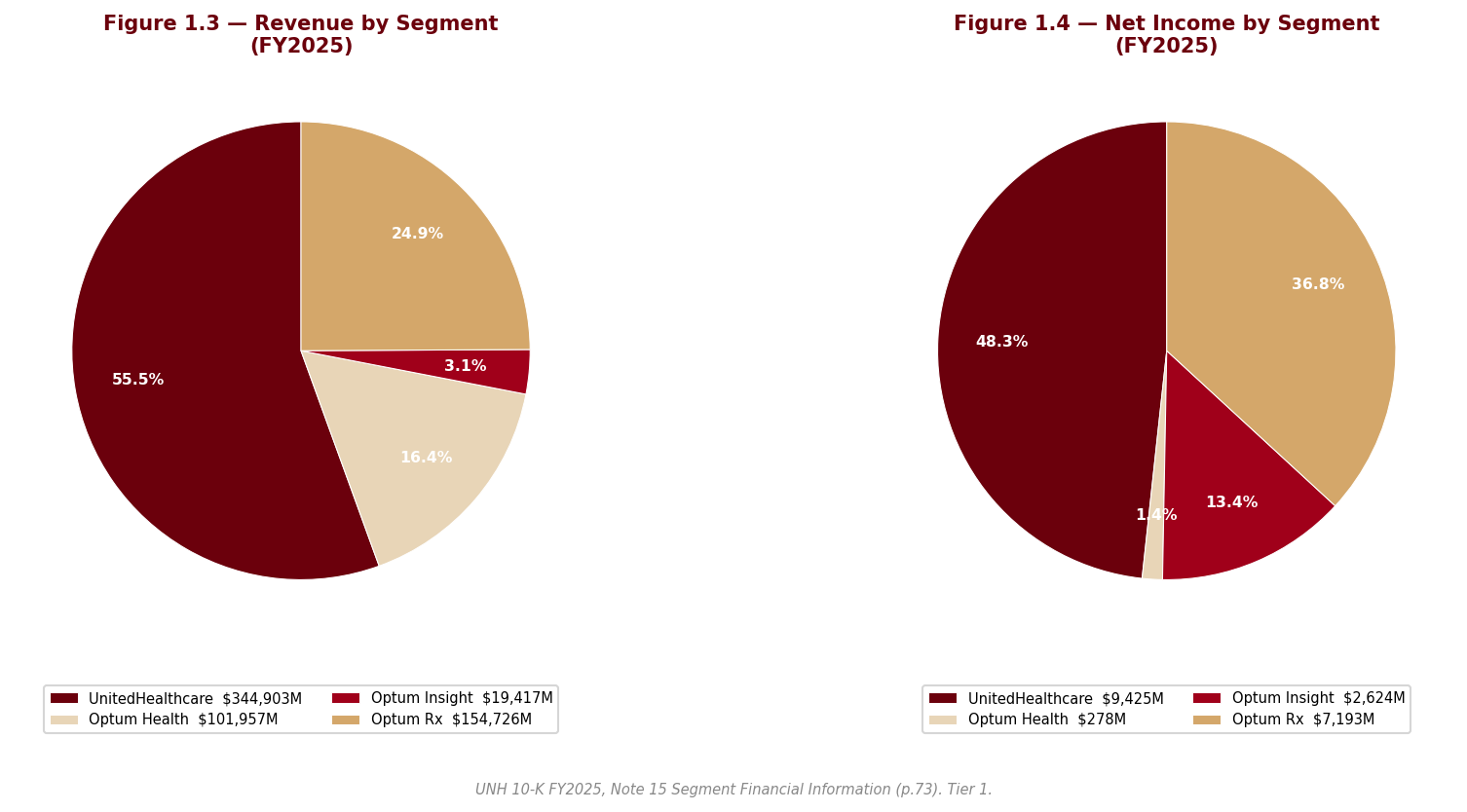
sources The company reports four segments across its two franchises. UnitedHealthcare is the risk-bearing insurance business, selling health benefits through Employer & Individual, Medicare & Retirement, and Community & State (Medicaid). Its economics are governed by a single variable — the spread between the premium it priced and the medical care ratio it actually realises — and in FY2025 that spread inverted against it as priced trend fell short of incurred trend. [Rating and price target withdrawn — see the note at the top.]
Optum Health delivers care — primary, specialty and surgical — and, critically, moves providers off fee-for-service into fully accountable value-based arrangements in which Optum Health itself assumes medical-cost risk for a monthly premium. The single driver is therefore the same medical-cost trend that drives UnitedHealthcare, layered on top of Medicare Advantage funding: when both compress simultaneously, as in FY2025, the segment has no natural hedge, and it swung to a full-year operating loss on funding cuts, the cost profile of newly added value-based patients, and a fourth-quarter reserve for anticipated 2026 losses. This is the analytically important point about the “diversified” model — Optum Health does not diversify away the insurance risk, it doubles the exposure to medical cost trend.
Optum Rx is the pharmacy-care and PBM business — retail network, home delivery, specialty and infusion — whose driver is script volume and managed drug spend. It was the relative bright spot in FY2025, with both revenue and operating earnings rising on new client wins and higher volumes. Optum Insight sells data, analytics, technology and managed services to payers, providers and governments on multi-year contracts and carries a signed-and-anticipated revenue backlog; its driver is backlog conversion, and its FY2025 was shaped by the tail of the Change Healthcare cyberattack recovery.
The segments are engineered to interlock: Optum Rx sells pharmacy management, Optum Health sells care delivery, and Optum Insight sells analytics and technology — all into UnitedHealthcare, priced at management’s estimate of fair value and eliminated in consolidation. The intended flywheel is vertical integration that lowers total cost of care and captures the provider margin that a pure insurer would pay away. The fragility, exposed in FY2025, is correlation: the two largest profit engines (UnitedHealthcare risk and Optum Health value-based care) are both long the same medical-cost-trend risk, so an industry-wide utilisation and funding shock hits both at once rather than being absorbed by one. Effective January 1, 2026 the company has also realigned the flywheel, moving Optum Financial (including Optum Bank) out of Optum Health and into Optum Insight, with prior periods to be recast from the Q1-2026 10-Q — a change that alters segment comparability going forward.
1.3 Geographic Exposure
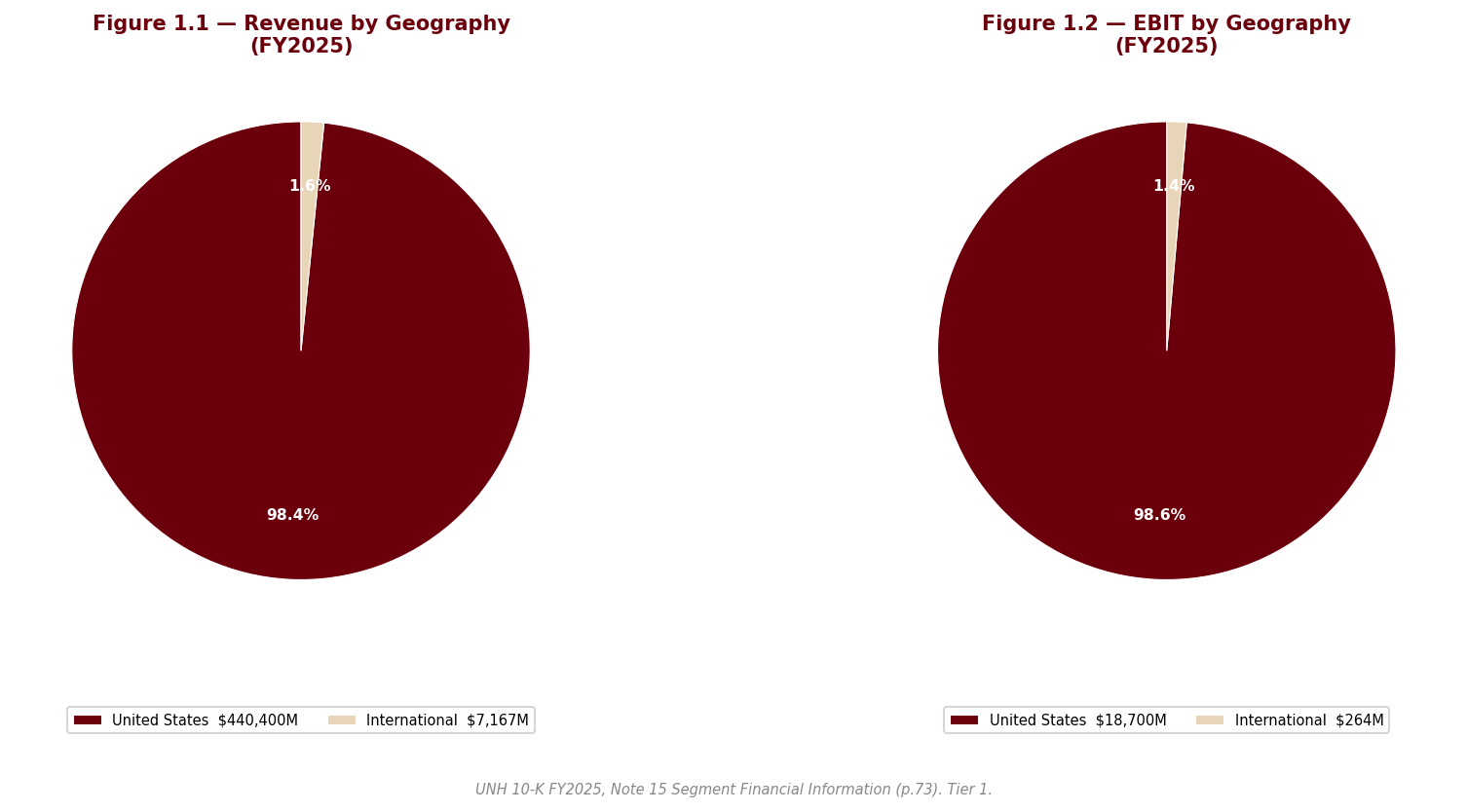
UnitedHealth is, for practical purposes, a domestic U.S. enterprise, and it is actively completing its exit from what little international footprint remained. The company sold its Brazil operations (Amil) in the prior year and has agreed to dispose of its remaining South American businesses, an exit expected to close in the second half of 2026. The consequence is that residual foreign-currency exposure is being wound down rather than managed as an ongoing operating risk. [Rating and price target withdrawn — see the note at the top.] That government-funding dependence is the dominant structural exposure and is developed in Section 2.
1.4 Management Team
sources The most important fact about the leadership team is that almost all of it is new, installed simultaneously, and installed in the middle of the worst operating year in the company’s modern history. Stephen Hemsley — a long-tenured former chief executive who ran the company through its earlier build-out — returned as Chief Executive Officer and Chair in May 2025; Wayne DeVeydt joined as Chief Financial Officer in September 2025; Dr. Patrick Conway became CEO of Optum in May 2025; and Timothy Noel became CEO of UnitedHealthcare in January 2025. Hemsley is the anchor, and his return is the single most reassuring governance signal available — he is the executive most credibly able to restore the pricing and forecasting discipline that failed in 2025. The offsetting concern is bench depth and coordination risk: a nearly complete refresh of the senior team, combining internal promotions with outside hires, executing a multi-year turnaround at the same time removes the continuity that would normally de-risk a recovery. Management explicitly frames this team as central to restoring “performance visibility,” which is a tacit acknowledgement that visibility had been lost. For an equity whose entire earnings power rests on the accuracy of one forecast, the credibility of the people now making that forecast is a first-order variable, not a soft factor.
1.5 Capital Allocation Track Record
| Year | Dividends Paid ($M) | Share Repurchases ($M) | CapEx ($M) |
|---|---|---|---|
| FY2021 | $5,280.0M | $5,000.0M | $2,454.0M |
| FY2022 | $5,991.0M | $7,000.0M | $2,802.0M |
| FY2023 | $6,761.0M | $8,000.0M | $3,386.0M |
| FY2024 | $7,533.0M | $9,000.0M | $3,499.0M |
| FY2025 | $7,916.0M | $5,545.0M | $3,622.0M |
Source: Company SEC filings (10-K); see Appendix A.1.
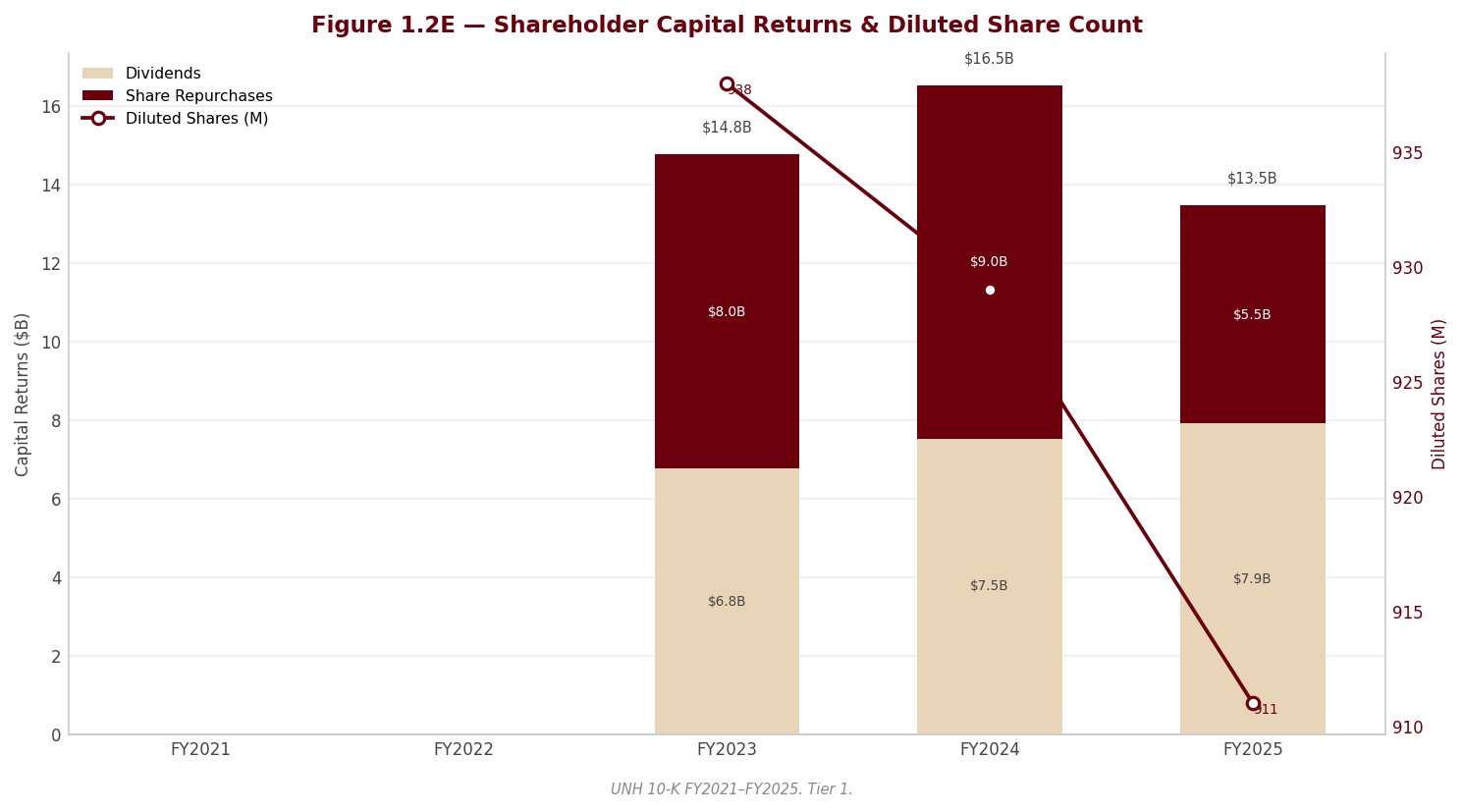
For most of the past decade the capital-allocation story was simple and shareholder-friendly: a steadily rising dividend, consistent buybacks that reduced the split-adjusted diluted share count from 968M to 911M, and capital expenditure sized to support growth rather than merely replace assets. The FY2025 total-shareholder-return yield of 4.5% and a dividend payout ratio of 65.7% show a business that has historically returned a large share of earnings while still funding reinvestment — a profile consistent with high returns on capital and management confidence. That confidence was visibly tested in FY2025: with EPS falling sharply, the payout ratio is now being measured against a depressed earnings base, and the buyback cadence that had reliably shrunk the share count is no longer self-evidently affordable from operating cash alone. The signal to watch is not the historical generosity of the return programme but whether it remains funded from earnings rather than balance-sheet capacity; the sustainability of that funding, and the parent-company constraints behind it, are examined in Sections 3, 5 and 6. On the reinvestment side, capital expenditure has skewed toward growth and technology — software and data platforms central to the value-based-care and AI strategy — rather than pure maintenance, which is consistent with an asset-light services model where the durable investment is in systems and clinical capability, not physical plant.
1.6 Competitive Positioning & Moat
sources [Rating and price target withdrawn — see the note at the top.] Regulation is simultaneously the industry’s deepest moat — the compliance, capital and contracting barriers keep new entrants out — and its principal threat, because the same regulator that erects the barrier sets the reimbursement. The winners are the largest, most vertically integrated players who can price accurately and absorb cost shocks; FY2025 demonstrated that even the largest can lose when the pricing input is wrong.
§1.6.2 Competitive advantages. UnitedHealth’s moat rests on three defensible pillars. First, scale: at $447,567.0M of revenue it is the largest U.S. health-benefits company, which confers unmatched fixed-cost absorption and provider-negotiating leverage. Second, vertical integration: the Optum-plus-UnitedHealthcare structure lets the company capture the care-delivery, pharmacy and analytics margin that a standalone insurer pays away, and — per management — lowers total cost of care through aligned, value-based payment incentives anchored in primary care. Third, data and PBM scale: Optum Rx’s managed drug spend and Optum Insight’s analytics footprint give the enterprise a cost-and-clinical information advantage that is genuinely hard to replicate and that it also monetises by selling to competing payers. These are structural, not cyclical, advantages.
§1.6.3 Competitive vulnerabilities. The moat has three real openings. The first is the one FY2025 exposed: scale and integration do not protect against a pricing error — if expected medical cost trend is set below realised trend, the fixed-premium model turns the company’s size into a magnifier of the mistake rather than a buffer. [Rating and price target withdrawn — see the note at the top.] The third is regulatory and political scrutiny — PBM reform, risk-adjustment audits and antitrust attention on further integration — which can constrain precisely the vertical model that constitutes the moat. Customer concentration in a single payer and the correlated cost-trend exposure across UnitedHealthcare and Optum Health compound these.
§1.6.4 Verdict. The competitive advantage is real and durable — scale and vertical integration are structural, and no domestic competitor matches the breadth of the Optum-plus-UnitedHealthcare system. But FY2025 is a warning that a wide moat is not the same as a stable margin: the model concentrates rather than diversifies medical-cost-trend risk, and it is levered to a single government payer whose funding is currently tightening. The durable question for long-run margin is therefore not whether the moat exists, but whether integrated value-based care restores a structurally higher margin as management intends, or whether government-funding compression has permanently reset the earnings base lower — a question this report resolves in the financial and valuation sections rather than here.
Section 2 — Key Risks & Catalysts
2.1 Downside Risks
sources UnitedHealth is not a company whose risk is dominated by operating execution or the commodity cycle; the dominant risk is regulatory and legal, layered on top of a medical-cost cycle that turned against the entire managed-care industry in 2025 and a set of accounting judgments that, read together, show a company whose historical earnings cushions have thinned. The risks below are ranked by the weight they should carry in the investment case, and each is grounded in a specific disclosure or footnote finding — not in generic sector language.
Risk 1 — A live federal investigation into Medicare, disclosed with no accrual and no estimable range
sources This is the risk that should lead the case. The Company faces an active Department of Justice action concerning its participation in the Medicare program, alongside long-running risk-adjustment coding scrutiny (RADV audits by CMS and the HHS Office of Inspector General), PBM investigations, antitrust history, and shareholder litigation. The forensic review flags the legal disclosure as a red item because it is boilerplate carrying no quantification: the filing lists essentially every conceivable regulator, then describes only one matter in detail — the long-running whistleblower False Claims Act case on risk-adjustment submissions — and states the Company is “often unable to estimate the losses or ranges of losses.” The most recent quarterly filing repeats the identical language while, for the first time, explicitly naming the DOJ’s Medicare actions in its forward-looking-statements risk list. §
The precise point matters. Under the accounting standard, recording no accrual means only that a loss is not both probable and reasonably estimable as management assesses it — it is emphatically not a statement that the exposure is small or unlikely. An analyst cannot size this from the filing, and the correct treatment is to carry it as a genuine, unquantified overhang rather than to read the silence as comfort. Why it matters to the financials: an adverse resolution could bring retrospective payment recoupments, civil penalties, a corporate integrity agreement constraining how the Medicare Advantage book is run, and reputational damage in a business already under political and media pressure. What would make it materialize or dispel: the court’s disposition of the Special Master report in the risk-adjustment case (the DOJ has moved to reject a recommendation that favored the Company), any first accrual or disclosed range, or a settlement. [Rating and price target withdrawn — see the note at the top.]
Probability: Medium (that the overhang persists and pressures the multiple is High; that it produces a financially material adverse judgment is Medium) | Timeframe: Immediate and ongoing | Quantified potential impact: Not quantifiable from the filing — no accrual and no range are disclosed; treated as a material unbounded overhang, not as immaterial.
Risk 2 — Medical-cost trend and the quality of reported earnings
sources Two red-flag findings converge here, and both bear on whether reported FY2025 earnings are a reliable base.
First, the medical-cost estimate itself. Medical costs payable is the Company’s largest and most judgmental estimate — the auditor’s single Critical Audit Matter (the IBNR reserve). In FY2025 the medical care ratio rose sharply while favorable prior-year reserve development, which had contributed meaningfully in each of the two prior years, collapsed to a token amount. This must be read correctly: it is evidence of restraint, not manipulation. Management did not release reserves to defend the earnings print — if anything it did the opposite, booking a premium-deficiency/loss-contract reserve for the first time in three years. The durable risk is different and more important than an earnings-management concern: a favorable-development tailwind the market had implicitly capitalized as recurring earnings quality is now gone, which lowers the underlying earnings base regardless of how the cycle turns. The sensitivity is severe — a small percentage deviation between estimated and actual medical costs swings net earnings materially — so reserving judgment now dominates the earnings line for a company running at a low-single-digit operating margin. Tellingly, a large favorable development swung back in the first half of 2026, which flatters the early recovery and underlines how quickly the sign of this one estimate can flip.
Second, the composition of reported operating income. [Rating and price target withdrawn — see the note at the top.] A one-time gain on the deconsolidation of a business was booked inside operating costs — above the line, not below it — flattering the operating result, while a large Q4 “kitchen-sink” restructuring charge ran the other way and included a loss-contract reserve explicitly set for anticipated 2026 value-based-care losses. [Rating and price target withdrawn — see the note at the top.] Any valuation anchored to reported FY2025 operating income without normalizing for these items will misstate earnings power — which is precisely why the valuation builds off a normalized, recovering margin path rather than the FY2025 print.
The structural point worth making once: the cost cycle is industry-wide — every major managed-care peer reported an elevated medical loss ratio in FY2025 — so this is not a UnitedHealth-specific execution failure. But vertical integration does not hedge it. UnitedHealthcare (the insurer) and the Optum value-based care-delivery business are both long the same medical-cost-trend risk; a utilization shock raises claims at the insurer and squeezes the capitated care-delivery unit at the same time, so the two segments amplify rather than offset each other when trend runs hot.
Probability: High (elevated trend and a thinner reserve cushion are current conditions, not tail events) | Timeframe: Immediate to 1–2 years | Quantified potential impact: Material — medical-cost estimation is the single largest swing factor in the earnings line, and the lost favorable-development cushion is a permanent reduction to the base rather than a timing item.
Risk 3 — Goodwill concentration and Optum Health impairment risk
sources Goodwill and other intangibles represent a very large share of total consolidated assets — the single largest category on the asset side. [Rating and price target withdrawn — see the note at the top.] The largest goodwill balance sits in the Optum Health reporting unit, which swung to a full-year operating loss in FY2025 and shed members, yet management asserts every reporting unit’s fair value was “substantially in excess” of carrying value at the annual test date. [Rating and price target withdrawn — see the note at the top.]
What an impairment would and would not do to the equity story: it would be a non-cash charge — it does not consume liquidity or trip debt covenants directly. [Rating and price target withdrawn — see the note at the top.] What would confirm or dispel: the FY2026 goodwill test on the realigned segment basis, the trajectory of Optum Health’s recovery, and how much goodwill migrates to Optum Insight in the re-allocation.
[Rating and price target withdrawn — see the note at the top.]
Risk 4 — Parent-company capital strain
sources This is the most under-appreciated risk in the case, because most readers assume group cash is fungible — and for a regulated insurance holding company it is not. UnitedHealth’s parent is a holding company that funds its dividend, buybacks and debt service largely from dividends paid up to it by regulated insurance and HMO subsidiaries. Those subsidiaries must hold prescribed minimum statutory capital and, in most states, need regulatory approval before transferring cash above set limits. In FY2025 the mechanism seized: upstream dividends from the regulated subsidiaries fell sharply, the parent had to push capital down into the subsidiaries rather than draw it up, and only a small fraction of the consolidated cash balance was actually available for general corporate use at the parent. Management halted share repurchases entirely in the fourth quarter, and the Company has been using reinsurance structured as deposits to relieve rising statutory-capital requirements as the medical loss ratio climbs.
[Rating and price target withdrawn — see the note at the top.] The Q4 buyback halt is the first visible symptom, not a cosmetic pause. What would confirm or dispel: the pace at which upstream dividend capacity recovers relative to statutory-capital needs, and the durability of the modest 2026 buyback resumption (which so far leans on forward-repurchase contracts). The valuation reflects this by assuming capital return is partly debt/forward-funded and upstream-constrained, and by not extrapolating the pre-shock buyback cadence.
Probability: Medium-High (the constraint is already visible in the filing) | Timeframe: Immediate to 1–2 years | Quantified potential impact: Constrains capital-return capacity and raises reliance on debt markets; a genuine limit on buyback pace rather than a solvency risk — group liquidity itself remains ample.
Risk 5 — Tax structure under direct IRS challenge
sources [Rating and price target withdrawn — see the note at the top.] Shortly after year-end, the Company received IRS Notices of Proposed Adjustment on intercompany transfer pricing with a foreign subsidiary for several back years, with the IRS seeking to significantly increase taxable income and potentially extend to later years. The Company’s own uncertain-tax-benefit balance has grown, which signals that management itself views these positions as contestable.
Why it matters: a meaningful part of the FY2025 tax benefit — and the multi-year low cash-tax profile — rests on positions the IRS is now formally attacking. [Rating and price target withdrawn — see the note at the top.] What would confirm or dispel: escalation to later tax years, a settlement, or an assessment.
[Rating and price target withdrawn — see the note at the top.]
2.2 Upside Catalysts
sources The picture is deliberately asymmetric: the downside risks above are more numerous and, in aggregate, weightier than the catalysts. [Rating and price target withdrawn — see the note at the top.]
Catalyst 1 — Medical-cost normalization and a medical-loss-ratio inflection
[Rating and price target withdrawn — see the note at the top.] Because the entire industry re-priced 2025 medical trend, a clean 2026 pricing cycle and moderating utilization would lift margins across the sector, and UnitedHealth has the scale and pricing sophistication to recover margin as contracts re-price. It would show up first in the quarterly medical care ratio and in the direction of prior-year reserve development. The valuation’s recovery path assumes only a partial return toward pre-shock margins — deliberately below the prior peak because the favorable-development cushion is gone and the cost environment is structurally higher — so a faster or fuller recovery is genuine upside to the target.
[Rating and price target withdrawn — see the note at the top.]
Catalyst 2 — Risk-regime normalization and a lower discount rate (the two-way risk)
[Rating and price target withdrawn — see the note at the top.] The valuation intentionally uses a shorter-window beta that reflects the post-shock, high-volatility regime UnitedHealth has traded in since 2025, rather than the company’s own long-run, pre-shock defensive beta. [Rating and price target withdrawn — see the note at the top.]
Probability: Medium | Timeframe: 1–3 years | Monitoring trigger: Realized volatility and the stock’s beta stabilizing back toward its long-run level; resolution of the legal, tax and capital overhangs that are keeping systematic risk elevated.
Catalyst 3 — Resolution or de-escalation of the federal and tax overhangs
A favorable disposition of the DOJ risk-adjustment matter, a settlement of the IRS transfer-pricing challenge on manageable terms, or simply the removal of headline uncertainty would each lift a discrete discount on the equity. Because these overhangs are currently unquantified, their resolution — even at a modest cash cost — can be a positive for the multiple by converting an unbounded risk into a known number. This is the mirror image of Risk 1 and Risk 5.
Probability: Low-Medium in any given year (these processes are slow) | Timeframe: 1–3 years | Monitoring trigger: Court disposition of the Special Master report; any first accrual or disclosed range; IRS settlement or assessment.
Catalyst 4 — Restoration of capital return as a signal of parent liquidity recovery
The resumption of buybacks at a meaningful, self-funded pace — rather than the current modest, forward-contract-supported cadence — would be the clearest signal that upstream dividend capacity from the regulated subsidiaries has recovered and that the parent-capital strain in Risk 4 is easing. [Rating and price target withdrawn — see the note at the top.]
[Rating and price target withdrawn — see the note at the top.]
2.3 Risk & Catalyst Summary
| # | Item | Type | Probability | Timeframe | Status | Monitoring Trigger |
|---|---|---|---|---|---|---|
| 1 | DOJ Medicare action / legal overhang — no accrual, no range | Risk | M | Immediate | Active | Special Master disposition; any first accrual or disclosed range |
| 2 | Medical-cost trend & earnings quality (reserve cushion gone; one-time items in operating income) | Risk | H | Immediate–1–2y | Active | Quarterly medical care ratio; reserve-development sign |
| 3 | Optum Health goodwill impairment | Risk | M | 1–2y | Monitoring | FY2026 goodwill test on realigned basis; Optum Health recovery |
| 4 | Parent-company capital strain / upstream-dividend constraint | Risk | M/H | Immediate–1–2y | Active | Upstream dividend capacity vs statutory-capital needs; buyback pace |
| 5 | Tax structure under IRS transfer-pricing challenge | Risk | M | 1–3y | Active | Escalation to later years; settlement or assessment |
| 6 | Medical-cost normalization / MLR inflection | Catalyst | M | 1–2y | Monitoring | [Rating and price target withdrawn — see the note at the top.] |
| 7 | [Rating and price target withdrawn — see the note at the top.] | Catalyst | M | 1–3y | Monitoring | Beta stabilizing to long-run level; overhangs clearing |
| 8 | Resolution of DOJ / IRS overhangs | Catalyst | L/M | 1–3y | Monitoring | Court disposition; IRS settlement |
| 9 | Restoration of self-funded capital return | Catalyst | M | 1–2y | Monitoring | [Rating and price target withdrawn — see the note at the top.] |
Source: Company SEC filings (10-K and subsequent 10-Q) and forensic footnote review; see Appendix A.1.
2.4 Risk Interdependencies
sources These risks are not independent draws — they share a common root in the medical-cost cycle and compound through the regulated-subsidiary capital structure. The most damaging combination is a simultaneous medical-cost overshoot (Risk 2) and parent-capital strain (Risk 4): a rising loss ratio both depresses earnings and raises the statutory capital the subsidiaries must retain, which throttles the upstream dividends the parent relies on — so the earnings hit and the capital-return constraint arrive together and reinforce each other. [Rating and price target withdrawn — see the note at the top.]
[Rating and price target withdrawn — see the note at the top.] They are the reason the market currently prices UnitedHealth with a post-shock, elevated systematic-risk profile; while they remain live, they keep the cost of equity high and depress the multiple regardless of operating performance — and a settlement or judgment large enough to matter would land while the parent’s free cash is already constrained. [Rating and price target withdrawn — see the note at the top.]
2.5 ESG & Regulatory Exposure
sources UnitedHealth’s material ESG and regulatory exposures are almost entirely of the “S” and “G” variety and are specific to the disclosures in this filing rather than generic. [Rating and price target withdrawn — see the note at the top.] Separately, Optum Rx faces active and expanding PBM regulation at both federal and state level — covering rebates, formularies, pricing benchmarks and specialty-drug pricing — with governmental investigations that have previously produced penalties and corporate integrity agreements. §
The social license dimension is unusually acute for this company and is disclosed as such: management explicitly acknowledges that the industry is subject to negative publicity, adverse media coverage and political debate over regulation that can depress the stock and invite scrutiny — a risk that became concrete during 2025. In response, the Company has launched a deliberate trust-and-transparency agenda: commissioning independent reviews of its pharmacy and care-management practices, committing to publish prior-authorization and claim-approval metrics, reducing prior-authorization requirements including for pediatric care, and pledging to pass through the full amount of manufacturer rebates over time. These are credible mitigants but also implicitly concede the reputational and regulatory pressure they respond to. Data and privacy exposure is heightened by the residual fallout from the Change Healthcare cyberattack, which compromised protected health information; the Company runs a formal cybersecurity program assessed against the NIST framework with board-level oversight, and states no cyber risk has yet been material to results while cautioning that this could change.
On governance, three filing-specific items warrant attention. First, the year was marked by senior leadership turnover, with the return of the prior chief executive as Chair and CEO during a period of withdrawn guidance and a sharp share-price decline — a signal of instability at the top that an investor should weigh. Second, the corporate-practice-of-medicine structure consolidates physician practices whose equity must legally be owned by a licensed physician but whose economics accrue to UnitedHealth through exclusive management agreements — a related-party-adjacent arrangement that is standard for the sector but carries no independent arm’s-length pricing disclosure. Third, and noted as a watch item rather than a finding: the substantive related-party, compensation and clawback disclosures are deferred to the 2026 proxy statement, which sits outside this filing set; governance commentary should be finalized only after that proxy is reviewed. [Rating and price target withdrawn — see the note at the top.]
Section 3 — Financial Analysis & Historical Performance
sources Three-Statement Linkage Confirmation: - Net Income ties (Income Statement → Cash Flow Statement): confirmed — the FY2025 operating cash flow reconciliation opens with total net earnings including noncontrolling interests (pre-tax income of $14,697.0M less tax expense of $1,890.0M), which reconciles to the $12,056.0M attributable to shareholders once the noncontrolling-interest share is removed; no unexplained bridging item. - Cash ties (Balance Sheet → Cash Flow Statement): confirmed — the closing cash and equivalents balance of $24,365.0M agrees between the balance sheet and the cash-flow statement. - Retained Earnings reconciliation (Beg RE + NI - Dividends = End RE): confirmed within the ordinary buyback mechanic — opening retained earnings of $96,036.0M plus net income of $12,056.0M less dividends of $7,916.0M, then reduced by the portion of the $5,545.0M of repurchases charged to retained earnings once additional paid-in capital is exhausted, reconciles to the closing balance of $95,603.0M. Retained earnings fell year-on-year for the first time in the period under review — the clearest single symptom of the FY2025 earnings shock.
3.1A Income Statement
Source: UnitedHealth Group FY2025 Form 10-K, Consolidated Statements of Operations; figures per the FL model — see Appendix A.1–A.2.
CAGR Summary
| Metric | 3Y CAGR | 5Y CAGR | 10Y CAGR |
|---|---|---|---|
| Revenue | 11.4% | 11.7% | - |
| EBITDA | -9.8% | -1.6% | - |
| Net Income | -15.7% | -4.8% | - |
| Diluted EPS | -14.5% | -3.8% | - |
| FCF | -11.8% | -4.4% | - |
Source: Company SEC filings (10-K); figures per the FL model — see Appendix A.1–A.2.
3.1B Income Statement — Analysis
sources The revenue line held; everything beneath it broke. The defining feature of UnitedHealth’s FY2025 income statement is the divergence between a top line that behaved normally and a profit structure that did not. [Rating and price target withdrawn — see the note at the top.] Growth was not driven by a single lever: management attributes it to Medicare Part D changes under the Inflation Reduction Act (which mechanically inflate both premiums and medical costs), continued Medicare Advantage and fee-based commercial expansion, higher-acuity Medicaid, and script-volume growth at Optum Rx — partly offset by attrition in risk-based commercial and Medicaid membership. The important read is that this is largely price-and-mix revenue tied to rising cost trend, not high-quality volume growth; the IRA-driven Part D dollars in particular arrive with an almost equal-and-opposite medical-cost obligation. Revenue growth of 11.8% therefore tells the reader almost nothing about the health of the franchise this year — the story is entirely in the cost ratios.
The medical loss ratio is the central operating fact of FY2025. Consolidated gross margin — which, for a managed-care insurer, is effectively the inverse of the blended medical-and-product cost ratio — compressed from 22.3% to 18.5%, extending a two-year slide from 24.5%. Management’s own explanation is unusually candid: its pricing trends and member health-status assumptions for 2025 were “well short” of the medical cost trends actually incurred. [Rating and price target withdrawn — see the note at the top.] This is the pivotal analytical judgment for the whole report: the margin damage is primarily cyclical and industry-wide — every major peer posted an elevated FY2025 loss ratio — but UnitedHealth layered company-specific damage on top through its value-based-care book at Optum Health and the fourth-quarter restructuring.
The compression cascaded down the P&L and was amplified at every line. EBIT collapsed to $18,964.0M from $32,287.0M — a steep single-year reduction in operating income — driving the EBIT margin from 8.1% to 4.2%. EBITDA fell to $23,325.0M (5.2% margin). Because the cost pressure sits in the largest line on the statement, a deterioration in the medical care ratio of the scale seen this year is magnified into a collapse in operating profit — the operating leverage that works so powerfully in an insurer’s favor in good years runs in reverse with equal force. The three-year EBITDA CAGR of -9.8% and net income CAGR of -15.7% capture how completely the FY2025 reset has erased the prior compounding.
Major movers — what actually moved the income statement:
-
Medical cost trend / MLR deterioration (structural reset, cyclically amplified). The single largest driver. The gap between priced-for and realized medical trend drove the gross-margin compression from 22.3% to 18.5% and is the root cause of the EBIT decline to $18,964.0M. Management warns these trends “may continue”; even with a 2026 recovery, the earnings base resets permanently lower because the priced margin has been rebuilt off a higher cost baseline, not because the cost spike simply reverses.
-
Collapse of favorable prior-year reserve development (RED flag — earnings quality, but read the direction carefully). This is the most commonly misread item in the filing, and it points the opposite way to the usual insurer-under-pressure pattern. Favorable development of prior-year medical reserves collapsed relative to the prior year and fell further below the year before that, while a premium-deficiency/loss-contract reserve was booked for the first time in three years. Critically, management did not release reserves to defend the print — if anything it built reserves into a falling-earnings year. That is a positive signal for reserve integrity and a mark of honest reporting, but it is a negative for the earnings base: the market had implicitly capitalized a recurring annual tailwind of favorable development as recurring earnings quality, and that cushion is now gone. Because medical costs payable is the auditor’s sole Critical Audit Matter and a small error in that estimate moves net earnings by a material amount, this one estimate dominates the profit line for a company now operating at a 4.2% operating margin. The swing-prone nature of the lever is visible in the subsequent-events file, where favorable development returned sharply in H1-2026 — the near-zero FY2025 figure now looks like a conservatively set year-end reserve being released in 2026.
-
Below-the-line disposal and FX losses — the FY2024/FY2025 distinction (YELLOW flag). The two down years have different anatomies, and conflating them is an analytical error. In FY2024, EBIT was essentially flat ($32,287.0M versus $32,358.0M), yet net income fell -35.6% — the damage was almost entirely below the operating line, driven by the large Brazil (Amil) disposal loss, much of it cumulative foreign-currency translation. In FY2025 the damage moved up into operating income (the MLR), while the South American exit continued to generate a further held-for-sale remeasurement loss (again with a heavy trapped-FX component) below the line. The remaining South American sale is expected to close only in H2-2026, leaving residual completion and FX-recycling risk. These disposal losses are real charges to equity and earnings but are non-operating and largely non-cash; they should be isolated from the underlying franchise.
-
[Rating and price target withdrawn — see the note at the top.] This is not an advantage to extrapolate. [Rating and price target withdrawn — see the note at the top.]
-
Q4 “kitchen-sink”: offsetting one-offs inside operating income (RED flag — quality of earnings). Reported EBIT of $18,964.0M is not clean. It is flattered by a large one-time gain on the deconsolidation of a business — booked inside operating costs, not below the line — together with net portfolio-divestiture gains concentrated at Optum Rx; and it is simultaneously depressed by a substantial fourth-quarter restructuring charge (real-estate and workforce actions, contractual reassessments, equity-security valuation losses, foundation pre-funding) plus an addition to Change Healthcare cyberattack loan-collection reserves at Optum Insight. Two features matter for a clean read: the deconsolidation gain is a genuine, non-recurring item that should be removed from any normalized operating base, so underlying operating earnings are lower than the $18,964.0M headline; and the restructuring charge includes a loss-contract reserve for anticipated 2026 losses on certain value-based-care contracts — a charge that, by construction, makes 2026 look better as it is drawn down. A valuation built on FY2025 operating income must normalize for both.
Quality of earnings. The forensic screens corroborate that this is a genuine operating reset rather than an accounting event: the Beneish M-Score reads clean and Sloan accruals sit in the normal range for FY2025, and the auditor issued an unqualified opinion with the sole Critical Audit Matter being medical IBNR — precisely the estimate flagged above. The caution is not fabrication; it is that “operating income” now contains recurring “special” items in both directions. Restructuring and portfolio-refinement gains and charges have appeared in consecutive years, so any management-defined “adjusted” operating margin that strips them out should be treated skeptically — a genuine one-off (the deconsolidation gain) and a recurring feature (portfolio churn) are being commingled inside the same line. Separately, capitalized-software amortization continued to rise into a falling-earnings year on unchanged useful lives — a growing structural charge and a monitoring item for any future life-extension that would flatter earnings, though not a manipulation flag today.
⚠ Items to Watch. If the EBIT margin fails to recover from 4.2% back toward even FY2024’s 8.1%, the “cyclical reset” thesis weakens toward “structural impairment,” and the earnings-power base assumed in the separate valuation would need to be lowered. If favorable prior-year reserve development does not normalize toward a positive contribution — or if a further premium-deficiency reserve is booked — the reserve cushion should be treated as permanently absent. [Rating and price target withdrawn — see the note at the top.]
3.2A Balance Sheet
Source: UnitedHealth Group FY2025 Form 10-K, Consolidated Balance Sheets; figures per the FL model — see Appendix A.1–A.2.
3.2B Balance Sheet — Analysis
sources Asset composition: an acquisition-built, intangible-heavy balance sheet. Total assets reached $309,581.0M, but the striking feature is what dominates them. Goodwill stands at $110,499.0M — the largest single line on the asset side and the accumulated cost of a decade of Optum-led acquisition, up from $75,795.0M in FY2021; including other intangibles, the acquired-asset base is larger still and, per the filing, is the dominant share of total assets. By contrast, tangible operating assets are modest for the revenue base: PP&E is just $10,762.0M, and the current ratio has sat at 0.8x throughout the period. That below-one current ratio is not a liquidity warning — it is the signature of the insurance model, where medical costs payable and other float liabilities are funded before claims are paid (a structurally negative working-capital position). The critical implication for the rest of this section is that any book-value or asset-based ratio must be read through the goodwill lens: with the asset base so heavily weighted to acquired goodwill and intangibles, book value per share of $103.30 is heavily a function of acquisition accounting, and tangible equity is a small fraction of the reported $94,110.0M.
Goodwill concentration is now a live impairment question (RED flag). The concern is not the size of goodwill per se but its concentration in the weakest reporting unit. Optum Health — which carries the largest goodwill balance in the group — swung to a full-year operating loss in FY2025 and lost members, yet management asserts all reporting units had fair values “substantially in excess” of carrying value at the October 1, 2025 annual test. Three timing problems undercut the comfort of that assertion: the test date precedes the Q4 kitchen-sink charges and the value-based-care deterioration; the January 1, 2026 realignment strips profitable Optum Financial/Optum Bank out of Optum Health, mechanically weakening the very reporting unit that carries the most goodwill; and the auditor did not elevate goodwill to a Critical Audit Matter. [Rating and price target withdrawn — see the note at the top.] A future non-cash impairment at Optum Health is a plausible downside that would reduce the $94,110.0M equity base; it is carried as an explicit scenario in the separate valuation.
Leverage: the deterioration is denominator-driven, not a debt binge. Net debt rose to $54,024.0M from $51,592.0M, and Net Debt/EBITDA jumped to 2.3x from 1.4x — its highest in the period and up from 1.0x in FY2023. But this is a classic analytical trap: total debt was essentially flat year-on-year ($78,389.0M versus $76,904.0M), and Debt/Equity barely moved at 0.8x. The leverage-ratio spike is almost entirely the collapse in EBITDA, not incremental borrowing — mechanically, the same debt looks far heavier against a halved cash-flow denominator. That distinction matters for the durability of the balance sheet: if EBITDA recovers, the ratio de-levers on its own without any debt paydown. The debt itself is well-laddered over decades with a modest near-term maturity schedule and three large undrawn revolving facilities fully backstopping commercial paper, and the company was in compliance with all covenants at year-end — group-level refinancing and covenant risk is low.
But the parent company is genuinely capital-constrained (RED flag). The comfort at the group level does not extend to the parent. UnitedHealth is a holding company that depends on dividends upstreamed from its regulated insurance subsidiaries, and that engine throttled sharply in FY2025: upstream subsidiary dividends fell sharply, the parent had to push capital down into the subsidiaries (a reversal from the prior year’s large upstreaming), and only a small fraction of the $24,365.0M of consolidated cash was disclosed as available for general corporate use. Rising medical cost ratios raise required statutory capital, and the company is using reinsurance treated as deposits to relieve that pressure. The visible symptom is that buybacks were halted entirely in Q4-2025. [Rating and price target withdrawn — see the note at the top.] Group liquidity is ample; parent-level free cash and the sustainability of the capital-return pace are the real constraint.
Working capital: stable float, but one screen misfires and one flag flatters the optics. The cash conversion cycle remains structurally negative (-18 days), the normal and favorable insurer profile. DSO improved modestly to 19 days — but this improvement is partly artificial: in FY2025 the company launched a new receivables-financing (factoring) facility and sold receivables during the year, which understates gross receivables at the balance-sheet date and is not like-for-like with prior years that had no such facility. Separately, an automated earnings-quality screen flags FY2022 receivables growth outpacing revenue growth as a possible revenue-recognition concern; for a managed-care insurer this is a false positive — that build tracked the large Change Healthcare/Optum acquisitions and pharmacy-services scaling, not aggressive recognition, and it does not recur in the FY2025 data. The screen was calibrated for product companies and does not fit an insurer’s receivables dynamics.
[Rating and price target withdrawn — see the note at the top.] A goodwill impairment at Optum Health, or a further premium-deficiency/held-for-sale remeasurement, would reduce the $94,110.0M equity base and further compress tangible book.
3.3A Cash Flow Statement
| FY2021 | FY2022 | FY2023 | FY2024 | FY2025 | |
|---|---|---|---|---|---|
| Cash from Operations ($M) | $22,343.0M | $26,206.0M | $29,068.0M | $24,204.0M | $19,697.0M |
| — Depreciation & Amortization ($M) | $3,103.0M | $3,400.0M | $3,972.0M | $4,099.0M | $4,361.0M |
| Capital Expenditures ($M) | $2,454.0M | $2,802.0M | $3,386.0M | $3,499.0M | $3,622.0M |
| Free Cash Flow ($M) | $19,889.0M | $23,404.0M | $25,682.0M | $20,705.0M | $16,075.0M |
| FCF Margin | 6.9% | 7.2% | 6.9% | 5.2% | 3.6% |
| FCF / Share | $20.80 | $24.64 | $27.38 | $22.29 | $17.65 |
| FCF Conversion (FCF/NI) | 115.1% | 116.3% | 114.7% | 143.7% | 133.3% |
| CapEx / Revenue | 0.9% | 0.9% | 0.9% | 0.9% | 0.8% |
| CapEx / D&A | 0.8x | 0.8x | 0.9x | 0.9x | 0.8x |
| Dividends Paid ($M) | $5,280.0M | $5,991.0M | $6,761.0M | $7,533.0M | $7,916.0M |
| Share Repurchases ($M) | $5,000.0M | $7,000.0M | $8,000.0M | $9,000.0M | $5,545.0M |
Source: UnitedHealth Group FY2025 Form 10-K, Consolidated Statements of Cash Flows; figures per the FL model — see Appendix A.1–A.2.
3.3B Cash Flow — Analysis
sources Operating cash flow fell with earnings — and looks better than it is. Operating cash flow declined to $19,697.0M from $24,204.0M, and free cash flow fell to $16,075.0M (3.6% of revenue), the weakest FCF margin of the period. Management attributes the decline primarily to lower net earnings, partly offset by working-capital movements, the sale of receivables and the non-recurrence of the 2024 cyberattack cash impacts. The headline FCF conversion of 133.3% of net income still looks robust — comfortably converting more than the whole of net income into cash, as it has for a decade — but that ratio overstates cash quality this year for two reasons that the analyst must strip out. First, it is flattered on the denominator: net income was itself depressed by non-cash disposal/held-for-sale losses and cushioned by the low cash-tax profile, so FCF-to-NI is mechanically high. Second, it is flattered on the numerator: the new receivables-factoring facility classifies receivable sales as an operating inflow, lifting reported OCF relative to prior years that had no such facility. Normalized for the factoring facility, underlying operating cash generation is weaker than the 133.3% conversion implies, and the year-on-year OCF comparison is not like-for-like. The durable point remains that the model is genuinely cash-generative — the decade-long history of converting more than all of its earnings into cash, clean Sloan accruals and a clean Beneish reading all support that — but FY2025’s specific conversion figure should not be taken at face value.
CapEx is disciplined and steady — this is not where cash went. Capital expenditure of $3,622.0M held at roughly 0.8% of revenue, consistent with the entire period, and CapEx/D&A sat at 0.8x. A CapEx/D&A ratio persistently below one tells the reader this is a capital-light services-and-insurance model whose reinvestment runs through acquisitions and capitalized software rather than physical plant — depreciation of the existing base slightly exceeds new tangible investment. There is no evidence of a capex cut to defend cash in the down year; investment intensity is unchanged, which is the right read (this is not a company starving maintenance to protect the dividend).
Capital-allocation waterfall: the mix is now under strain. Across the five-year window, free cash flow has overwhelmingly been returned to shareholders through a rising dividend and large buybacks, with acquisitions funded largely from a combination of cash flow and incremental debt. The FY2025 inflection is telling: the dividend rose again to $7,916.0M — management protected the dividend — but buybacks were cut to $5,545.0M from $9,000.0M and halted outright in the fourth quarter. Set against FCF of only $16,075.0M, dividends plus buybacks consumed essentially all of the year’s free cash flow, which is why (per the balance-sheet analysis) the residual return was increasingly debt- and subsidiary-funded rather than organically financed. This mix made sense while FCF ran well above $16,075.0M; at the FY2025 level, and with upstream dividend capacity constrained, the buyback halt is the rational and expected pressure valve — and a signal that the pre-2025 pace of capital return is not assured until earnings and parent-level cash recover.
⚠ Items to Watch. If FCF fails to recover from $16,075.0M back toward the $20,705.0M+ range, dividends alone (already $7,916.0M) would absorb a large share of free cash flow, leaving little organic room for buybacks and forcing continued reliance on debt to sustain the total payout. A sustained fall in FCF conversion after adjusting for the factoring facility — rather than the flattered 133.3% headline — would be the earliest sign that the cash engine, not just the accounting-earnings line, has structurally weakened.
3.4 Returns Analysis
| FY2021 | FY2022 | FY2023 | FY2024 | FY2025 | |
|---|---|---|---|---|---|
| ROIC | 20.2% | 21.4% | 21.6% | 18.2% | 11.3% |
| ROE | 25.2% | 26.9% | 26.9% | 15.9% | 12.9% |
| ROA | 8.4% | 8.8% | 8.6% | 5.0% | 4.0% |
| Interest Coverage | 14.4x | 13.6x | 10.0x | 8.3x | 4.7x |
Source: Company SEC filings (10-K); figures per the FL model — see Appendix A.1–A.2.
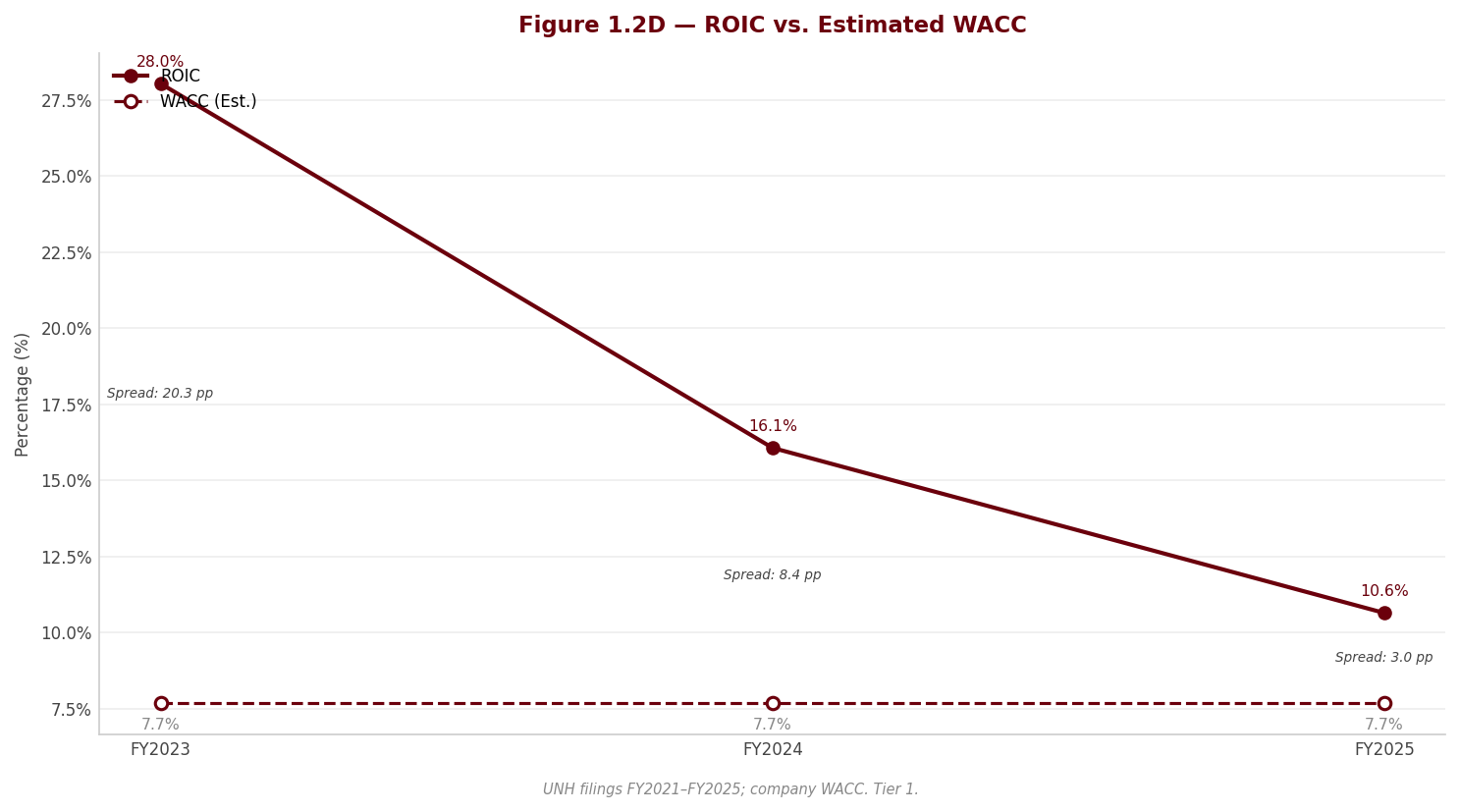
Returns compressed to the point where the spread over the cost of capital has narrowed sharply. Return on invested capital fell to 11.3% in FY2025, down sharply from 18.2% a year earlier and well below the FY2021–FY2023 range of 20.2% to 21.6%. Return on equity fell to 12.9% and return on assets to 4.0%. This is the most important long-run signal in the section: for most of the past decade UnitedHealth generated returns on invested capital comfortably in excess of any reasonable estimate of its weighted-average cost of capital (WACC), and that positive spread is the economic engine behind the franchise’s value creation. At 11.3%, ROIC still clears the weighted-average cost of capital — so the company continues to create economic value rather than destroy it — but only just: the once-wide spread has narrowed to a slim positive margin, a small fraction of the gap the franchise earned for most of the past decade. The entire investment question is whether FY2025 is a cyclical trough from which returns re-widen or a new, structurally lower plateau; at this compressed spread, the margin for error against the cost of capital is now thin. The interest-coverage trend reinforces the operating-leverage point: coverage fell to 4.7x from 8.3x — still comfortably positive and investment-grade, but well below the FY2021 level of 14.4x, again driven by the EBIT collapse against a rising interest bill of $4,002.0M.
DuPont decomposition: margin is the whole story; leverage is quietly rising. Decomposing FY2025 ROE of 12.9% into its drivers, net margin was 2.7%, asset turnover 1.47x, and the equity multiplier 3.25x. The swing factor is unambiguously net margin: asset turnover has been remarkably stable — 1.40x in FY2021 versus 1.47x in FY2025, and the equity multiplier has drifted only gradually higher — so the collapse in ROE from 25.2%–26.9% in FY2021–FY2023 to 12.9% is almost entirely the margin compression from 2.7% (against 6.0% in FY2021), not a change in asset efficiency or leverage. The one quiet, structural shift worth flagging is the equity multiplier, which has risen to 3.25x from 2.98x — a gradually more leveraged balance sheet is providing modest support to ROE even as margins fall, which means reported ROE would look worse still on an unchanged capital structure. The read for the reader: returns will recover only when the medical margin recovers; there is no efficiency or financial-engineering lever that meaningfully changes the trajectory.
3.5 Altman Z-Score (Most Recent FY)
| Component | FY2023 | FY2024 | FY2025 |
|---|---|---|---|
| X1 (Working Capital / Total Assets) | -0.075 | -0.060 | -0.079 |
| X2 (Retained Earnings / Total Assets) | 0.350 | 0.322 | 0.309 |
| X3 (EBIT / Total Assets) | 0.118 | 0.108 | 0.061 |
| X4 (Equity / Total Liabilities) | 0.508 | 0.474 | 0.453 |
| X5 (Revenue / Total Assets) | 1.358 | 1.342 | 1.446 |
| Z-Score | 2.18 | 2.10 | 2.03 |
| Zone | Grey | Grey | Grey |
Source: Company SEC filings (10-K); figures per the FL model — see Appendix A.1–A.2.
Interpret the Z-score with the model’s limitations front of mind. The Altman Z-Score reads 2.03 for FY2025, in the “Grey” zone, having drifted down from 2.18 in FY2023 — a mild, consistent deterioration driven almost entirely by the X3 component (EBIT/Total Assets), which fell from 0.118 to 0.061 as operating income collapsed. The score here is computed on the private-firm Z′ coefficients (0.717·X1 + 0.847·X2 + 3.107·X3 + 0.420·X4 + 0.998·X5), so it is read against the Z′ bands — the “Grey” zone spanning 1.23 to 2.90, with distress below and safety above — rather than the classic manufacturing-Z thresholds. Two structural features mean this score materially overstates distress risk for UnitedHealth and should not be read as a credit warning. First, X1 (working capital/total assets) is negative throughout (-0.079 in FY2025) — but that reflects the insurance float model, where a below-one current ratio is normal and healthy, not a liquidity deficit; the Altman family of models — private-firm Z′ included — is calibrated on manufacturers and penalizes exactly the balance-sheet shape that is a strength for an insurer. Second, with goodwill and intangibles dominating the asset base, the balance sheet is inflated by acquisition accounting, depressing the asset-scaled ratios. The genuine credit picture is better captured by the debt structure discussed above: well-laddered maturities over decades, a light near-term maturity schedule, large undrawn revolvers, and full covenant compliance — investment-grade with ample group liquidity. [Rating and price target withdrawn — see the note at the top.] The Z-score is presented for completeness and comparability; here it is a poor proxy for actual default risk.
4. Valuation withdrawn
This section stated what the shares were worth and what to do about them. It rested on an exit multiple set by hand — across the coverage it averaged 24% below where each company actually traded — so the conclusion largely restated that assumption instead of testing it. Rather than leave it standing, it has been withdrawn while the method is rebuilt.
Nothing else in this report depends on it: the financial analysis above and below is drawn from the company's own filings, and every figure links to the page it was verified against.
Section 5 — Financial Metrics & Peer Benchmarking
Read this section differently than usual. FY2025 was a synchronised cyclical trough for the entire managed-care group: every one of the four peers reported an elevated medical-loss ratio, and every earnings-based multiple in the tables below is therefore struck on depressed profit. A low peer P/E this year is not evidence of “cheap,” and a high one is not evidence of “expensive.” For that reason, relative valuation carries materially less weight in this report than it would in a normal year, and the section is written to prevent the reader from drawing the usual conclusions from the usual numbers.
5.1 Peer Selection
sources The comparable set — CVS Health, Elevance Health, Cigna and Humana — is the natural US managed-care and health-services cohort: the only other scaled, publicly listed entities that combine an insured risk book with adjacent pharmacy, care-delivery or health-services operations. All four file 10-Ks under US GAAP with a 31 December fiscal year-end, so there is no accounting-standard or period-alignment gap to bridge; the comparison is like-for-like on form, and the caveats that follow are about business mix, not reporting basis.
The critical point for the reader is that these four are not interchangeable, and treating them as a single “insurer” bucket would mislead:
- Elevance is the cleanest structural comparable — Blue-branded health plans plus the smaller Carelon services arm — and is the primary like-for-like benchmark for UnitedHealthcare. Its Carelon business is far smaller than UNH’s Optum, so where UNH’s consolidated economics beat Elevance, that gap partly reflects Optum rather than superior health-plan underwriting.
- CVS Health is a retail-pharmacy, pharmacy-benefit and insurance conglomerate; premiums are only about a third of revenue, so its consolidated margins are structurally, not competitively, lower — and its FY2025 earnings-based multiples are further distorted by a large goodwill impairment (see 5.7).
- Cigna is pharmacy-benefit-led: the overwhelming majority of revenue is Evernorth pharmacy throughput, with insurance premiums a small minority. Its thin headline margins are a revenue-mix artifact of low-margin drug pass-through, not evidence of weakness.
- Humana is Medicare-Advantage-concentrated, so its cost cycle has a different shape from UNH’s more diversified book, and its FY2025 free cash flow is distorted by one-off working-capital timing.
| Peer | Ticker | Exchange | Filing Type | Accounting Standard | Fiscal Year End | Comparability Note |
|---|---|---|---|---|---|---|
| CVS Health Corporation | CVS | NYSE | 10-K | US GAAP | December | Retail-pharmacy + PBM + insurer; consolidated margins not comparable to a pure health plan; FY2025 earnings depressed by a goodwill impairment |
| Elevance Health, Inc. | ELV | NYSE | 10-K | US GAAP | December | Closest structural comparable; Blue-branded plans + smaller Carelon services arm |
| The Cigna Group | CI | NYSE | 10-K | US GAAP | December | PBM-led (Evernorth); insurance a minority of revenue; low margins are a mix artifact |
| Humana Inc. | HUM | NYSE | 10-K | US GAAP | December | Medicare-Advantage-concentrated; FY2025 FCF depressed by working-capital timing |
Source: Peer-company SEC filings; comparability notes in 5.7 — see Appendix A.1.
5.2 Profitability Comparison
sources Before reading a single margin below, anchor on the one fact that governs the whole table: FY2025 was an industry-wide managed-care margin shock. Elevated Medicare Advantage and Medicaid utilisation lifted every company’s medical-loss ratio simultaneously and compressed every company’s margin. The absolute levels here are a shared trough, not a set of durable competitive differentials — so the exercise that matters is relative positioning within a bad year, not the level itself.
Comparative: Most Recent Full Fiscal Year
| Metric | UnitedHealth | CVS Health Corporation | Elevance Health, Inc. | The Cigna Group | Humana Inc. |
|---|---|---|---|---|---|
| Revenue ($M) | $447,567.0M | $402,067.0M | $199,125.0M | $274,900.0M | $129,664.0M |
| Gross Margin | 18.5% | 13.8% | 14.9% | 9.3% | 14.5% |
| EBITDA Margin | 5.2% | 2.3% | 4.9% | 4.4% | 2.7% |
| EBIT Margin | 4.2% | 1.2% | 4.1% | 3.3% | 2.1% |
| Net Margin | 2.7% | 0.4% | 2.8% | 2.2% | 0.9% |
| FCF Margin | 3.6% | 1.9% | 1.6% | 3.1% | 0.3% |
Source: Peer-company SEC filings; comparability notes in 5.7 — see Appendix A.1.
Note on comparability: CVS and Cigna revenue and margins are shaded by low-margin pharmacy/retail throughput (premiums are a minority of revenue for both), so their gross and EBIT margins are not directly comparable to UNH’s insurance-plus-Optum structure. CVS’s EBIT, EBITDA and net margins are additionally depressed by a non-cash goodwill impairment and are shown as-reported, not normalised. See 5.7.
Read against the two genuine like-for-like insurers, UNH’s positioning is respectable but not commanding this year. UNH’s EBIT margin sits essentially level with Elevance’s and ahead of Humana’s, while its EBITDA and net margins edge above Elevance’s — the residual advantage attributable largely to Optum’s higher-margin services and pharmacy earnings layered on top of a health plan whose underwriting margin compressed alongside the whole group’s. The comparison against CVS and Cigna is close to meaningless at the margin line: their single-digit gross margins reflect drug and retail cost pass-through, not inferior insurance economics, and ranking UNH “ahead” of them on gross margin would be an artifact of revenue mix. The honest read is that in the FY2025 downturn UNH’s scale and vertical integration cushioned the blow relative to Elevance and Humana, but did not insulate it — the margin reset hit UNH too.
Historical: UnitedHealth Own 5-Year Progression
| Metric | FY2021 | FY2022 | FY2023 | FY2024 | FY2025 |
|---|---|---|---|---|---|
| Gross Margin | 24.2% | 24.6% | 24.5% | 22.3% | 18.5% |
| EBITDA Margin | 9.4% | 9.8% | 9.8% | 9.1% | 5.2% |
| EBIT Margin | 8.3% | 8.8% | 8.7% | 8.1% | 4.2% |
| Net Margin | 6.0% | 6.2% | 6.0% | 3.6% | 2.7% |
| FCF Margin | 6.9% | 7.2% | 6.9% | 5.2% | 3.6% |
Source: Peer-company SEC filings; comparability notes in 5.7 — see Appendix A.1.
UNH’s own five-year path is the cleaner story: FY2025’s EBIT margin of 4.2% marks a distinct step down from the mid-single-digit levels the company sustained through FY2021–FY2024, consistent with the genuine margin reset documented in Section 3 — a reset driven by the medical-cost step-up and the collapse of favourable prior-year reserve development, not by a one-off. The peer benchmarking should be read through that lens: UNH is being compared against peers at the same point in the same cycle, so the table describes where UNH sits at the trough, not its through-cycle earning power, which is higher.
5.3 Returns Comparison
sources Comparative: Most Recent Full Fiscal Year
| Metric | UnitedHealth | CVS Health Corporation | Elevance Health, Inc. | The Cigna Group | Humana Inc. |
|---|---|---|---|---|---|
| ROIC | 11.3% | 2.9% | 10.3% | 11.3% | 8.8% |
| ROE | 12.9% | 2.4% | 12.9% | 14.3% | 6.7% |
| ROA | 4.0% | 0.7% | 4.7% | 3.8% | 2.4% |
| Asset Turnover | 1.45x | 1.59x | 1.64x | 1.74x | 2.65x |
Source: Peer-company SEC filings; comparability notes in 5.7 — see Appendix A.1. Peer ROIC figures are analyst-computed on a simplified basis; small differences versus UNH’s own figure should not be over-read. CVS returns are depressed by a goodwill impairment (see 5.7).
On ROIC, UNH sits at the top of the insurer pack but is no longer the clear cohort leader it was before FY2025: its return is ahead of Humana and Elevance but effectively level with Cigna, which edges it. The vertical-integration premium that Optum’s capital-light services and pharmacy earnings historically delivered has been compressed by the trough, not eliminated — the advantage survives in direction but is far narrower than in prior years, as UNH’s own five-year history below makes plain (the FY2025 figure is roughly half the low-twenties returns of FY2021–FY2023). Just as important, the spread of ROIC over the cost of capital has narrowed sharply: it remains positive, so UNH is not destroying capital, but on the approved WACC the cushion is now only modest rather than the wide margin the company earned pre-trough. Whether that spread re-widens as margins normalise is the central question the valuation must resolve. CVS’s low-single-digit ROIC is an impairment artifact and should be ignored for ranking purposes.
The picture is more honest — and less flattering — on the other two metrics. On ROE, UNH is only mid-pack: it is roughly level with Elevance and actually trails Cigna, whose lower-capital, PBM-weighted model earns a higher accounting return on equity this year. On ROA, UNH again sits behind Elevance. And on asset turnover, UNH posts the lowest figure in the group by a clear margin — the direct consequence of the same vertical integration that underpins its top-of-pack ROIC: Optum’s acquisitions have loaded the balance sheet with goodwill and operating assets (goodwill and intangibles dominate the asset base, as quantified in Section 3), so UNH generates less revenue per dollar of assets than the asset-lighter peers and monetises that heavier base through margin and mix rather than turnover. The advantage is real but narrower than the headline suggests: it is concentrated in return-on-capital and margin, and even there the FY2025 reset has pulled UNH back to level with the best insurer peer rather than clear of the field. On the more capital-normalised measures the gap has closed further as the margin reset compressed UNH’s numerator.
Historical: UnitedHealth Own 5-Year Progression
| Metric | FY2021 | FY2022 | FY2023 | FY2024 | FY2025 |
|---|---|---|---|---|---|
| ROIC | 20.2% | 21.4% | 21.6% | 18.2% | 11.3% |
| ROE | 25.2% | 26.9% | 26.9% | 15.9% | 12.9% |
| ROA | 8.4% | 8.8% | 8.6% | 5.0% | 4.0% |
Source: Peer-company SEC filings; comparability notes in 5.7 — see Appendix A.1.
UNH’s own history confirms that FY2025 returns are a cyclical low rather than a structural break: ROIC, ROE and ROA all step down into FY2025 from the levels sustained across the prior four years, mirroring the margin reset. A normalised, through-cycle return would sit above the FY2025 print — which is precisely why the valuation does not extrapolate the trough.
5.4 Leverage & Liquidity Comparison
sources Comparative: Most Recent Full Fiscal Year
| Metric | UnitedHealth | CVS Health Corporation | Elevance Health, Inc. | The Cigna Group | Humana Inc. |
|---|---|---|---|---|---|
| Net Debt / EBITDA | 2.3x | 6.1x | 2.3x | 2.0x | 2.3x |
| Total Debt / Equity | 0.8x | 0.9x | 0.7x | 0.8x | 0.7x |
| Interest Coverage | 4.7x | 1.5x | 5.8x | 6.5x | 4.3x |
| Current Ratio | 0.8x | 0.8x | 1.5x | 0.8x | 2.0x |
| FCF Margin | 3.6% | 1.9% | 1.6% | 3.1% | 0.3% |
Source: Peer-company SEC filings; comparability notes in 5.7 — see Appendix A.1. CVS’s Net Debt/EBITDA and interest coverage are distorted by the goodwill-impairment-driven collapse in EBITDA and are not representative of underlying leverage (see 5.7).
On leverage, UNH is unremarkable — and that is the correct read, not a criticism. Its Net Debt/EBITDA sits in the middle of the clean comparables, essentially level with Elevance and Humana and modestly above Cigna’s lower figure; total debt-to-equity is likewise mid-pack. CVS’s apparent 6.1x leverage is an impairment artifact — the denominator has collapsed, not the debt risen — and should be disregarded in the ranking. Interest coverage tells the same middling story: UNH’s coverage is comfortable in absolute terms but trails both Elevance and Cigna, a reminder that the FY2025 earnings compression has thinned UNH’s cushion relative to peers, not just relative to its own history.
The one figure that stands out is UNH’s current ratio, the lowest in the group. For a managed-care holding company this is largely structural — medical-claims payables and the float dynamics of an insurance book depress the reported current ratio without signalling liquidity stress — but it should be read alongside the parent-company capital constraint documented in Section 3 (upstream subsidiary-dividend capacity was throttled in FY2025 and only a small fraction of consolidated cash is freely available at the parent). Group-level liquidity is ample; the constraint is at the parent, and the peer current-ratio comparison does not capture that nuance. UNH’s FCF margin remains among the healthier in the cohort — a point developed in 5.5 — with Humana’s near-zero figure a one-off (see 5.7) rather than a structural gap.
5.5 Valuation Multiples Comparison
sources Comparative: Current Price
| Metric | UnitedHealth | CVS Health Corporation | Elevance Health, Inc. | The Cigna Group | Humana Inc. |
|---|---|---|---|---|---|
| EV/EBITDA | 18.2x | 19.1x | 11.3x | 8.1x | 15.6x |
| P/E | 30.7x | 68.5x | 15.3x | 12.3x | 39.3x |
| FCF Yield | 4.4% | 6.4% | 3.7% | 11.4% | 0.8% |
Source: Peer-company SEC filings; comparability notes in 5.7 — see Appendix A.1.
All peer valuation multiples are market-sourced and computed on FY2025 (trough) earnings, so P/E and EV/EBITDA are elevated across the entire cohort. CVS’s 68.5x P/E is a goodwill-impairment artifact, not a valuation signal; Humana’s 0.8% FCF yield reflects one-off working-capital timing (see 5.7). Multiples are subject to change with price movements.
This is the table most likely to mislead, and the warning at the top of the section applies most forcefully here. Every P/E and EV/EBITDA multiple shown sits on FY2025 trough earnings, so the whole cohort looks optically expensive. Read naively, the ranking says UNH is among the most expensive names (a premium EV/EBITDA and a 30.7x P/E), while Cigna at 12.3x and Elevance at 15.3x look “cheap.” That inference is wrong, or at least unsafe, on three counts:
- Cigna’s low multiple is a mix artifact. Its P/E and EV/EBITDA are struck against a large, low-margin pharmacy-services revenue base; the multiple is not comparable to a risk-bearing insurer’s and does not make Cigna structurally cheaper than UNH on a quality-adjusted basis.
- CVS’s high P/E is an impairment artifact. Its 68.5x figure is the mechanical result of the goodwill write-down crushing the denominator; it is noise, not a rich valuation.
- The denominators are cyclically depressed for all of them. Because FY2025 earnings sit at a cohort-wide trough, every P/E is inflated relative to a normalised figure — so a cross-sectional multiple comparison this year mostly measures who took the biggest earnings hit, not who offers the best value.
UNH’s premium to Elevance is therefore only partly a “quality premium” for Optum, scale and vertical integration; it is also amplified by UNH absorbing a proportionally large earnings hit into the FY2025 denominator. UNH’s FCF yield of 4.4% is the more robust cross-check in the group — cash-based and less distorted by the reserve and impairment noise that corrupts the earnings multiples — and it sits mid-pack, neither conspicuously cheap nor rich. The practical conclusion, stated plainly: relative multiples inform this valuation less than usual, and the DCF and normalised-earnings work in the separate valuation should carry the weight.
Historical: UnitedHealth EV/EBITDA (period-end price)
| FY2021 | FY2022 | FY2023 | FY2024 | FY2025 |
|---|---|---|---|---|
| 18.8x | 17.2x | 14.9x | 14.6x | 15.5x |
Source: Peer-company SEC filings; comparability notes in 5.7 — see Appendix A.1.
UNH’s own EV/EBITDA history frames the point: the current multiple reflects a compressed EBITDA denominator rather than an expanded valuation, so the “premium” is as much a numerator problem as a price problem. [Rating and price target withdrawn — see the note at the top.]
5.6 Efficiency Comparison
| Metric | UnitedHealth | CVS Health Corporation | Elevance Health, Inc. | The Cigna Group | Humana Inc. |
|---|---|---|---|---|---|
| Days Sales Outstanding | 19 days | 36 days | 40 days | 38 days | 9 days |
| Days Inventory Outstanding | - | 20 days | 0 days | 11 days | 0 days |
| Days Payables Outstanding | 36 days | 19 days | 16 days | 16 days | 19 days |
| Cash Conversion Cycle | -18 days | 38 days | 24 days | 33 days | -10 days |
| CapEx / Revenue | 0.8% | 0.7% | 0.6% | 0.4% | 0.4% |
Source: Peer-company SEC filings; comparability notes in 5.7 — see Appendix A.1.
The working-capital cycle metrics in the first four rows are not meaningful operating-efficiency signals for these companies, and should not be read as such. For managed-care businesses, “receivables” are premium and CMS receivables, the largest payables (medical claims and benefits payable, pharmacy claims payable) sit outside the trade-payables line entirely, and only the retail-pharmacy names carry real inventory — which is why Elevance and Humana show essentially zero days of inventory while CVS and Cigna carry some. The resulting DSO, DPO and cash-conversion figures are computed mechanically for completeness but describe accounting structure, not managerial efficiency; ranking the companies on them would be a category error. For genuine operating efficiency, the meaningful metrics are the medical-loss ratio, asset turnover and ROIC covered above.
The one efficiency row that does carry signal is CapEx/Revenue, where all five companies run only minimal physical capital expenditure relative to revenue — confirming the asset-light-at-the-margin nature of the model (the heavy assets are goodwill and acquired businesses, not physical plant). UNH’s capital intensity is broadly in line with the group; its differentiation is in what it does with acquired assets, not in physical reinvestment.
5.7 Comparability Caveats
sources The tables above are only decision-useful if the reader understands exactly where each peer is not a clean comparable. Every material issue below is reflected in the commentary beside the relevant table, not hidden here.
-
Sector-wide FY2025 margin trough (affects the entire cohort — the single most important caveat). FY2025 was an industry-wide managed-care margin shock: elevated Medicare Advantage and Medicaid utilisation lifted every company’s medical-loss ratio and compressed every company’s margin in the same year. Because the whole group is at a cyclical low simultaneously, the absolute margins, returns and — critically — the P/E and EV/EBITDA multiples are a shared trough, not durable differentials. The comparison is valid for relative positioning within the down-year; it is not a normalised, through-cycle picture, and the earnings multiples are inflated across every name because they sit on depressed earnings.
-
CVS Health — business mix (revenue, gross/EBIT/EBITDA/net margins). CVS is a retail-pharmacy, PBM and insurer conglomerate; premiums are only about a third of its revenue, and its “cost of products sold” is real retail and drug cost, structurally different from a health plan’s medical cost. Its consolidated single-digit margins are therefore not comparable to UNH’s insurance-plus-Optum structure, and its consolidated benefit ratio is not a clean medical-loss ratio. UNH’s margin “advantage” over CVS is a mix artifact and should not be presented as competitive outperformance.
-
CVS Health — goodwill impairment (EBIT/EBITDA/net margins, ROE, ROA, ROIC, Net Debt/EBITDA, interest coverage, P/E). CVS’s FY2025 operating and net income are depressed by a large non-cash goodwill impairment on its Health Care Benefits reporting unit. All CVS figures are shown as reported, not normalised, which mechanically inflates its P/E to 68.5x and its Net Debt/EBITDA to 6.1x, and depresses its margins and returns. These are impairment artifacts, not underlying leverage or valuation, and are excluded from every ranking judgement in this section.
-
Cigna — PBM-led mix (revenue, gross/EBIT/EBITDA margins, MCR). Cigna is dominated by Evernorth pharmacy services; pharmacy revenue is the large majority of the total and insurance premiums a small minority. Its thin headline margins reflect low-margin pharmacy pass-through, not weakness versus UNH, and its medical-loss ratio covers only its small insured book — it is not a consolidated managed-care MLR. All Cigna margin comparisons are directional only.
-
Elevance — the clean comparable (informational). Elevance is the closest structural match to UnitedHealthcare and the single best like-for-like peer, with clean period and standard alignment. The one nuance: its Carelon services arm is far smaller than UNH’s Optum, so where UNH’s consolidated economics beat Elevance’s, the gap reflects Optum’s contribution, not just superior health-plan underwriting. Elevance’s EBIT was reconstructed from pre-tax income plus interest because it prints no operating-income line; the reconstruction ties cleanly to revenue less all operating-expense lines.
-
Humana — one-off cash-flow distortion (FCF margin, FCF yield). Humana’s FY2025 operating cash flow collapsed from the prior year on working-capital timing (benefits-payable and Medicare-receivable timing) layered on the margin shock, leaving free cash flow — and its 0.8% FCF yield — unusually depressed. [Rating and price target withdrawn — see the note at the top.]
-
Working-capital cycle metrics not meaningful (DSO/DIO/DPO/CCC, all peers). For these insurers, the working-capital cycle metrics are largely uninformative: the largest payables sit outside trade payables, receivables are premium/CMS balances, and only the retail-pharmacy names carry inventory. They are computed for completeness but must not be used to rank operating efficiency — MLR, asset turnover and ROIC are the meaningful measures.
-
All valuation multiples are market-sourced on trough earnings. EV/EBITDA, P/E, EV/Revenue and FCF yield are Tier 2 market-sourced, using market capitalisations as of mid-August 2026 and FY2025 primary-filing balance-sheet and earnings inputs. Because the earnings denominators are at a cohort-wide trough, every earnings multiple is elevated; a normalised view requires the forward, through-cycle earnings used in the separate valuation rather than the trailing multiples here.
-
Cross-period comparability — the January 2026 segment realignment. A further caveat applies across time rather than across peers: effective 1 January 2026 UNH realigned its reporting segments, moving Optum Financial (including Optum Bank) out of Optum Health and into Optum Insight, with prior periods to be recast in 2026 filings. FY2025 figures in this section are on the pre-realignment basis. Any comparison of UNH’s forward segment economics against this FY2025 benchmark — or against peers using UNH’s recast 2026 segments — must account for the shift, which removes a profitable, capital-light business from the reporting unit that posted an operating loss in FY2025 and carries the largest goodwill balance. It is a reason to treat forward segment-level peer comparisons with added caution.
-
CVS sourcing note (auditability). CVS figures are taken from the CVS FY2025 10-K filed on SEC EDGAR, not the earlier (FY2024) CVS 10-K held in the working folder, to keep the comparison period aligned with UNH’s FY2025 and with the Elevance, Cigna and Humana FY2025 filings.
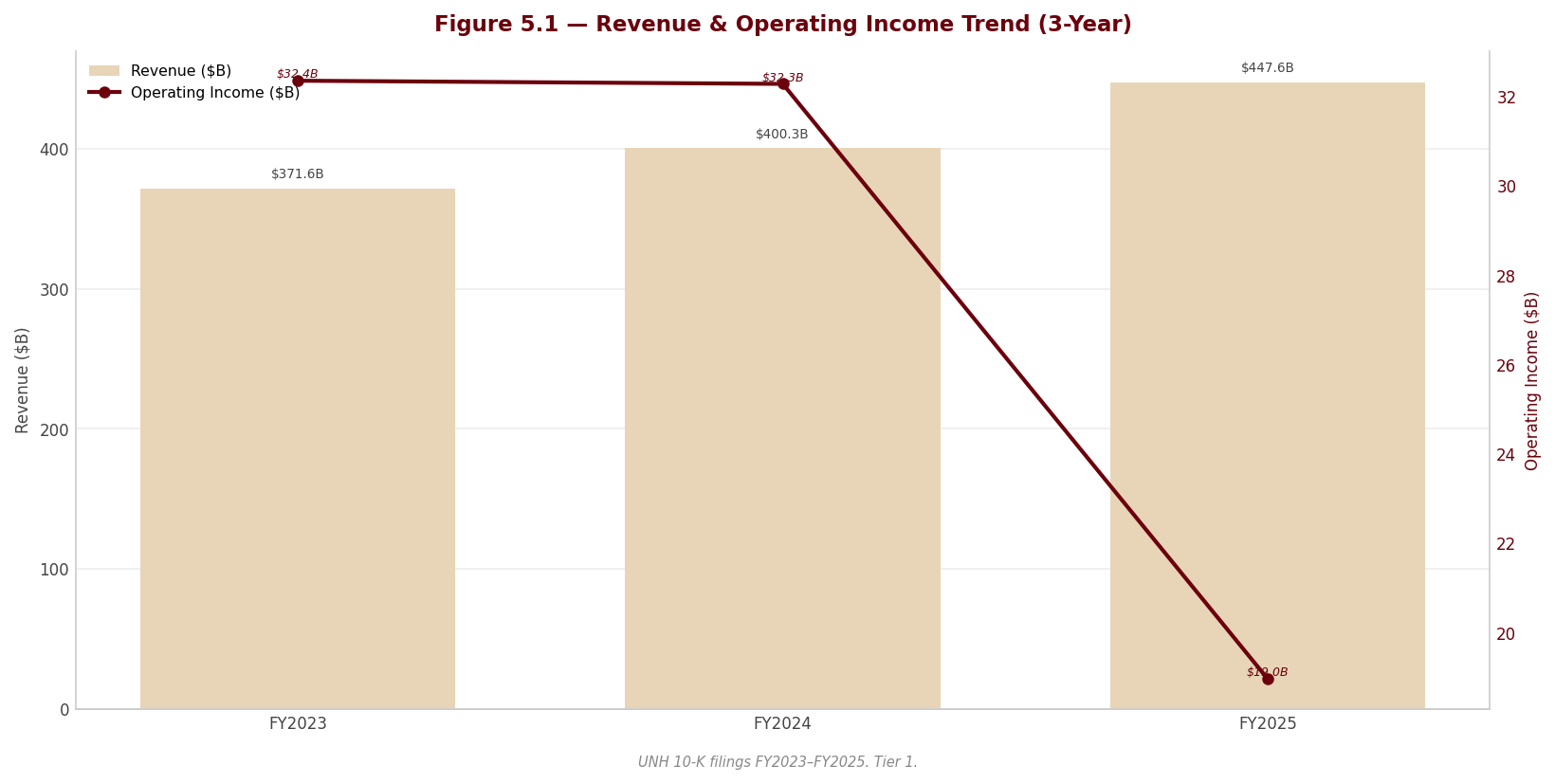
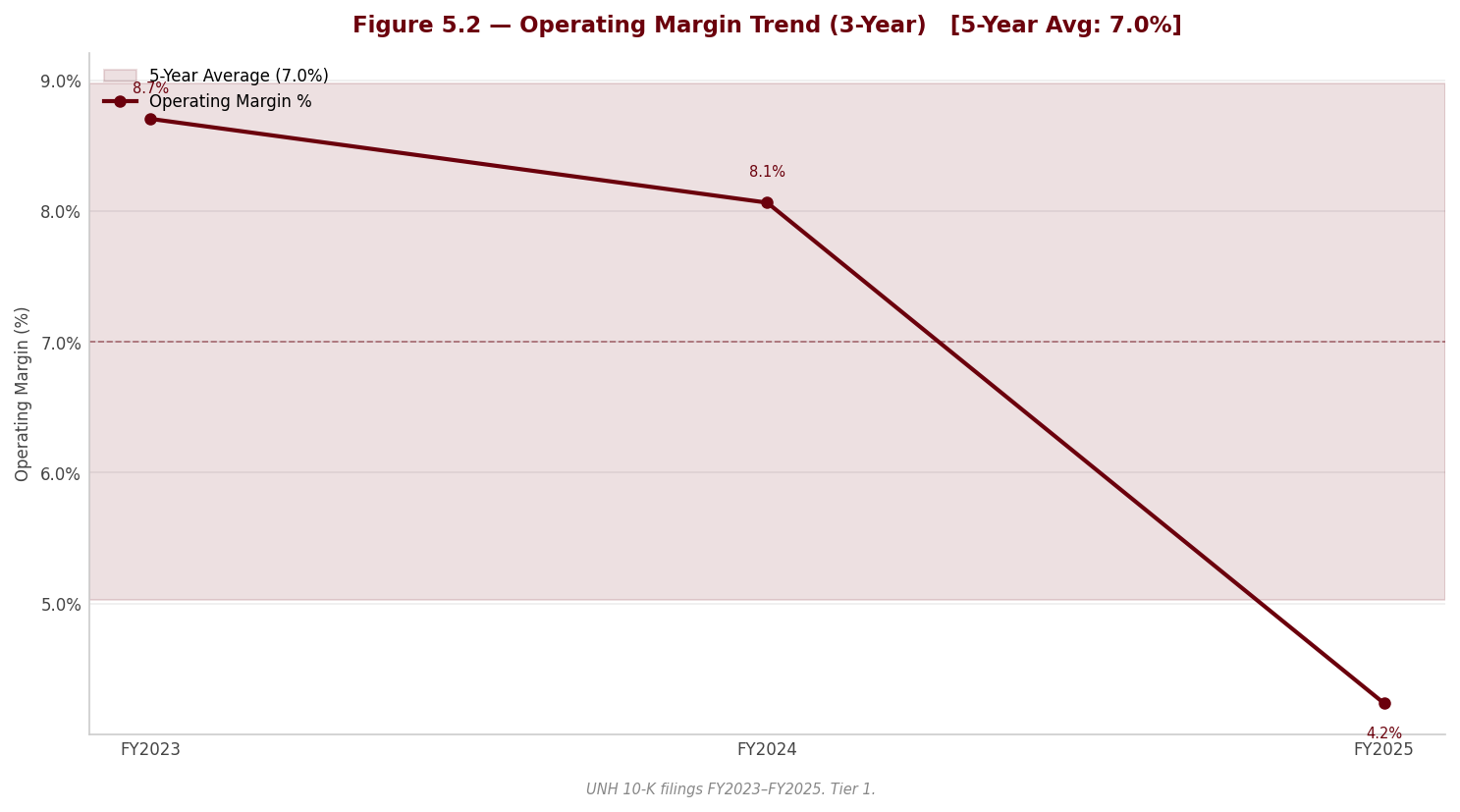
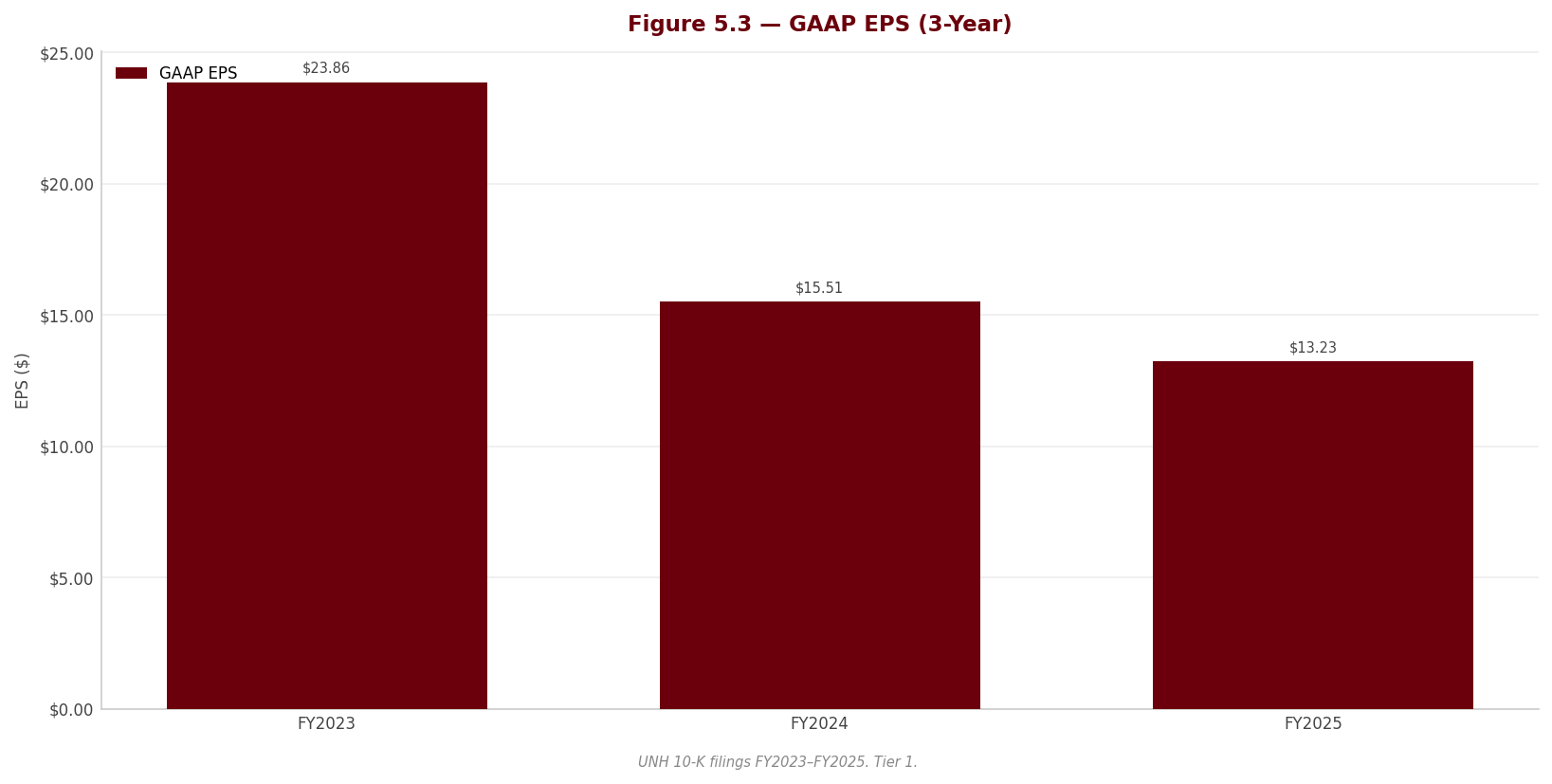
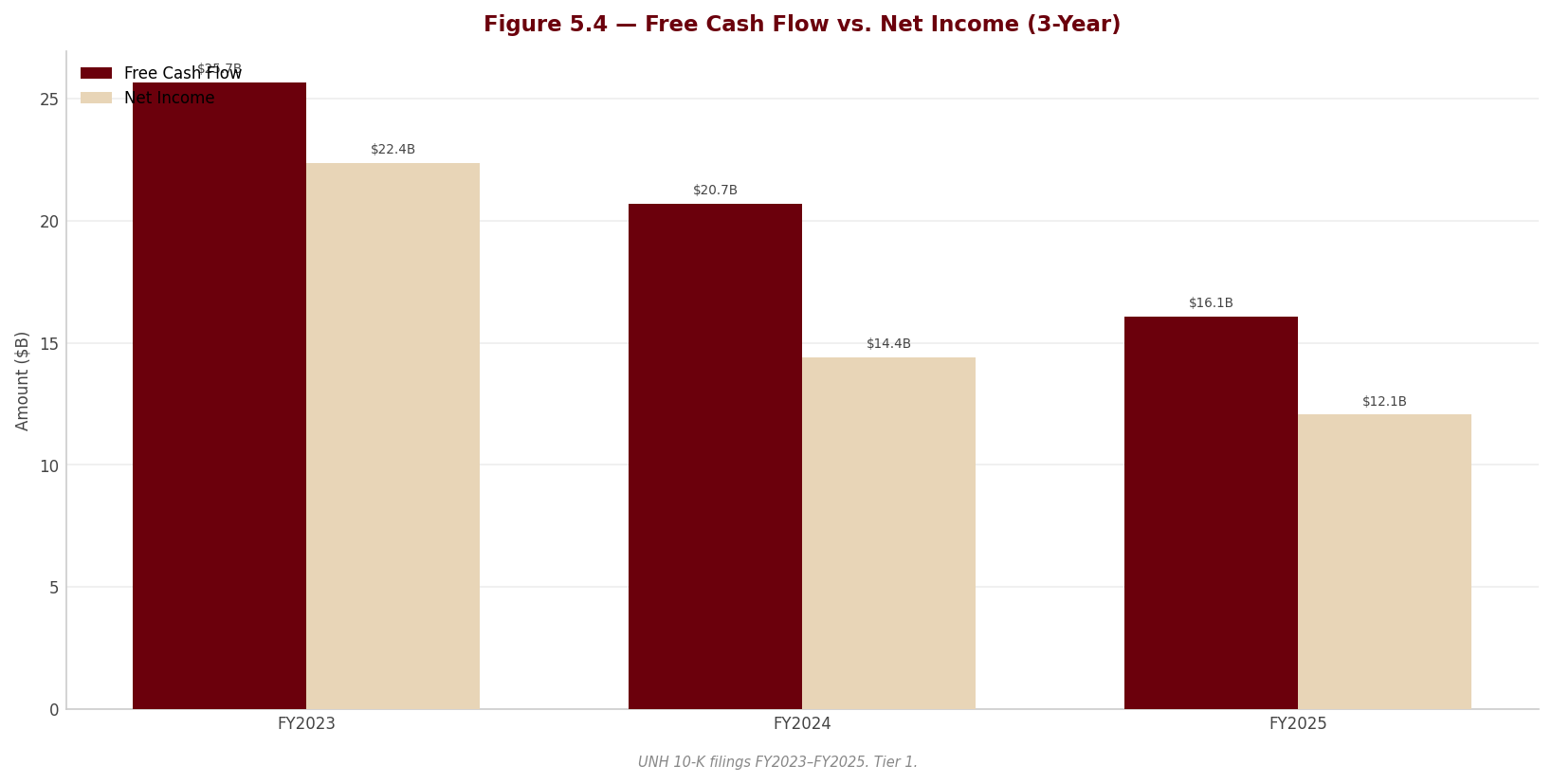
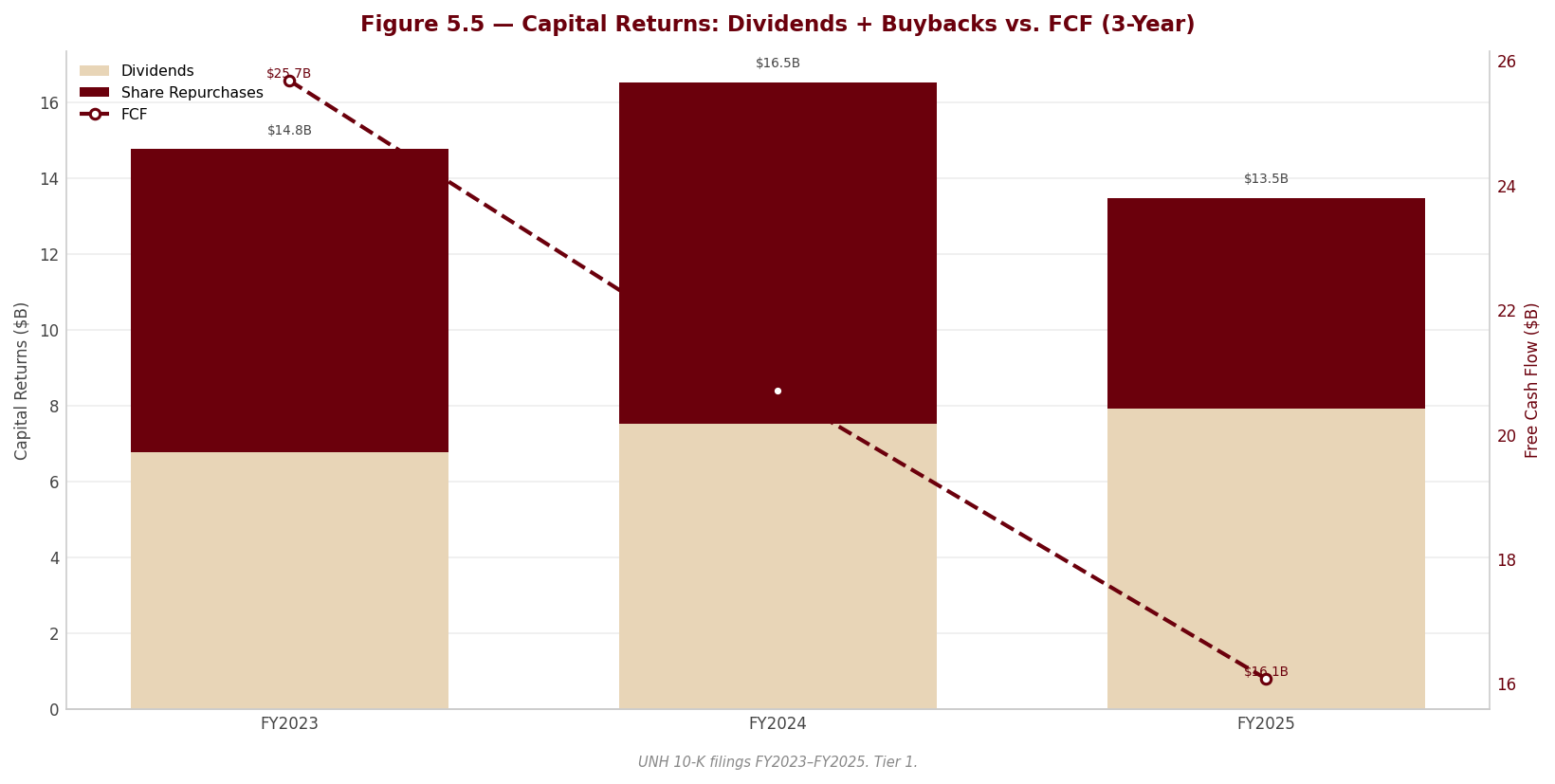
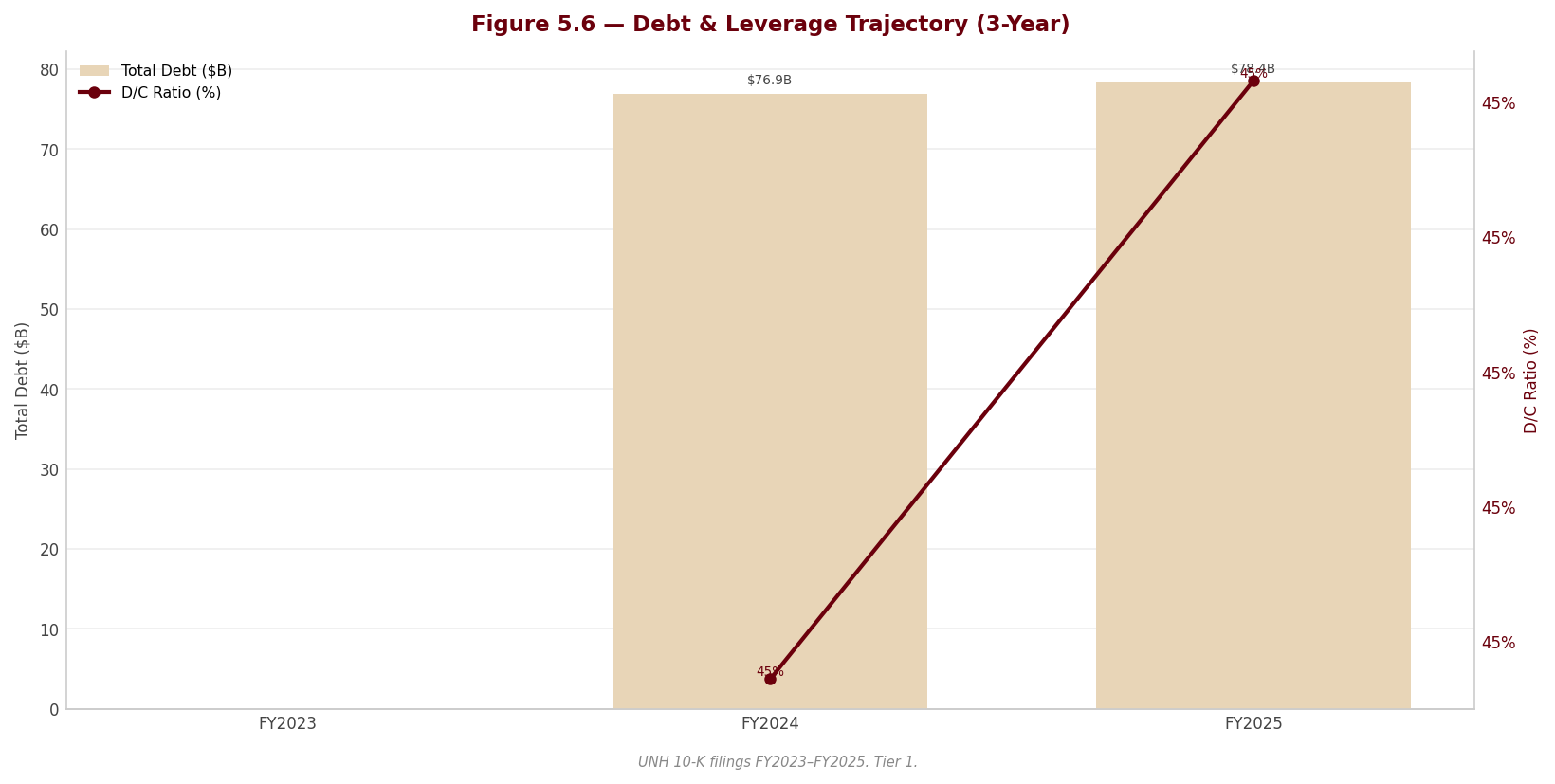
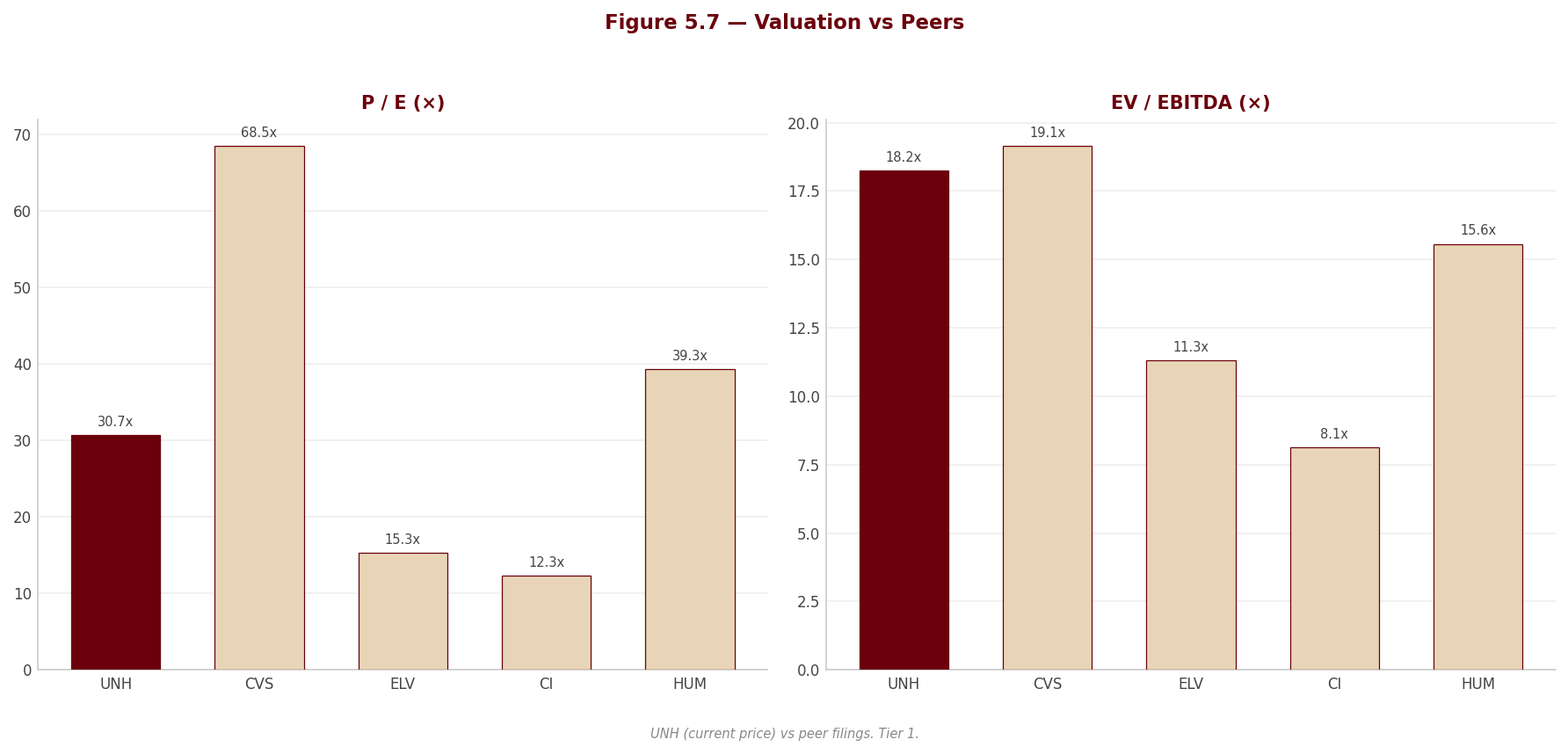
6. Valuation & Price Target withdrawn
This section stated what the shares were worth and what to do about them. It rested on an exit multiple set by hand — across the coverage it averaged 24% below where each company actually traded — so the conclusion largely restated that assumption instead of testing it. Rather than leave it standing, it has been withdrawn while the method is rebuilt.
Nothing else in this report depends on it: the financial analysis above and below is drawn from the company's own filings, and every figure links to the page it was verified against.
Section 7 — Quarterly Update: Q2 2026
Portfolio Action
sources [Rating and price target withdrawn — see the note at the top.]
| Assessment | |
|---|---|
| Action | [Rating and price target withdrawn — see the note at the top.] |
| Reason | [Rating and price target withdrawn — see the note at the top.] |
| Thesis intact? | PARTIALLY — the operating recovery is confirmed and is higher quality in Q2 2026 than the first-half aggregate suggests, but three things weakened: parent-company cash available for general corporate use is $1.1 billion against $3.5 billion of committed outflows in the first two days after quarter end (10-Q pp. 12, 22–23), 1H operating cash flow of $19,964M rose $7,320M while total net earnings including noncontrolling interests — the basis the cash-flow statement starts from — rose only $2,105M, with the entire gap in receivables and other assets (10-Q p. 6), and goodwill of $110,645M now equals 112.4% of shareholders’ equity with no interim impairment test disclosed (10-Q p. 1). |
| Trigger to revisit | Parent-level liquidity. [Rating and price target withdrawn — see the note at the top.] |
Source: Form 10-Q for the quarterly period ended 30 June 2026; FL valuation model (Valuation sheet) for the fair-value, price and rating references — see Appendix A.1–A.2.
7.1 Results at a Glance
| Metric | Q2 2026 | Q2 2025 | YoY Δ | Q1 2026 | QoQ Δ |
|---|---|---|---|---|---|
| Revenue ($M) | $112,032.0M | $111,616.0M | +0.4% | $111,721.0M | +0.3% |
| Gross Profit ($M) ᵃ | $23,299.0M | $20,012.0M | +16.4% | $25,409.0M | -8.3% |
| Gross Margin | 20.8% | 17.9% | +2.9 pp | 22.7% | -1.9 pp |
| EBITDA ($M) | $9,031.0M | $6,234.0M | +44.9% | $10,019.0M | -9.9% |
| EBITDA Margin | 8.1% | 5.6% | +2.5 pp | 9.0% | -0.9 pp |
| EBIT ($M) | $7,991.0M | $5,150.0M | +55.2% | $8,990.0M | -11.1% |
| EBIT Margin | 7.1% | 4.6% | +2.5 pp | 8.0% | -0.9 pp |
| Net Income ($M) | $5,484.0M | $3,406.0M | +61.0% | $6,280.0M | -12.7% |
| Net Margin | 4.9% | 3.1% | +1.8 pp | 5.6% | -0.7 pp |
| Diluted EPS | $6.04 | $3.74 | +61.5% | $6.90 | -12.5% |
YoY Δ is computed as (CQ - PYSQ) / |PYSQ| × 100 — revenue: (112,032 - 111,616) / 111,616 × 100 = +0.4%. QoQ Δ is computed as (CQ - PQ) / |PQ| × 100 — revenue: (112,032 - 111,721) / 111,721 × 100 = +0.3%. Margins are computed as metric / revenue × 100 — gross margin CQ: 23,299 / 112,032 × 100 = 20.8%; EBITDA margin CQ: 9,031 / 112,032 × 100 = 8.1%; EBIT margin CQ: 7,991 / 112,032 × 100 = 7.1%; net margin CQ: 5,484 / 112,032 × 100 = 4.9%. Margin deltas are in percentage points (CQ margin - comparator margin). The 7.1% EBIT margin and its +2.5 pp YoY movement tie exactly to management’s own “operating margin” line (10-Q p. 18), as does the 4.9% net earnings margin at +1.8 pp.
ᵃ UnitedHealth Group does not present a gross-profit line. Gross profit here is total revenues less the two direct cost-of-revenue lines — medical costs of $75,358M plus cost of products sold of $13,375M = $88,733.0M in Q2 2026 (Q2 2025: $78,585M + $13,019M = $91,604.0M) — excluding the separately reported operating costs line of $14,268.0M and depreciation and amortisation of $1,040.0M. EBIT is struck after both and therefore equals the reported earnings from operations of $7,991.0M (10-Q p. 2). For an insurer the more meaningful ratio is the medical care ratio, set out below.
Source: Form 10-Q for the quarterly period ended 30 June 2026 — Condensed Consolidated Statements of Operations (10-Q p. 2); Q1 2026 column from the FL workbook quarterly series (Data sheet, col. 22), which reconciles exactly to the six-month statement less the three-month column (revenue $223,753M - $112,032M = $111,721M; EBIT $16,981M - $7,991M = $8,990M; net earnings attributable to UnitedHealth Group common shareholders $11,764M - $5,484M = $6,280M). Two different six-month net-earnings figures appear in this filing and both are used in this section on their correct basis: $11,764M attributable to UnitedHealth Group common shareholders, which is the basis of the Net Income row and of diluted EPS throughout this report, and $12,151M of total net earnings including noncontrolling interests, which is the line the Condensed Consolidated Statements of Cash Flows opens with. The $387M difference is the six-month earnings attributable to noncontrolling interests (10-Q pp. 2, 6). Each figure below is labelled with its basis; they are never mixed within a single calculation.
Medical care ratio — the ratio that actually governs this business
| Measure | Q2 2026 | Q2 2025 | YoY Δ | Q1 2026 | QoQ Δ |
|---|---|---|---|---|---|
| Reported MCR (medical costs / premiums) | 86.7% | 89.4% | -2.7 pp | 83.9% ᵇ | +2.8 pp |
| Prior-year reserve development ($M, favourable) | (200) | — ᶜ | +200 | (1,050) | -850 |
| Premium deficiency / loss-contract reserve release ($M) | (49) | — ᶜ | +49 | (187) | -138 |
| Current-accident-year MCR ᵈ | 87.0% | 89.4% | -2.4 pp | 85.3% | +1.7 pp |
| Operating margin excluding both reserve items ᵉ | 6.9% | 4.6% | +2.3 pp | 6.9% | -0.0 pp |
ᵇ Q1 2026 reported MCR is derived, not printed: (six-month medical costs $148,847M - Q2 $75,358M) / (six-month premiums $174,517M - Q2 $86,956M) = $73,489M / $87,561M = 83.9% (10-Q pp. 2, 18).
ᶜ Note 4 discloses prior-year development for the six months only. The standalone quarter is derived by differencing this filing’s six-month rollforward against the Q1 2026 10-Q’s three-month rollforward: prior years $(1,250)M - $(1,050)M = $(200)M in Q2 2026, and premium deficiency/loss-contract reserves $(236)M - $(187)M = $(49)M. On the same basis Q2 2025 is $(320)M - $(320)M = nil, and the loss-contract line was nil in both 2025 quarters (10-Q p. 11; Q1 2026 10-Q p. 11; Q2 2025 10-Q p. 11). The derived $(49)M Q2 loss-contract release corroborates management’s own “$50 million” figure for the quarter (10-Q p. 8). §
ᵈ Current-accident-year MCR = current-year reported medical costs / premiums, taken directly from Note 4’s “Current year” line: Q2 2026 ($150,333M - $74,726M) = $75,607M / $86,956M = 87.0%; Q1 2026 $74,726M / $87,561M = 85.3%; Q2 2025 ($152,316M - $73,731M) = $78,585M / $87,905M = 89.4% (10-Q p. 11; Q1 2026 10-Q p. 11).
ᵉ EBIT less both reserve items, over revenue: Q2 2026 ($7,991M - $200M - $49M) / $112,032M = 6.9%; Q1 2026 ($8,990M - $1,050M - $187M) / $111,721M = 6.9%; Q2 2025 $5,150M / $111,616M = 4.6%.
Source: Form 10-Q for the quarterly period ended 30 June 2026 — Note 4, Medical Costs Payable (10-Q p. 11) and Results Summary (10-Q p. 18); standalone-quarter splits derived by differencing against the Form 10-Q for the quarterly period ended 31 March 2026 (10-Q p. 11).
This is the single most important finding in the section. The brief on this quarter was that roughly $1.25 billion of favourable prior-year reserve development flattered first-half operating earnings — about 7% of the total. That is arithmetically true: $1,250M against six-month operating earnings of $16,981M is 7.4%, and against the $2,712M six-month increase in operating earnings it is 46.1%. [Rating and price target withdrawn — see the note at the top.] Strip both reserve items from both 2026 quarters and the operating margin is 6.9% in each — flat sequentially, up 2.3 pp year on year. [Rating and price target withdrawn — see the note at the top.] The Q1-to-Q2 sequential decline in reported EBIT margin (-0.9 pp) is almost entirely the absence of the Q1 reserve release, not operational deterioration.
Segment results — under the 1 January 2026 realignment
| Segment | Revenue Q2 2026 ($M) | Revenue Q2 2025 ($M) ᶠ | YoY Δ | Op. Earnings Q2 2026 ($M) | Op. Earnings Q2 2025 ($M) ᶠ | YoY Δ | Op. Margin Q2 2026 | Op. Margin Q2 2025 ᶠ | Δ pp |
|---|---|---|---|---|---|---|---|---|---|
| UnitedHealthcare | 86,017 | 86,103 | -0.1% | 3,942 | 2,075 | +90.0% | 4.6% | 2.4% | +2.2 pp |
| Optum Health | 23,472 | 24,725 | -5.1% | 1,190 | 429 | +177.4% | 5.1% | 1.7% | +3.4 pp |
| Optum Insight | 5,402 | 5,232 | +3.2% | 1,369 | 1,205 | +13.6% | 25.3% | 23.0% | +2.3 pp |
| Optum Rx | 38,292 | 38,459 | -0.4% | 1,490 | 1,441 | +3.4% | 3.9% | 3.7% | +0.2 pp |
| Optum eliminations | (1,503) | (1,191) | +26.2% ᵍ | — | — | — | — | — | — |
| Optum (total) | 65,663 | 67,225 | -2.3% | 4,049 | 3,075 | +31.7% | 6.2% | 4.6% | +1.6 pp |
| Corporate eliminations | (39,648) | (41,712) | -4.9% ᵍ | — | — | — | — | — | — |
| Consolidated | $112,032.0M | $111,616.0M | +0.4% | $7,991.0M | $5,150.0M | +55.2% | 7.1% | 4.6% | +2.5 pp |
ᶠ Prior-period segment amounts have been recast to reflect the 1 January 2026 realignment moving Optum Financial, including Optum Bank, out of Optum Health and into Optum Insight; the reportable segments themselves are unchanged (10-Q pp. 14–15, footnote (b); MD&A p. 19). Within this filing the year-on-year comparison is therefore like-for-like — but against any earlier publication it is not. The Q2 2025 10-Q (p. 20) originally reported Optum Health Q2 2025 revenue of $25,205M and operating earnings of $636M (a 2.5% margin), and Optum Insight revenue of $4,828M and operating earnings of $998M (20.7%). The recast moves $207M of quarterly operating earnings and $404M of external revenue (plus $76M of intra-Optum revenue) from Optum Health to Optum Insight — a business earning roughly a 43% operating margin on ~$480M of quarterly revenue. The six-month figures tie to the same $410M transfer. Consequence for the reader: Optum Health’s headline +177.4% earnings growth is measured against a base cut by 32.5% through a reporting change, and Optum Insight’s 25.3% margin now includes a bank. Any comparison of these segments against the segment history in Sections 3 and 5 — which is on the 2025 Form 10-K basis — is not like-for-like. Group-level operating earnings are unaffected: the realignment moves earnings between segments, it does not create them.
ᵍ Eliminations are negative amounts; a positive Δ means a larger elimination, not an improvement.
Source: Form 10-Q for the quarterly period ended 30 June 2026 — Note 9, Segment Financial Information (10-Q pp. 14–15) and MD&A reportable segment summary (10-Q p. 20); originally-reported Q2 2025 segment figures from the Form 10-Q for the quarterly period ended 30 June 2025 (p. 20).
UnitedHealthcare contributed $1,867M of the $2,841M group operating-earnings increase (65.7%) and Optum Health $761M (26.8%); together 92.5%. Both are margin recoveries, not growth: UnitedHealthcare revenue fell 0.1% and Optum Health revenue fell 5.1%. §
7.2 P&L Drivers
sources Revenue: The top line was effectively flat — $112,032.0M against $111,616.0M, +0.4% — because price and mix offset a materially smaller book. UnitedHealthcare served 48,525 thousand medical members against 50,115 thousand, 1,590 thousand fewer people (-3.2%), with Medicare Advantage down 785 thousand (-9%), Medicaid down 710 thousand (-9%) and risk-based commercial down 785 thousand (-9%), partly offset by fee-based commercial up 735 thousand (+3%) (10-Q p. 21). [Rating and price target withdrawn — see the note at the top.] By line, premiums fell $949M (-1%) to $86,956M while services rose $979M (+11%) to $10,018M, products rose $271M (+2%) and investment and other income rose $115M (+10%) — so the entire revenue increase came from non-premium lines (10-Q p. 18). Optum Rx filled 387 million adjusted scripts against 414 million, -6.5%, “as a result of the contraction in people served at UnitedHealthcare”; Optum Health served approximately 93 million people against 95 million (10-Q p. 21).
Cost and margin: COGS of $88,733.0M in Q2 2026 versus $91,604.0M in Q2 2025 fell 3.1% against revenue at +0.4%, worth +2.9 pp of gross margin — the whole of it in medical costs, which fell $3,227M (-4%) while cost of products sold rose $356M (+3%) (10-Q p. 18). Management attributes the medical-cost decline to “fewer people served across UnitedHealthcare and Optum Health and favorable prior period reserve development, partially offset by elevated medical cost trend which remains above historical levels and continues to be affected by higher provider reimbursement under the No Surprises Act and increased service and coding intensity in commercial” (10-Q p. 19). Operating costs of $14,268.0M against $13,778.0M rose 3.6%, taking the operating cost ratio to 12.7% from 12.3% and giving back 0.4 pp — management cites “investments in people, process and technology” and business mix (10-Q pp. 18–19). D&A of $1,040.0M in Q2 2026 versus $1,084.0M in Q2 2025 fell 4.1%, so EBITDA margin expanded the same +2.5 pp as EBIT margin. The movement is predominantly structural rather than reserve-driven: as set out in 7.1, stripping the $200M of prior-year development and $49M of loss-contract release leaves an operating margin of 6.9% against 4.6% — 2.3 pp of the reported 2.5 pp expansion, so 91.2% of the improvement is operational. The residual noise is small this quarter: net portfolio divestitures were a net loss of $39M and restructuring and other actions a net $51M benefit, together +$12M, against a $2,841M increase (10-Q pp. 7–8).
Below the line: Interest expense of $962.0M fell 6.3% from $1,027.0M on $4,813M of six-month debt repayment and no commercial paper outstanding, a $65M tailwind partly offset by the loss on sale of subsidiary and subsidiaries held for sale widening to $(61)M from $(41)M on the South American exit (10-Q pp. 2, 6, 11). [Rating and price target withdrawn — see the note at the top.] Diluted EPS of $6.04 rose $2.30 (+61.5%) against $3.74, and fell $0.86 (-12.5%) against $6.90; the 0.5 pp by which EPS growth exceeded net-income growth is the diluted share count falling 0.4% to 906 million from 910 million (10-Q p. 2).
7.3 Balance Sheet & Cash Flow
| Metric | Q2 2026 | Q2 2025 | YoY Δ | Q1 2026 | QoQ Δ |
|---|---|---|---|---|---|
| Cash ($M) | $28,585.0M | $28,596.0M | -0.04% | $28,001.0M | +2.1% |
| Net Debt ($M) | $44,743.0M | $50,597.0M | -11.6% | $49,916.0M | -10.4% |
| Net Debt / LTM EBITDA | 1.7× ʰ | — | — | — | — |
| Total Assets ($M) | $309,727.0M | $308,573.0M | +0.4% | $312,644.0M | -0.9% |
| Equity ($M) ⁱ | $98,447.0M | $94,724.0M | +3.9% | $97,881.0M | +0.6% |
| OCF ($M) | $11,052.0M | $7,188.0M | +53.8% | $8,912.0M | +24.0% |
| CapEx ($M) ʲ | $799.0M | $886.0M | -9.8% | $763.0M | +4.7% |
| FCF ($M) | $10,253.0M | $6,302.0M | +62.7% | $8,149.0M | +25.8% |
| Dividends Paid ($M) ʲ | $2,087.0M | $2,000.0M | +4.4% | $2,005.0M | +4.1% |
YoY and QoQ percentages use the same formulas as 7.1 — net debt YoY: (44,743 - 50,597) / |50,597| × 100 = -11.6%; net debt QoQ: (44,743 - 49,916) / |49,916| × 100 = -10.4%.
ʰ Net Debt / LTM EBITDA: LTM EBITDA = Q3 2025 $5,414.0M + Q4 2025 $1,497.0M + Q1 2026 $10,019.0M + Q2 2026 $9,031.0M = $25,961.0M (the two 2025 quarters are taken from the workbook’s standalone quarterly series, Data sheet row 20, cols 20–21, because the section-7 data pack carries only the CQ/PYSQ/PQ columns). Net Debt $44,743.0M / $25,961.0M = 1.7×. This ratio is flattered downward by nothing and inflated upward by one thing: the LTM window still contains the Q4 2025 trough of $1,497.0M of EBITDA. [Rating and price target withdrawn — see the note at the top.] Net debt reconciles exactly to the filing: short-term borrowings and current maturities $3,827M plus long-term debt $69,501M less cash $28,585.0M = $44,743.0M (10-Q p. 1), and the $73,328M of total debt matches the carrying value disclosed in the fair-value note (10-Q p. 10).
ⁱ Equity here is the parent-only basis used throughout this report: total equity of $104,513M less nonredeemable noncontrolling interests of $6,066M = $98,447.0M (10-Q p. 1). Redeemable noncontrolling interests of $1,436M sit outside equity in the mezzanine and are excluded from both.
ʲ CapEx and dividends are stored as positive magnitudes in the workbook and shown as such here; both are cash outflows. A positive Δ therefore means a larger outflow. Both tie to the filing: six-month capex of $1,562M = $799.0M + $763.0M, and the two 2026 dividend payments of $2,005M on 17 March and $2,087M on 23 June (10-Q pp. 6, 12).
Source: Form 10-Q for the quarterly period ended 30 June 2026 — Condensed Consolidated Balance Sheets (10-Q p. 1) and Condensed Consolidated Statements of Cash Flows (10-Q p. 6); standalone-quarter cash-flow figures derived by the pipeline from the six-month statement less the prior 10-Q’s three-month statement.
Balance sheet note: The material movement is deleveraging paid for out of the investment and receivables book rather than out of retained cash: total debt fell to $73,328M from $78,389M at 31 December 2025 after $2,500M of long-term repayments and $2,313M of net short-term repayments, with no commercial paper outstanding at 30 June 2026, while cash rose to $28,585.0M from $24,365M — net debt down 11.6% year on year and 10.4% sequentially (10-Q pp. 1, 6, 11). Against that, three asset-side lines moved the other way and explain the cash: other current receivables fell $4,975M to $24,722M, accounts receivable fell $1,445M to $21,573M, and $3.2 billion of receivables were sold in the six months under a $3.3 billion 364-day uncommitted receivables financing facility that does not appear in the Q2 2025 10-Q at all (10-Q pp. 1, 7). Medical costs payable fell to $38,930M from $39,337M at year-end and, more tellingly, from $39,659M at 31 March 2026 — a $729M sequential decline — with IBNR reserves down to $26.5 billion from $27.6 billion at 31 March 2026 (10-Q p. 11; Q1 2026 10-Q p. 11). Goodwill rose to $110,645M and, with other intangibles of $19,749M, stands at $130,394M — 42.1% of total assets and 112.4% of shareholders’ equity of $98,447.0M — with no interim impairment test disclosed anywhere in the filing (10-Q p. 1).
Cash flow note: FCF conversion = FCF / Net Income = $10,253.0M / $5,484.0M = 187.0% in Q2 2026, against 185.0% in Q2 2025 and 129.8% in Q1 2026 — but the six-month composition disqualifies the headline as evidence of earnings quality. Six-month operating cash flow rose $7,320M to $19,964M while total net earnings including noncontrolling interests — the line the cash-flow statement opens with, and therefore the correct basis for this comparison — rose only $2,105M to $12,151M (the equivalent figure attributable to UnitedHealth Group common shareholders is $11,764M, up $2,066M; the $387M difference is the noncontrolling interest, 10-Q pp. 2, 6); over the same period the change in accounts receivable swung $3,162M favourably (+$1,481M against -$1,681M) and the change in other assets swung $5,163M favourably (+$3,020M against -$2,143M), together $8,325M — more than the entire OCF improvement — while medical costs payable ran $4,791M the other way (-$420M against +$4,371M) (10-Q p. 6). Management’s own attribution is consistent: “increased earnings, timing of government payments, other favorable working capital dynamics and legislative changes from the Inflation Reduction Act impacting pharmacy rebates” (10-Q p. 22) — three of those four are timing, not conversion. Add the $3.2 billion of receivables sold under the financing facility and the position is that the cash is real but a substantial part of it is a pull-forward of collections rather than earnings turning into cash.
7.4 Footnote Review
sources Page references are the printed page numbers of the Form 10-Q for the quarterly period ended 30 June 2026. All nine notes were read in full in this session, together with the four primary statements, the whole of Item 2 (MD&A), Item 3, Item 4 and Part II Items 1, 1A, 2, 5 and 6. Comparisons against the prior-year and prior-sequential periods were made by reading the corresponding notes in the Form 10-Q for the quarterly period ended 30 June 2025 and the Form 10-Q for the quarterly period ended 31 March 2026.
Note 1 — Basis of Presentation (10-Q pp. 7–8) Consolidation basis is unchanged: UnitedHealth Group and its subsidiaries including variable interest entities, intercompany accounts and transactions eliminated; the year-end balance sheet derived from audited statements. The note restates that the most significant estimates are medical costs payable and goodwill and that “the impact of any change in estimates is included in earnings in the period in which the estimate is adjusted.” Three quantified items sit inside this note. (i) Receivables financing facility — a $3.3 billion 364-day uncommitted facility under which $3.2 billion of receivables were sold in the six months, $1.7 billion collected from counterparties with $130 million not yet remitted, plus $2.0 billion remitted in respect of 2025 sales; the loss on discounted receivables was immaterial. Changed materially vs. Q2 2025, where no such facility is disclosed anywhere in the filing, and changed vs. Q1 2026, where only $585 million had been sold in the first quarter — meaning roughly $2.6 billion of the six-month total was sold in Q2 2026 alone. This is an uncommitted, annually renewable source that materially assists reported operating cash flow and can be withdrawn. (ii) Net portfolio divestitures — a net loss of $39M for the quarter (Optum Health $(35)M, Optum Insight $(4)M) against a net gain of $191M for the six months, recorded within operating costs. (iii) Restructuring and other actions — a $50M decrease in loss contract reserves and $1M of net equity-security valuation gains for the quarter; for the six months, $415M added to operating costs, offset by $75M of investment income and a $187M decrease in medical costs, including a $400 million contribution to the United Health Foundation funded by the cash gain on an Optum Insight disposal. Analytical significance: the quarter’s non-operating noise nets to roughly +$12M and is immaterial; the six-month noise is not, and the loss-contract reserve established in Q4 2025 is being drawn down as a 2026 tailwind exactly as the forensic review anticipated. Remaining performance obligations were $10.7 billion, down from $11.0 billion at 31 March 2026, “of which more than half is expected to be recognized in the next three years.”
Note 2 — Investments (10-Q pp. 8–9) [Rating and price target withdrawn — see the note at the top.] Available-for-sale gross unrealised losses widened to $1,893M from $1,625M at 31 December 2025, with $1,638M of that in positions held twelve months or longer, and 31,000 of 42,000 positions in an unrealised loss position. Equity securities were $5.9 billion (from $5.5 billion) and equity-method investments $4.0 billion (from $3.8 billion). [Rating and price target withdrawn — see the note at the top.] Changed vs. year-end in magnitude, not in character: a further $268M of mark-to-market pressure ran through other comprehensive income, not earnings. [Rating and price target withdrawn — see the note at the top.]
Note 3 — Fair Value (10-Q pp. 10–11) Assets at fair value on a recurring basis total $81,875M — 25% Level 1, 73% Level 2, 2% Level 3 — with no transfers in or out of Level 3 during the six months ended 30 June 2026 or 2025. Level 3 holdings of $1,375M ($500M corporate obligations, $76M equity securities, $799M loan receivables) are essentially unchanged from $1,372M at year-end. Two disclosures matter analytically. First, the Level 1 / Level 2 mix of cash and cash equivalents shifted sharply: $15,784M Level 1 and $12,801M Level 2 at 30 June 2026, against $19,848M and $4,517M at 31 December 2025 — roughly $8.3 billion of “cash” now sits in instruments valued on observable inputs rather than quoted prices in active markets. It remains cash and cash equivalents under GAAP, but it is a different liquidity profile than the year-end balance. [Rating and price target withdrawn — see the note at the top.]
Note 4 — Medical Costs Payable (10-Q p. 11) The most important note in the filing, treated in full in 7.1 above. Six-month reported medical costs of $148,847M comprise $150,333M of current-year costs, $(1,250)M of favourable prior-years’ development and $(236)M of changes in premium deficiency and loss contract reserves. The prior-year comparison is $(320)M of development and nil loss-contract movement on $152,316M of current-year costs. Changed vs. Q2 2025 dramatically and vs. the full year 2025 even more so — the 2025 Form 10-K disclosed favourable development of only $140M for the entire year. Management’s stated cause is “a favorable respiratory illness season along with various other individually insignificant factors,” where the prior-year language was that development “did not include any individually significant factors.” Medical costs payable ended at $38,930M against $38,427M a year earlier, with IBNR of $26.5 billion against $26.7 billion at 31 December 2025 and $27.6 billion at 31 March 2026. Two readings, and honesty requires both. Against the release: IBNR fell $1.1 billion sequentially while $200M of prior-year development was taken, so the cushion is being drawn on. [Rating and price target withdrawn — see the note at the top.] On balance the release looks earned rather than manufactured; but it is $200M of a $7,991M operating result and it should not be extrapolated, because the same disclosure showed $140M for a whole year as recently as 2025.
Note 5 — Short-Term Borrowings and Long-Term Debt (10-Q p. 11) The entire note is two sentences: “As of June 30, 2026, the Company had no commercial paper outstanding,” with everything else incorporated by reference to Note 8 of the 2025 Form 10-K. No covenant level and no actual ratio is disclosed in this filing — MD&A adds only that “as of June 30, 2026, we were in compliance with the various covenants under our bank credit facilities” (10-Q p. 23), which is a compliance assertion, not a headroom figure. No headroom calculation is possible from this document. What can be measured from the statements: $2,500M of long-term debt repaid and $2,313M of short-term borrowings repaid net in the six months, against $2,969M of long-term issuance and $1,403M of net short-term repayment in the prior-year period — a $6,379M swing from net issuer to net repayer (10-Q p. 6). Changed vs. [Rating and price target withdrawn — see the note at the top.] Best A- / Stable (10-Q p. 23). [Rating and price target withdrawn — see the note at the top.]
Note 6 — Shareholders’ Equity (10-Q pp. 11–12) [Rating and price target withdrawn — see the note at the top.] Changed vs. Q2 2025: increased, and this is the first capital-returns decision since the Q4 2025 halt that signals confidence rather than caution. (ii) Forward share repurchase contracts — new this year and the most important item in the note. During the six months the company entered forward contracts to repurchase up to $2.0 billion of stock with settlement on or before 1 July 2026; the counterparty completed the purchase of 6.4 million shares at an average price of $312.73, and at 30 June 2026 the company carried a $2.0 billion liability in other current liabilities, paid on 1 July 2026. There is no equivalent disclosure in the Q2 2025 10-Q. Analytical significance: the accounting repurchase and the cash repurchase diverge. The equity statement shows $3,232M of repurchases in Q2 2026 (against $2,505M in Q2 2025) and $3,728M for the six months, while the cash flow statement shows only $1,646M of cash paid for the six months (against $5,545M) (10-Q pp. 4–6). Roughly $2.0 billion of the buyback was executed inside the quarter but paid for one day after the balance-sheet date — flattering both quarter-end cash of $28,585.0M and six-month operating and financing cash flow. (iii) Additional paid-in capital was reduced to nil from $559M at 1 January 2026, with the remaining $2,318M of six-month repurchase cost charged directly against retained earnings — the APIC buffer is now fully exhausted, so all future repurchase cost above par flows straight through retained earnings.
Note 7 — Commitments and Contingencies (10-Q pp. 12–13) — see also the dedicated litigation entry below Beyond legal matters the note discloses one quantified commitment: a first-quarter-2026 agreement to acquire a health-care company for $3.0 billion, completed on 2 July 2026 for $1.5 billion in cash with the remaining $1.5 billion payable within one year. The counterparty is not named and no segment allocation is given. Read against Note 6’s $2.0 billion forward settlement on 1 July, the company committed $3.5 billion of cash in the first two days after quarter end — against the $1.1 billion of cash the MD&A states was “available for general corporate use” at 30 June 2026 (10-Q p. 22). The remainder must come from subsidiary dividends or new borrowing.
Note 8 — Held for Sale and Dispositions (10-Q p. 13) The remaining South American operations, agreed for sale in Q4 2025, are expected to close in the second half of 2026. Held-for-sale disposal groups carry total assets of $1,039M (South America) and $912M (other businesses) against total liabilities of $986M and $730M — after remeasurement write-downs to fair value less cost to sell of $(1,656)M and $(561)M respectively, $2,217M in total, including $893M of cumulative foreign currency translation losses and $273M of noncontrolling interests on the South American businesses. During the six months, completed dispositions realised $1.1 billion of cash on assets of $1.2 billion and liabilities of $445M, producing a net gain of $211M within operating costs — a $525M gain at Optum Insight against a $314M incremental loss at Optum Health — of which $400M was contributed to the United Health Foundation. Changed materially vs. Q2 2025, where the note was a single held-for-sale table with no dispositions completed and no remeasurement of this size. Analytical significance: the exit is expensive and the losses continue to accrue ($(61)M this quarter, $(133)M for the six months, against $(41)M and $(56)M), and roughly $1.95 billion of assets remain to be sold into a second-half close.
Note 9 — Segment Financial Information (10-Q pp. 14–15) Four reportable segments, unchanged. The 1 January 2026 realignment moved Optum Financial including Optum Bank from Optum Health to Optum Insight, with prior-period segment information recast — treated in full in 7.1, including the $207M of quarterly operating earnings and $480M of quarterly revenue that moved, and the resulting break with any pre-2026 segment publication. The note also discloses per-segment capital expenditure and D&A: Optum Insight took $291M of the quarter’s $799M of capex (36.4%) and $414M of the $1,040M of D&A (39.8%), against $303M and $385M a year earlier; Optum Health capex fell to $210M from $292M (-28.1%), which is a visible retreat in the segment that has been the problem. Segment total assets: UnitedHealthcare $125,495M (from $129,587M), Optum Health $72,716M (from $69,810M), Optum Insight $62,875M (from $60,358M), Optum Rx $59,656M (from $61,674M). Note that Optum Health’s asset base grew 4.2% year on year while its revenue fell 5.1% — the asset intensity of the value-based-care business is rising as it shrinks.
Related-party transactions (10-Q pp. 1–2, 4–7, 9, 12–13) UnitedHealth Group has no controlling shareholder and this 10-Q contains no related-party transactions note, consistent with the full-footnote read of the 2025 Form 10-K. This is documented rather than assumed: Note 1’s consolidation policy states only that the statements include UnitedHealth Group and its subsidiaries including variable interest entities with intercompany accounts and transactions eliminated (10-Q p. 7), and no related-party caption appears in the notes index (10-Q table of contents). The filing does, however, quantify five related-interest relationships, and each is set out here with the current-quarter and prior-year-quarter amount.
| Relationship | Q2 2026 | Q2 2025 | Change | Source |
|---|---|---|---|---|
| Earnings attributable to noncontrolling interests | $186M | $166M | +12.0% | 10-Q p. 2 |
| Distributions to nonredeemable noncontrolling interests | $179M | $158M | +13.3% | 10-Q p. 4 |
| Acquisition and other adjustments of nonredeemable NCI | +$63M | $(19)M | +$82M | 10-Q p. 4 |
| Redeemable NCI fair-value and other adjustments | +$16M | $(10)M | +$26M | 10-Q p. 4 |
| Nonredeemable NCI balance | $6,066M | $5,745M | +5.6% | 10-Q pp. 1, 4 |
| Redeemable NCI balance (mezzanine) | $1,436M | $4,315M | -66.7% | 10-Q p. 1; Q2 2025 10-Q p. 1 |
| Equity-method investments | $4.0bn | $3.8bn (31 Dec 2025) | +5.3% | 10-Q p. 9 |
| Contribution to the United Health Foundation | nil in Q2 2026; $400M in Q1 2026 | nil | +$400M YTD | 10-Q p. 8 |
| Forward-repurchase counterparty — shares held on the company’s behalf | 6.4M shares at $312.73 avg; $2.0bn liability at 30 June 2026, settled 1 July 2026 | none disclosed | new | 10-Q p. 12 |
Source: Form 10-Q for the quarterly period ended 30 June 2026 — Condensed Consolidated Balance Sheets (p. 1), Statements of Operations (p. 2), Statements of Changes in Equity (pp. 4–5), Note 1 (p. 8), Note 2 (p. 9) and Note 6 (p. 12); Q2 2025 comparatives from the Form 10-Q for the quarterly period ended 30 June 2025.
No terms changed, because there are no related-party terms to change. The two items that warrant attention are not related-party transactions in the technical sense but function economically as such: the United Health Foundation, a company-affiliated charitable entity that received $400 million of disposal proceeds in Q1 2026 — a discretionary transfer of shareholder cash out of the group recorded inside operating costs — and the forward-repurchase counterparty, an unnamed financial institution that held 6.4 million shares on the company’s behalf across the quarter end, where the filing states the EPS calculation “includes an immaterial reduction to net earnings attributable to UnitedHealth Group common shareholders for undistributed earnings attributable to the shares held by the counterparty.” Both are disclosed; neither is quantified as a related-party balance.
Contingencies and litigation (10-Q pp. 12–13, 26) 1. DOJ False Claims Act action on Medicare risk-adjustment coding (the 2011 whistleblower case). The DOJ announced on 14 February 2017 that it would pursue certain claims; in March 2025 a court-appointed Special Master recommended summary judgment in the company’s favour on all remaining claims; in April 2025 the DOJ moved to reject that report. The company “cannot reasonably estimate the outcome which may result from this matter given its procedural status.” Amount at stake: not disclosed. Accrual: none disclosed. The finding here is the absence of change. The wording is verbatim identical to the Q1 2026 10-Q (p. 13) and to the Q2 2025 10-Q (p. 12): the paragraph has not moved in five consecutive quarters, and the DOJ’s motion has now been pending for sixteen months. Under the False Claims Act, damages are trebled and per-claim penalties apply to a claim population running to millions of risk-adjustment submissions, so the exposure is unbounded and unquantified. This remains the single largest unpriced tail risk in the file and nothing in this quarter narrows it in either direction. 2. IRS transfer-pricing Notices of Proposed Adjustment. On 6 March 2026 the company received NOPAs for the 2017 through 2020 tax years involving intercompany transfer pricing with a foreign subsidiary; the IRS “is seeking to significantly increase taxable income for each of the applicable periods and could also seek similar adjustments for subsequent years after 2020.” The company disagrees, intends to “vigorously contest,” and states that at 30 June 2026 “its reserves for uncertain tax positions are adequate based on current available information.” No dollar amount is disclosed for the proposed adjustments, and no unrecognised-tax-benefit balance is given in this filing. Changed vs. Q2 2025, where the matter did not exist; unchanged in substance vs. Q1 2026 (10-Q p. 13), where the identical paragraph first appeared — the only edit between the two filings is the balance-sheet date and a shift from first person to third person. [Rating and price target withdrawn — see the note at the top.] 3. Government investigations, audits and reviews. The company lists CMS, state insurance departments, state attorneys general, the OIG, OPM, the Office for Civil Rights, the GAO, the FTC, Congressional committees, the DOJ, the SEC, the IRS, the DEA, the Department of Labor, the FDIC, the CFPB, the Defense Contract Audit Agency and the FDA, plus foreign regulators, and states it “has also been responding to subpoenas, information requests and investigations from governmental entities.” CMS and OIG have selected certain local plans for risk adjustment data validation (RADV) audits which “may result in retrospective adjustments to payments.” No amounts, no accruals, no ranges. Confirmed unchanged vs. Q2 2025 (10-Q p. 12) — the paragraph is boilerplate and identical. 4. Ordinary-course legal actions — class actions and suits by members, care providers, consumer advocacy organisations, customers, shareholders and regulators, covering medical malpractice, employment, intellectual property, antitrust, privacy and contract claims. The company records liabilities “where appropriate” but states it “is often unable to estimate the losses or ranges of losses.” No aggregate accrual is disclosed. Confirmed unchanged vs. Q2 2025 (10-Q p. 12). 5. Pending acquisition consideration — $1.5 billion payable within one year following the 2 July 2026 completion (10-Q p. 12). A firm, dated obligation rather than a contingency.
Part II Item 1 adds nothing beyond Note 7, and Item 1A states there have been “no material changes to the risk factors as disclosed in our 2025 10-K” (10-Q p. 26) — so Section 2 remains the operative risk register in full. Item 4 concludes that disclosure controls were effective at 30 June 2026 and that there were no changes in internal control over financial reporting during the quarter (10-Q p. 25).
Subsequent events (10-Q pp. 12, 23, 26 — there is no dedicated subsequent-events note) The notes run 1 through 9 and end with segment information (10-Q p. 15); no subsequent-events note exists in this filing. The post-quarter facts the filing does disclose are: (i) settlement of the $2.0 billion forward share repurchase liability on 1 July 2026 (10-Q p. 12); (ii) completion on 2 July 2026 of the $3.0 billion health-care acquisition, $1.5 billion paid in cash with $1.5 billion payable within one year (10-Q pp. 12, 23); (iii) the cover page states 897,594,847 shares issued and outstanding at 31 July 2026, against 905 million at 30 June 2026 — roughly 7.4 million shares retired in July, consistent with the forward settlement (10-Q cover page, unnumbered; balance sheet p. 1); and (iv) the report was signed on 10 August 2026 by Stephen Hemsley as Chair and CEO, Wayne DeVeydt as CFO and Dennis Stankiewicz as Chief Accounting Officer (10-Q p. 28). Item 5 confirms that no director or officer adopted or terminated a Rule 10b5-1 or non-Rule 10b5-1 trading arrangement during the quarter (10-Q p. 26).
Guidance status (10-Q pp. 16–24 — none given) This Form 10-Q contains no financial guidance of any kind. There is no revenue, earnings-per-share, medical-cost-ratio or operating-margin outlook anywhere in Item 2; the Executive Overview lists five backward-looking bullets only (10-Q p. 18), and the Forward-Looking Statements section is a generic risk enumeration (10-Q p. 24). The company withdrew guidance during 2025 and this filing does not restore it. What the MD&A does provide are directional statements without numbers: Medicare Advantage membership contraction “which we expect to continue throughout 2026”; value-based-care lives that “contracted and [are] expected to continue throughout 2026”; a 2027 Medicare Advantage Final Notice that “moved towards the expected industry forward medical cost trend [but] remains below”; Medicaid funding that “remains insufficient”; and a voluntary pledge “to rebate 2026 profits on our individual exchange products to customers” (10-Q pp. 17–18). Every one of those is a headwind, and none is quantified. The absence of restored guidance eighteen months after the withdrawal is itself the datum: management is not yet willing to underwrite a number.
7.5 What Changed This Quarter
sources - The reserve contribution to the recovery is real but front-loaded into Q1 — and this quarter is cleaner than the first half suggests. Of the $1,250M of favourable prior-year development recognised in the six months, $1,050M (84.0%) landed in Q1 2026 and only $200M in Q2 2026 (derived from Note 4 against the Q1 2026 10-Q, 10-Q p. 11). Including the $49M loss-contract release, reserve items contributed $249M — 8.8% of the quarter’s $2,841M operating-earnings increase and 3.1% of its operating earnings. [Rating and price target withdrawn — see the note at the top.] - The MCR improvement survives the same test. Reported MCR of 86.7% against 89.4% is a 2.7 pp gain; on the current-accident-year basis, which excludes all prior-year development, it is 87.0% against 89.4% — 2.4 pp, or 89% of the reported gain, is genuine (10-Q pp. 11, 18). Management attributes it to “favorable prior period reserve development, affordability and medical cost management initiatives, and pricing trends,” partly offset by trend “which remains above historical levels and continues to be affected by higher provider reimbursement under the No Surprises Act and increased service and coding intensity in commercial” (10-Q p. 19). Sequentially the current-year MCR rose 1.7 pp from Q1’s 85.3% — Q2 is the seasonally heavier quarter, but the direction should be tracked. - The recovery is entirely margin, on a shrinking book. Revenue grew 0.4% while UnitedHealthcare served 1,590 thousand fewer people (-3.2%) — Medicare Advantage -785 thousand, Medicaid -710 thousand, risk-based commercial -785 thousand — and Optum Rx filled 387 million adjusted scripts against 414 million (-6.5%) (10-Q p. 21). Premiums fell $949M; all of the revenue increase came from services (+$979M), products (+$271M) and investment income (+$115M) (10-Q p. 18). A margin recovery on a contracting membership base is a different asset from a margin recovery on a growing one, and management expects the contraction “to continue throughout 2026.” - Parent-company liquidity is the sharpest new risk, and it is quantified. Of $28,585.0M of consolidated cash, only $1.1 billion was “available for general corporate use” at 30 June 2026 — unchanged from 31 March 2026 but down from $3.3 billion at 30 June 2025, a 66.7% decline (10-Q p. 22; Q1 2026 10-Q p. 22; Q2 2025 10-Q p. 22). Against that $1.1 billion the company committed $3.5 billion in the first two days after quarter end: the $2.0 billion forward-repurchase settlement on 1 July and $1.5 billion of acquisition cash on 2 July, with a further $1.5 billion payable within a year (10-Q pp. 12, 23). [Rating and price target withdrawn — see the note at the top.] - Buybacks resumed decisively — and $2.0 billion of them were financed past the balance-sheet date. The company repurchased 8.7 million shares at an average price of $355.37 in the quarter (2.0 million at $303.59 in April, 5.0 million at $358.57 in May, 1.7 million at $405.41 in June), against a Q4 2025 halt (10-Q p. 26). But the accounting and the cash diverge: $3,232M of repurchases in the equity statement against $1,646M of six-month cash outflow, with $2.0 billion sitting as a current liability at 30 June and paid on 1 July (10-Q pp. 4, 6, 12). Authorisation remaining fell to 10.6 million shares (1.2% of shares outstanding) from 17.3 million at end-April. [Rating and price target withdrawn — see the note at the top.] - Operating cash flow of $19,964M for the six months is up $7,320M on total net earnings including noncontrolling interests up only $2,105M, and the gap is not earnings conversion. (Total net earnings is the basis the cash-flow statement opens from, $12,151M; the figure attributable to UnitedHealth Group common shareholders is $11,764M, up $2,066M, the $387M difference being the noncontrolling interest — 10-Q pp. 2, 6.) The favourable swings in accounts receivable ($3,162M) and other assets ($5,163M) total $8,325M — more than the entire OCF improvement — while medical costs payable ran $4,791M the other way (10-Q p. 6). Layered on top, $3.2 billion of receivables were sold under a $3.3 billion uncommitted facility that did not exist in the Q2 2025 filing, roughly $2.6 billion of it in this quarter alone (10-Q p. 7; Q1 2026 10-Q p. 7). The 187.0% FCF conversion is a collection pull-forward, not a conversion ratio to capitalise. - The segment realignment makes Optum Health’s turnaround look larger than it is. Prior periods were properly recast (10-Q pp. 14–15), so the comparison inside this filing is clean — but the recast cut Optum Health’s Q2 2025 operating-earnings base from the $636M originally published to $429M by moving Optum Financial and Optum Bank (roughly $480M of quarterly revenue at a ~43% operating margin) into Optum Insight (Q2 2025 10-Q p. 20). Optum Health’s headline +177.4% is measured against a base 32.5% smaller than the one Sections 3 and 5 carry. Group operating earnings are unaffected. Optum Insight’s 25.3% margin now includes a bank. [Rating and price target withdrawn — see the note at the top.] Debt fair value sits $4,282M below carrying value (10-Q p. 10). This is the balance-sheet repair the bear case said the company could not fund while earnings were depressed. - Goodwill of $110,645M is now 112.4% of shareholders’ equity, with no interim impairment test disclosed and the realignment having stripped a ~43%-margin business out of the highest-goodwill reporting unit. Goodwill plus intangibles of $130,394M is 42.1% of total assets (10-Q p. 1). [Rating and price target withdrawn — see the note at the top.] Optum Health’s asset base grew 4.2% year on year while its revenue fell 5.1%. - Two open matters produced no update, and in one case that is the story. The DOJ Medicare risk-adjustment action carries wording identical to the Q1 2026 and Q2 2025 filings, with the DOJ’s motion to reject the Special Master’s favourable report pending for sixteen months, no accrual and no estimable range (10-Q p. 13). The IRS transfer-pricing NOPAs for 2017–2020, first disclosed in Q1 2026, are repeated verbatim with no amount, no reserve figure and the same “vigorously contest” language (10-Q p. 13). Neither risk has been narrowed; neither has been sized. - The exit from South America is still unfinished and still costing money. Held-for-sale groups carry $2,217M of cumulative remeasurement write-downs, including $893M of cumulative FX translation losses; the loss on sale widened to $(61)M this quarter from $(41)M, and $(133)M for the six months from $(56)M; roughly $1.95 billion of assets remain to be sold into a second-half 2026 close (10-Q pp. 2, 13). - No guidance was restored. The filing contains no revenue, EPS, MCR or margin outlook of any kind, eighteen months after the 2025 withdrawal (10-Q pp. 16–24).
7.6 Portfolio Decision
sources [Rating and price target withdrawn — see the note at the top.] The quarter confirms the recovery thesis on the metric that matters and does not change the report-level call, because the price already reflects it. Operating earnings of $7,991.0M and a 7.1% operating margin against 4.6% are, on examination, 91.2% operational: only $200M of prior-year reserve development and $49M of loss-contract release sit inside the $2,841M increase, and the current-accident-year MCR of 87.0% against 89.4% delivers 89% of the reported 2.7 pp MCR gain without any reserve help. That is a materially better answer than the first-half aggregate implies — the $1,250M of six-month development that looked like a 7.4% flattering of first-half earnings turns out to be $1,050M of Q1 and $200M of Q2 — and it is the strongest evidence yet that the FY2025 trough was cyclical rather than structural. [Rating and price target withdrawn — see the note at the top.] Against that, four things keep this a hold rather than an add. The underlying operating margin is 6.9%, not the 7.6% first-half headline, so the model should not be built on the printed number. The recovery is pure margin on a book that shrank by 1,590 thousand members and 27 million scripts, with management expecting the contraction to continue through 2026 and no guidance restored to underwrite the trajectory. The 187.0% FCF conversion is a receivables pull-forward — $8,325M of receivable and other-asset swings against a $7,320M OCF improvement, plus $3.2 billion of receivables sold under a facility that did not exist a year ago — not cash conversion to capitalise. [Rating and price target withdrawn — see the note at the top.] A quarter that improves the evidence for a thesis without improving its price is a quarter to hold. [Rating and price target withdrawn — see the note at the top.]
What would change this view: [Rating and price target withdrawn — see the note at the top.] Alternatively, the share price falling to or below $374.16, restoring the margin of safety. [Rating and price target withdrawn — see the note at the top.] Any one of these reverses a specific element of the evidence on which this quarter’s conclusion rests.
Report Versions
Every published version of this report, newest first — each one kept so a reader can see what changed and when.
| Version date | Files |
|---|---|
| 2026-08-13 Current | Model (Excel) |
| 2026-06-08 | Model (Excel) |
| 2026-06-06 | Model (Excel) |