
Southern Copper Corporation
Section 1 — Business Overview, Operations & Competitive Positioning
sources
1.1 The Business
sources Southern Copper mines copper — together with by-product molybdenum, silver, zinc and gold — from a set of large, high-grade, long-life open-pit deposits in Peru and Mexico, processes it through its own smelters and refineries, and sells almost all of it unhedged at prevailing market prices. The economic model is simple and unusually pure: the company is a low-cost, vertically integrated volume producer whose earnings rise and fall with the copper price, cushioned by by-product credits that hold its net cash cost among the lowest in the industry.
That model generated record net sales of $13,420.0M in FY2025 and split-adjusted diluted earnings of $5.24 per share, the high point of a decade in which revenue has more than doubled from $5,379.8M in FY2016. Growth has come in two distinct waves — the copper-price surge of FY2021, and the FY2025 record driven by higher by-product volumes (particularly zinc from the newly ramped Buenavista concentrator) and firmer copper, molybdenum and silver prices — a distinction that matters because price-led gains reverse with the cycle while volume gains compound. The business is vertically integrated end to end: it mines and mills ore, smelts concentrate into blister and anode copper, refines anode into cathode, and recovers refined silver and gold at its Ilo precious-metals plant, while also producing cathode directly via solvent extraction/electrowinning (SX-EW). Management states it believes the company holds the largest copper reserves in the world. Incorporated in Delaware and dual-listed on the New York and Lima exchanges under the ticker SCCO, the company operates a heavily unionized workforce across its Peruvian and Mexican sites; a precise headcount is not relied upon here.
Key Information
| Item | Value |
|---|---|
| Ticker | SCCO |
| Sector / Industry | Metals & Mining — Copper |
| Report Date | 2026-08-12 |
| Most Recent FY Revenue | $13,420.0M |
| EBIT Margin (Most Recent FY) | 52.2% |
| Diluted Weighted-Average Shares | 827M |
| Current Price | $194.48 |
Source: Company SEC filings (10-K); see Appendix A.1.
1.2 Operating Segments
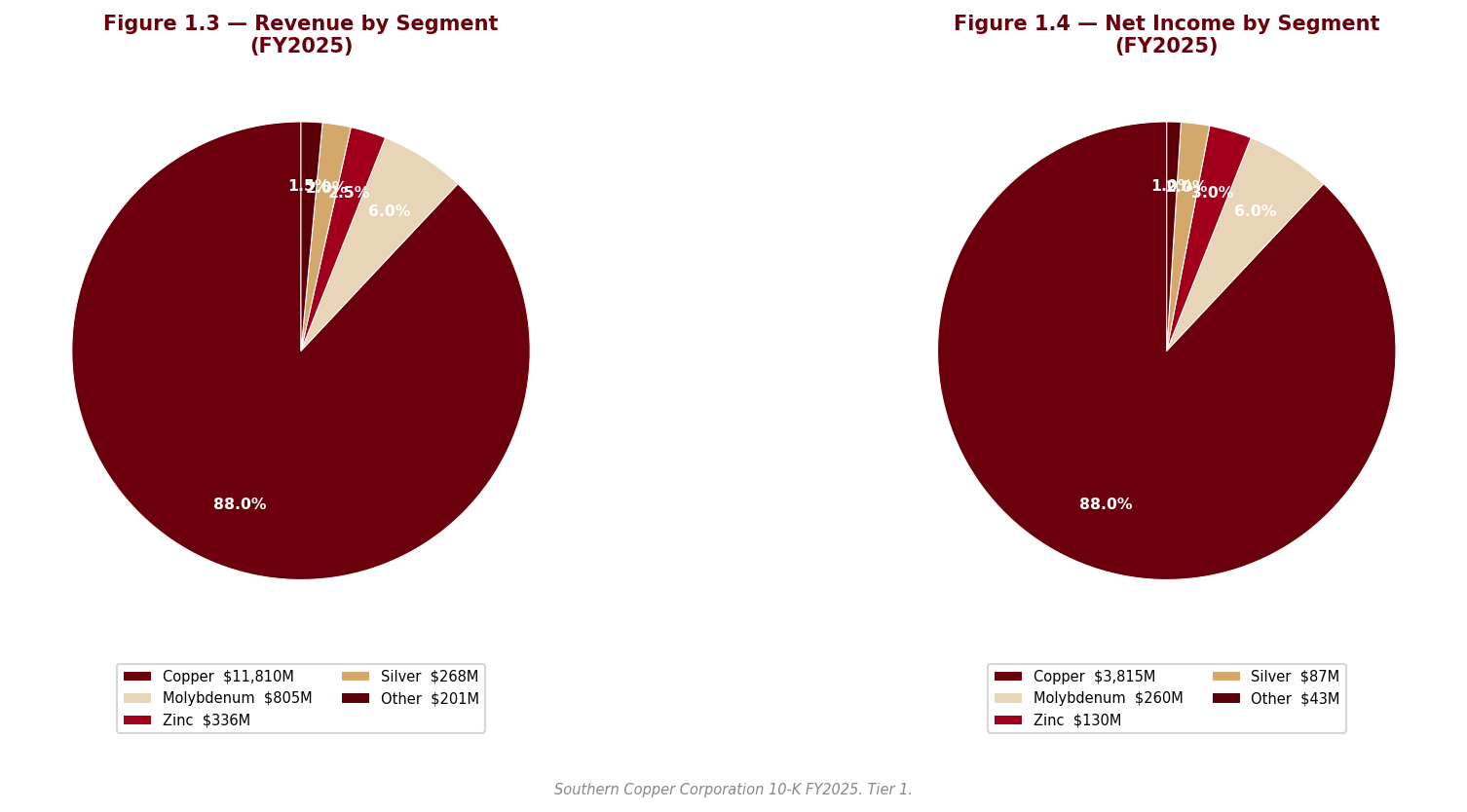
sources The company manages itself as three reportable segments, grouped by shared economic characteristics, products, processes, regulatory regimes, labor contracts and currency risk. The Chief Executive Officer is the chief operating decision maker and evaluates each segment on operating income and total assets. Management deliberately keeps the Peruvian and Mexican open-pit operations separate rather than combining them, because the two countries impose very distinct regulatory, environmental and political regimes and negotiate labor agreements differently — a segmentation choice that is itself a signal of how country-specific this business is. §
Peruvian Operations. The Toquepala and Cuajone open-pit copper-molybdenum porphyry mines, high in the southern Andes, feed a single integrated processing chain — smelter, refinery, precious-metals plant, and dedicated industrial railroad and port at Ilo on the coast. Ore from both mines is railed to Ilo and processed without distinction between the two, yielding copper cathode plus molybdenum and silver by-products, with SX-EW cathode produced alongside. The one variable that drives this segment is the copper price, mediated by ore grade.
Mexican Open-pit. Conducted through the Minera México subsidiary, this segment comprises the La Caridad and Buenavista complexes with their own smelting, refining, precious-metals and copper-rod plants. Management describes the Buenavista ore body as one of the world’s largest porphyry copper deposits and the oldest continuously operated copper mine in North America. It produces copper and zinc with molybdenum and silver by-products; the recently commissioned Buenavista zinc concentrator now allows zinc recovery alongside copper and was the single largest driver of the FY2025 volume step-up. This is the company’s largest earnings contributor, and again copper price is its dominant lever.
Mexican Underground (IMMSA). The IMMSA unit is a set of five underground poly-metallic mines — principally Charcas, Santa Bárbara, San Martín, Santa Eulalia and Taxco — plus a zinc refinery, producing zinc, lead, copper, silver and gold. It is the smallest and most operationally troubled of the three: the Taxco mine has been suspended by a strike running well over a decade and a half, and San Martín was restored only after a protracted illegal stoppage and costly renovation. Because its output mix is weighted to zinc, silver and lead, IMMSA is the one segment whose economics are driven less by copper than by the base- and precious-metal complex; its FY2025 recovery came from higher silver and lead volumes and prices.
How the system fits together. The segments are not a diversified conglomerate but a single copper machine replicated across two countries: mine, concentrate, smelt, refine, and credit the accompanying molybdenum, silver, zinc and gold against copper cash cost. The asset base is anchored by mature, long-life open-pit mines and backed by very large concession packages — indefinite in Peru, renewable long-term in Mexico — with reserve lives management describes in decades, estimated conservatively and reviewed annually by third-party qualified persons. Layered on top is an unusually deep greenfield pipeline: Tía María, a permitted SX-EW cathode project in Arequipa, Peru, now in active construction and management’s stated primary near-term catalyst; Los Chancas, a copper-molybdenum porphyry in Apurímac stalled by illegal miners occupying the area; the world-class Michiquillay resource in Cajamarca; and, in Mexico, the low-capital El Pilar oxide project near Buenavista and the large, long-life El Arco deposit in Baja California. Each of these is real optionality, but each is gated on permitting and community consent rather than on geology or capital — which is precisely why the pipeline is a source of value and of risk at the same time. The system’s flywheel is the by-product credit; its structural fragility is that all of it depends on one commodity price and two jurisdictions.
1.3 Geographic Exposure
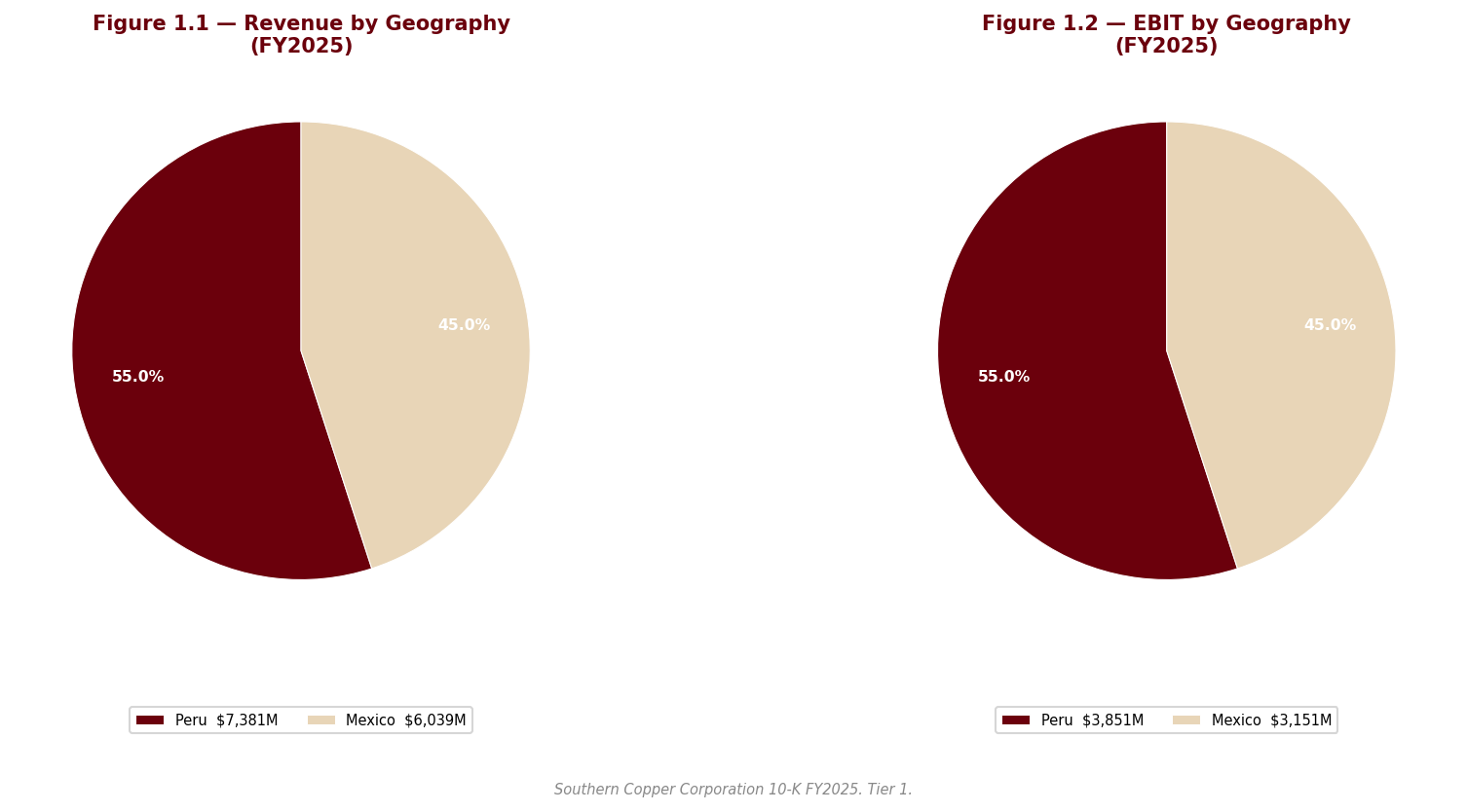
sources Geographically the company is concentrated to an extreme degree: substantially all of its mining, smelting and refining assets sit in Peru and Mexico, with exploration extending only into Argentina and Chile. Revenue, by contrast, is global — copper and molybdenum are priced off COMEX, the LME and Platt’s, and the company generally sells at prevailing market prices to customers worldwide. This produces a deliberate currency asymmetry: the U.S. dollar is the functional currency and sales are invoiced predominantly in dollars, while a meaningful share of operating costs is denominated in Peruvian soles and Mexican pesos. The result is that local-currency strength, more than local inflation, is the currency variable that pressures unit costs. The concentration of the entire asset base in two emerging-market jurisdictions is the defining operational reality of this company; the political, regulatory and community dimensions of that exposure are material enough to warrant their own treatment in Section 2.
1.4 Management Team & Control Structure
sources The leadership anchor is continuity. The company is run by a long-tenured operating team — Óscar González Rocha as Chief Executive Officer and Raúl Jacob as Chief Financial Officer — with no CEO change and no restatement in the period, and an unqualified auditor’s opinion on both the financial statements and internal control. For a business whose value rests on decades-long mine plans and multi-year greenfield builds, that operating stability is a genuine asset, and there is no evident succession crisis or thin-bench gap in the disclosed record. The bench, however, is not independent of the controlling owner, which is where the assessment turns.
Southern Copper is not a widely held company. It is an indirect, majority-owned subsidiary of Grupo México, held through Americas Mining Corporation, whose controlling stake approaches nine-tenths of the shares — leaving a public free float of little more than one-tenth. That control is not passive: through its voting power Grupo México can determine the outcome of substantially all shareholder votes and thereby set board composition, dividend policy, the scale of capital projects, asset sales and the level of debt. Several officers and directors also serve Grupo México or its affiliates. The minority owns an economic interest in an asset it does not, in any practical sense, control.
Related-party dealings with the parent (forensic flag, elevated concern). This control structure expresses itself through a broad and structurally embedded web of related-party transactions with Grupo México affiliates. The company buys captive power, rail freight, construction, engineering and a full suite of corporate and administrative services — accounting, legal, tax, treasury, procurement, logistics — from parent-controlled entities, and transacts in metal with an affiliated smelting company. The power arrangements are effectively captive in the literal sense: the IMMSA unit takes the overwhelming majority of the output of the parent’s wind park, so the subsidiary underwrites the parent’s generation assets rather than contracting at arm’s length in the open market. The disclosed volume of these purchases was the highest of the three years reported and rose sharply year over year, while related-party payables to the parent roughly tripled. The company points to an Article Nine charter provision requiring independent-committee review of material affiliate transactions above a defined size, and to Audit Committee oversight, as its governance guardrail. [Rating and price target withdrawn — see the note at the top.] The pattern extends to the balance sheet — a growing share of the Mexican pension plan’s assets is invested in the parent’s own common stock. Stated plainly and without euphemism: the minority bears an unquantifiable value-transfer risk, because value can be moved to the controlling parent through the pricing of intercompany purchases, captive power and services with no disclosed market check, and the assertion of arm’s-length pricing cannot be verified from the filing as presented. This is a governance and earnings-quality overhang, not a clean cost line, and it is developed further in Section 2.
1.5 Capital Allocation Track Record
| Year | Dividends Paid ($M) | Share Repurchases ($M) | CapEx ($M) |
|---|---|---|---|
| FY2021 | $2,473.8M | — | $892.3M |
| FY2022 | $2,705.8M | — | $948.5M |
| FY2023 | $3,092.4M | — | $1,008.6M |
| FY2024 | $1,637.2M | — | $1,027.3M |
| FY2025 | $2,485.1M | — | $1,325.3M |
Source: Company SEC filings (10-K); see Appendix A.1.
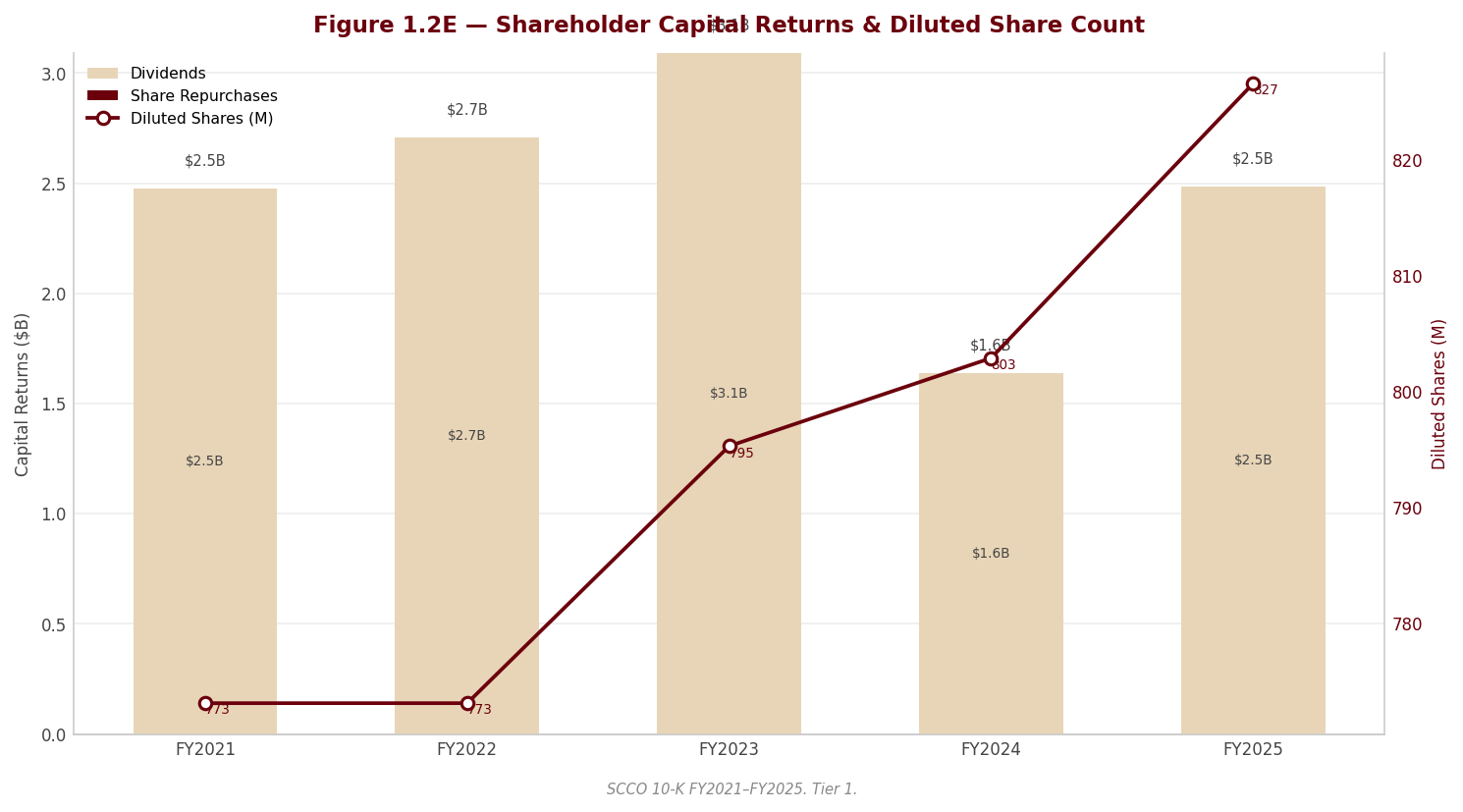
Capital allocation reflects the priorities of a controlling shareholder running a business at a capital-spending peak. Two things stand out. First, capital is being deployed heavily back into the ground: the multi-year expansion program, anchored by the large, multi-year Tía María build, has driven CapEx materially higher, and management has approved a still larger program for the year ahead. This is growth investment, not mere asset replacement — CapEx now runs well above the depreciation-and-depletion charge, the signature of a company adding capacity rather than simply sustaining it. Second, cash returns to shareholders are large, rising and delivered almost entirely through the dividend: the legacy repurchase authorization has been dormant since the middle of the last decade, and the board has instead paired the cash dividend with a recurring stock dividend. That stock dividend is the reason the split-adjusted diluted share count rose from 780M to 827M in the latest year, after years of near-total stability.
The tension in this mix is the point a portfolio manager should carry forward. Cash-plus-stock distributions have run ahead of net income and drawn down retained earnings, even as the dividend was raised into the teeth of the capex peak — and that combination is being funded, in part, by new borrowing rather than by internally generated cash alone. A high and rising payout 57.3% and total shareholder yield 2.1%, maintained alongside a debt-financed megaproject, steadily converts equity into leverage and thins the balance-sheet cushion available to minority holders in a copper downcycle. The distributions are pro-rata, so this is not per-share extraction; but the policy is set by a parent-controlled board that receives the overwhelming share of every dollar paid out, and that governance dimension is inseparable from the financial one. The leverage and free-cash-flow consequences are quantified in Section 3.
1.6 Competitive Positioning & Moat
sources 1.6.1 Industry structure. Copper is a cyclical, capital-intensive commodity in which competition is based primarily on price and service, and the metal competes at the margin against substitutes such as aluminum and plastics. Returns in this industry are won not by product differentiation but by position on the cost curve and by control of long-life, high-grade orebodies — the two things that let a producer stay profitable through the trough and capture the upside at the peak. Several of the company’s larger competitors are more diversified and have consolidated; Southern Copper has instead stayed a concentrated, integrated copper pure-play. The structural demand backdrop is favorable — copper’s centrality to electrification and the energy transition underpins a multi-decade demand case — but that is a tailwind available to every producer, not a company-specific moat.
1.6.2 Competitive advantages. The moat here is cost and resource, and it is real. Management characterizes the company’s controllable cash cost as among the lowest of any copper producer of comparable size, a position built on high-grade, integrated operations and, critically, on substantial by-product credits. The molybdenum, silver, zinc, gold and sulfuric acid recovered as part of the copper process are credited against copper cash cost, and it is these credits — swinging with the by-product complex — that pushed the net cash cost sharply lower in FY2025 and place the company in the low quartile of the industry. On the operating metrics that matter in this sector — margin, returns on capital and leverage — Southern Copper stands at or near the top of its peer group; the detailed benchmarking is presented in Section 5, but the source of that advantage is disclosed here: the lowest-cost, most integrated position, backed by what management states is the world’s largest copper reserve base. That reserve position, long-life and estimated at a conservative copper price, is itself a durable advantage, extended by an unusually deep greenfield pipeline (Tía María, Los Chancas, Michiquillay, El Pilar, El Arco) that gives the company decades of embedded growth optionality few competitors can match.
1.6.3 Competitive vulnerabilities. The vulnerabilities are the mirror image of the model’s purity. First and foremost, the company is largely unhedged and sells at prevailing prices, so the copper price is the single dominant earnings variable — there is essentially no buffer between the commodity cycle and the income statement. Second, the by-product credit that flatters cash cost is itself volatile; the same leverage that lowered net cost in FY2025 can raise it when molybdenum, silver and zinc prices soften. Third, the entire asset base sits in two emerging-market jurisdictions, exposing the company to Peruvian political instability and community conflict (Cuajone, Tía María, Los Chancas) and to Mexican mining-law changes, shorter concessions and the long tail of Sonora River litigation — the growth pipeline in particular advances only with permitting and community consent that cannot be assured. Fourth, the controlling-shareholder governance structure and its unbenchmarked related-party dealings are a standing overhang on the minority. Reserve depletion, which requires continuous replenishment, and the judgment-heavy carrying value of leach-pad ore stockpiles round out the list; these financial-quality items are treated in Sections 2 and 3.
1.6.4 Verdict. Operationally, this is a high-quality business — arguably the best asset in its peer group: lowest-quartile cash cost, peer-leading margins and returns, the industry’s deepest reserve base, and a long-life integrated footprint that supports durable, structural margin advantage through the cycle. Its margin durability, on operating grounds, is genuine and defensible. The case against the stock, developed in the sections that follow, is emphatically not a case against the business: it rests on the price paid for that quality and on the commodity and jurisdictional risk embedded in it — not on any deterioration in the franchise itself.
Section 2 — Key Risks & Catalysts
sources
2.1 Downside Risks
sources Southern Copper’s risk profile is dominated by two forces that sit above every operational detail: a single, unhedged commodity price, and a controlling shareholder whose interests need not align with the minority’s. The company is not exposed to the diffuse, offsetting risks of a diversified industrial — it is a concentrated bet on copper, produced in two emerging-market jurisdictions, inside a corporate structure the minority does not control. The most important thing a reader can take from this section is that the investment case turns almost entirely on the master variable, the copper price; the governance and country risks below shape the distribution of outcomes around it and, in a downcycle, would compound its effect.
Risk 1 — Copper price: the master variable
sources The company is essentially a single-commodity, largely unhedged producer that sells at prevailing market prices, so the copper price is the one input that determines the earnings outcome. The extraordinary margins the company is currently earning are, first and foremost, a function of a high copper price — not of any recent structural improvement in the business. That is the crux of the investment view: the case for caution rests on copper normalising toward a mid-cycle level over time, not on any operational deterioration. Copper prices have historically swung widely on forces entirely outside the company’s control — global growth, Chinese demand, trade and tariff policy, inventory cycles, and substitution toward aluminium and plastics — and an extended price decline would compress margins directly, could force curtailment of higher-cost output, and would raise the prospect of inventory write-downs. The exposure is amplified by the by-product complex: molybdenum, silver and zinc credits, which currently flatter the net cash cost, are themselves volatile and can swing the reported cash cost per pound in either direction, so a simultaneous softening in copper and by-products would hit the cost line at the very moment the revenue line weakens. [Rating and price target withdrawn — see the note at the top.]
Probability: High (that copper is volatile and mean-reverting over a cycle) | Timeframe: Immediate and ongoing | Quantified potential impact: Not quantified here; the earnings and valuation sensitivity to copper is modelled in Section 3. Directionally, because the business is unhedged, the effect of a price move flows through to operating income with little dampening.
Risk 2 — Related-party dealings with the controlling shareholder (RED FLAG)
sources This is the most important governance risk and the report’s primary red flag. The company is an indirect, majority-owned subsidiary of its parent, which holds an overwhelming majority of the shares and can therefore determine the outcome of substantially all shareholder votes — board composition, dividend policy, the scale of capital projects, asset sales and the level of debt — leaving the public minority with an economic interest in an asset it does not control. That control expresses itself through a broad and structurally embedded web of purchases from parent affiliates: captive power, rail freight, construction, engineering and a full suite of corporate and administrative services, together with metal transactions with an affiliated smelting company. These arrangements are not incidental. The power supply is effectively captive — the company’s underground unit absorbs almost all of the output of the parent’s wind park, so the subsidiary underwrites the parent’s generation assets rather than contracting in an open market. The disclosed volume of affiliate purchases was the highest of the years reported and rose steeply, while related-party payables to the parent climbed sharply year over year.
[Rating and price target withdrawn — see the note at the top.] The company points to an Article Nine charter provision requiring independent-committee review of material affiliate transactions above a defined size, and to Audit Committee oversight, as its guardrail — a real procedural check, but not a market price. The same pattern recurs on the balance sheet: a rising share of the Mexican pension plan’s assets is invested in the parent’s own common stock, tying employee retirement security to the parent’s share price, and the board approved a discretionary “solidarity contribution” to the parent’s home state — a politically directed use of capital authorised by a parent-controlled board. Stated without euphemism: the minority bears an unquantifiable value-transfer risk, because value can be moved to the controlling parent through the pricing of intercompany purchases, captive power and services with no disclosed market check, and the assertion of arm’s-length pricing cannot be verified from the filing as presented. This is a standing governance and earnings-quality overhang, not a clean cost line, and its cost/margin implications are carried into Section 3.
Probability: High (the transactions are recurring, growing and disclosed to continue) | Timeframe: Immediate and ongoing | Quantified potential impact: Not quantifiable by design — the absence of a benchmark is precisely why the value transferred, if any, cannot be sized. The impact is best read as a persistent discount the market should apply to reported earnings quality.
Risk 3 — Capital allocation under the controlling shareholder (RED FLAG)
sources The second red flag is the distribution policy, which is set by the parent-controlled board and serves a shareholder that receives the overwhelming share of every dollar paid out. Cash-plus-stock distributions have run ahead of net income and drawn down retained earnings, and the cash dividend was raised even as a multi-billion-dollar mine build proceeds and the capital-spending program steps up — with the gap funded, in part, by successive debt issues rather than by internally generated cash alone. The legacy share-repurchase authorisation has been dormant since the middle of the last decade, so shareholder return runs entirely through the dividend, and the recurring stock dividend steadily lifts the share count. The sustainability question is qualitative but sharp: a high and rising payout, maintained through a capex peak and topped up with new borrowing, mechanically converts equity into leverage and thins the balance-sheet cushion available to the minority in a copper downcycle. This is not per-share extraction — distributions are pro-rata — but it is a genuine capital-structure and governance risk, because the policy prioritises a controlling owner’s cash needs over balance-sheet conservatism at exactly the point in the cycle when conservatism matters most. The free-cash-flow, net-debt and dividend-coverage consequences are quantified in Section 3.
Probability: High (the posture is established and confirmed in the most recent quarterly disclosures) | Timeframe: Immediate and ongoing, with the strain rising into the capex peak | Quantified potential impact: Not quantified here; Section 3 show the leverage trajectory. Directionally, gross debt is rising and the dividend is partly debt-funded, so the balance-sheet cushion is thinning rather than building ahead of a potential downturn.
Risk 4 — Peru country and social-licence risk
sources A large share of the asset base sits in Peru, whose business environment has been marked by acute political instability — a succession of removed presidents, congressional turmoil, corruption investigations and a transitional government facing elections. The more direct threat to production is at the community level: violent protests by communities adjoining the Cuajone mine previously blocked the rail line and seized water-reservoir facilities, cutting supply to part of the mining camp and prompting a government-declared state of emergency before production resumed; the flagship Tía María project has a decade-long history of community and legal opposition; and the Los Chancas project has been stalled outright by illegal miners occupying the area, which the company has been unable to clear. Because obtaining and keeping local-community acceptance now often requires substantial community-infrastructure spending, this risk hits the financials through both lost production and a rising social cost of operating. Permitting for the greenfield pipeline is gated on the same social licence, so Peru risk is simultaneously a threat to current output and to the growth optionality that supports the long-term value case.
Probability: High (instability and community friction are recurring, not episodic) | Timeframe: Immediate and ongoing | Quantified potential impact: Not quantified; the effect ranges from temporary production interruptions at existing mines to multi-year delay or abandonment of pipeline projects. A blockade of an operating mine has an immediate revenue effect; a permitting failure removes embedded growth value.
Risk 5 — Mexico regulatory, environmental and legal risk
sources The Mexican asset base faces a distinct and intensifying regulatory risk. Recently enacted mining-law changes shorten concession terms, tighten water-use conditions, require guarantees for site closure and remediation, and mandate a contribution of net earnings to indigenous communities for new projects, alongside a constitutional reform providing for the popular election of judges whose effects management cannot yet assess. Several of these changes are before the courts, so their final scope is unresolved — an overhang on both the cost base and the developability of the Mexican pipeline. Layered on top is the long tail of the 2014 Sonora River spill: numerous collective, civil and constitutional actions remain pending more than a decade later, and a federal environmental authority filed a criminal complaint alleging that remediation was incomplete. Management characterises every one of these matters as without merit, not reasonably estimable, and not material individually or in aggregate, and books no provision — a blanket characterisation that, given a live criminal complaint and scores of unresolved actions, deserves scepticism rather than acceptance at face value. Because mineral rights belong to the state and the company operates under terminable concessions, adverse regulatory or judicial outcomes in Mexico could raise costs, restrict operations, or in the extreme impair concession tenure.
Probability: Medium-to-High (regulatory change is enacted and litigation is live; the magnitude of impact is uncertain) | Timeframe: 1–3 years for regulatory and judicial outcomes; the spill litigation is open-ended | Quantified potential impact: Not estimable — management provides no accrual and no range. The exposure is a genuine, unquantified tail risk on the Mexican operations.
Risk 6 — Reserve depletion and accounting-estimate risk
sources Two related risks sit inside the accounting. First, because reserves deplete as mines are worked and mine-development cost is amortised on a units-of-production basis, a downward revision to the reserve base would directly accelerate depreciation and depletion and reduce reported earnings — a mechanical link that makes the annually reviewed reserve estimate a genuine earnings variable, not a footnote. Long-term viability depends on continually replenishing reserves through exploration and near-mine investment, which cannot be assured indefinitely. [Rating and price target withdrawn — see the note at the top.] A related watch item, developed in Section 3, is that closure-and-reclamation (asset-retirement) provisions have been revised downward in consecutive years with the excess credited to cost of sales — a recurring benefit that flatters margin and raises the question of whether the closure liability is now conservatively enough provisioned.
Probability: Medium | Timeframe: 1–3 years (estimate revisions occur at annual review) | Quantified potential impact: Not quantified; a reserve or leach-recovery revision would flow through depreciation/depletion or a write-down to cost of sales. The direction of recent asset-retirement revisions has been earnings-favourable, which is itself a reason for caution about their durability.
Risk 7 — Operational hazards, labour and unquantified litigation
sources Mining, smelting and refining carry hazards that are partly uninsurable — industrial accidents, seismic events, open-pit wall failures and, most consequentially, the structural risk of a tailings-storage-facility failure, which could cause catastrophic environmental damage and loss of life and has drawn heightened industry scrutiny after major failures elsewhere. The workforce is heavily unionised in both countries: one Mexican underground mine has been suspended by a strike running well over a decade and a half, and another was restored only after a protracted illegal stoppage and costly renovation, so labour disruption is a demonstrated, recurring drag rather than a theoretical one. The company also carries a Peruvian “labour shares” proceeding now in judgment-execution, in which a court ordered the physical delivery of a block of investment shares to former employees; the core dispute is a valuation ratio whose resolution spans a range from de minimis to potentially significant, and the company has obtained interim constitutional relief while the matter remains under appeal. Management states the contingency cannot be reasonably estimated and books no accrual. Both this and the Sonora spill litigation are live, unquantified tail risks that a rational analyst should carry as open items rather than dismiss.
Probability: Medium (operational disruption is recurring; a catastrophic tailings event is low-probability, high-severity) | Timeframe: Ongoing; the litigation outcomes are open-ended | Quantified potential impact: Not estimable — no accruals are provided for the litigation, and a tailings failure, while remote, would be severe. The labour disruptions have a demonstrated but contained production cost.
2.2 Upside Catalysts
sources The catalyst picture is deliberately asymmetric, and the report does not manufacture balance. The company carries substantially more, and more structural, downside risks than near-term upside catalysts, and the largest identifiable catalyst is not company-specific at all — it is the copper price. A reader should treat the risks above as the base case and the catalysts below as the routes by which a cautious view would be proven wrong.
Catalyst 1 — Sustained or rising copper price (the primary risk to a cautious rating)
sources Because the bearish view rests on copper reverting toward a mid-cycle level, the clearest catalyst against that view is the price simply not reverting. Copper’s structural demand case — electrification, grid build-out and the broader energy transition — is real and multi-decade, and management points to a tight market with thin inventories. If the price holds at or above current levels, the company’s present margins are sustained rather than normalised, the entire earnings base the caution is built on stays intact, and the valuation case for patience weakens materially. [Rating and price target withdrawn — see the note at the top.] It is not company-specific — it is available to every producer — but for an unhedged pure-play it flows through with unusual force.
Probability: Medium | Timeframe: Immediate and ongoing | Monitoring trigger: The copper price itself, spot and forward, together with global inventory days and Chinese demand indicators; a durable break above the level assumed in the valuation would invalidate the normalisation thesis.
Catalyst 2 — Tía María delivered on time and on budget
sources The flagship greenfield is now a real, funded build rather than a dormant permitting option, and it is management’s stated primary near-term growth catalyst. If it is completed on schedule and within budget and ramps to its cathode capacity, it would add low-cost volume — the kind of growth that compounds rather than reverses with the cycle — and would validate the company’s ability to execute in a district with a long history of opposition. Delivery would also retire some of the execution uncertainty currently discounted in the pipeline’s value.
Probability: Medium | Timeframe: Approximately 1–3 years to start-up and ramp | Monitoring trigger: Reported construction-completion percentage, project spending against budget, and the absence of new blockades or adverse legal rulings; the number of active lawsuits against the project is a direct social-licence gauge.
Catalyst 3 — De-escalation of community conflict and unlocking of the pipeline
sources Much of the company’s embedded growth value is trapped behind social-licence and permitting friction — most visibly the illegal-mining occupation stalling Los Chancas and the community opposition around Tía María and the broader Peruvian pipeline. Genuine resolution of these conflicts, or a durable improvement in the Peruvian permitting environment, would convert stalled optionality into developable projects and lift the long-term production trajectory. This is a slower, more diffuse catalyst than a single project milestone, but it is the one that would most change the multi-decade growth case.
Probability: Low-to-Medium | Timeframe: 2–5 years | Monitoring trigger: Regaining operational control of the Los Chancas area, signed and honoured community agreements, favourable court rulings on pipeline projects, and a stabilising Peruvian political backdrop.
Catalyst 4 — Governance improvement
A meaningful narrowing of the governance discount — for example, disclosure of independent arm’s-length benchmarks for the related-party dealings, a more balance-sheet-conservative distribution policy through the capex peak, or a reduction in the pension plan’s concentration in the parent’s stock — would directly address the two red flags above and could support a higher-quality earnings multiple. [Rating and price target withdrawn — see the note at the top.]
Probability: Low | Timeframe: Uncertain | Monitoring trigger: Any disclosure of independent valuation for affiliate transactions, a change in dividend policy toward coverage by internally generated cash, or a reduction in related-party balance-sheet concentration.
2.3 Risk & Catalyst Summary
| # | Item | Type | Probability | Timeframe | Status | Monitoring Trigger |
|---|---|---|---|---|---|---|
| 1 | Copper price — the master variable (unhedged, single-commodity) | Risk | H | Immediate/ongoing | Active | Spot and forward copper price; by-product prices; inventory days |
| 2 | Related-party dealings with controlling shareholder; no arm’s-length benchmark (RED) | Risk | H | Immediate/ongoing | Active | Affiliate purchase volumes and related-party payables trend; any disclosed benchmark |
| 3 | Capital allocation — total distributions (cash dividend plus a non-cash stock dividend) have at times exceeded earnings and keep drawing retained earnings down; the cash dividend alone is covered at peak earnings but thinly at mid-cycle, while growth capex is part-funded by new debt (RED) | Risk | H | Immediate/ongoing | Active | Net-debt trajectory; dividend coverage by internally generated cash |
| 4 | Peru country and social-licence risk (blockades, illegal mining, permitting) | Risk | H | Immediate/ongoing | Active | Community blockades; Los Chancas control; permitting progress |
| 5 | Mexico regulatory, environmental and legal risk (mining-law, Sonora spill) | Risk | M–H | 1–3 yrs / open-ended | Active | Court rulings on mining-law and spill litigation; concession terms |
| 6 | Reserve depletion and accounting-estimate risk (UoP depletion; leach-pad CAM) | Risk | M | 1–3 yrs | Monitoring | Annual reserve review; leach-recovery assumptions; ARO revisions |
| 7 | Operational hazards, labour and unquantified litigation (tailings, strikes, labour shares) | Risk | M | Ongoing / open-ended | Latent/Active | Tailings-standard compliance; labour disputes; litigation outcomes |
| 8 | [Rating and price target withdrawn — see the note at the top.] | Catalyst | M | Immediate/ongoing | Monitoring | Copper price vs. valuation assumption; demand and inventory data |
| 9 | Tía María delivered on time and on budget | Catalyst | M | 1–3 yrs | Active | Completion %; spend vs. budget; lawsuit count |
| 10 | De-escalation of community conflict; pipeline unlocked | Catalyst | L–M | 2–5 yrs | Monitoring | Los Chancas control; community agreements; Peru stability |
| 11 | Governance improvement | Catalyst | L | Uncertain | Latent | Disclosed affiliate benchmarks; dividend-policy change |
Source: Company SEC filings (10-K) and forensic footnote review; see Appendix A.1.
2.4 Risk Interdependencies
sources The risks in this business are not independent draws; they are correlated in a way that would concentrate damage precisely in a downturn. The controlling variable is the copper price, and almost every other risk is worse when the price is falling. A copper downcycle would compress margins directly (Risk 1) at the same moment that the by-product credits cushioning cash cost also soften, so the cost line deteriorates just as revenue does. Into that weaker cash-flow environment, the capital-allocation posture (Risk 3) becomes acutely more dangerous: a dividend that already runs ahead of net income and is partly funded by new debt would, in a low-price year, either force a politically difficult cut by a parent-controlled board or drive leverage higher against a shrinking earnings base — the very cushion the minority would need is being spent building it. The governance risk (Risk 2) compounds this, because the same board that sets the distribution policy also directs the unbenchmarked affiliate spending; in a downturn, the incentive to preserve parent cash flows through related-party channels and dividends runs directly against minority interests.
The country risks interact with the commodity risk on the other side of the ledger. A Peruvian blockade or a Mexican regulatory or judicial setback (Risks 4 and 5) that curtails production is damaging at any price, but it is disproportionately damaging when a high copper price is the thing making the current margins attractive — losing volume in a high-price environment forfeits the peak-cycle economics the whole bull case depends on. Finally, the reserve and accounting-estimate risks (Risk 6) tend to surface in weak years: a low copper price can render marginal reserves uneconomic, forcing a downward revision that accelerates depletion and can trigger leach-inventory write-downs — an accounting hit stacked on top of the operating hit. The scenario that would be disproportionately damaging is therefore the coincident one: a copper downcycle that simultaneously compresses margins, exposes the debt-funded dividend, invites a reserve revision, and lands while a community or regulatory disruption removes volume. None of these is independent of the price, which is why the price is the master variable and why the governance overhang matters most in exactly the conditions where the minority can least afford it.
2.5 ESG & Regulatory Exposure
sources Environmental. The company’s single largest environmental exposure is physical and structural: waste rock and tailings are its largest waste stream, and a defect or failure of a tailings-storage facility could be catastrophic — a risk the company acknowledges has drawn heightened industry scrutiny after major failures elsewhere. Against this, management reports adopting the international industry tailings standard across its main operations, forming an internal tailings-review committee, maintaining high water recovery at its dams, and earning global-tailings-standard accreditation at its open-pit mines, and it reports that its operations retain recognised occupational-health-and-safety and environmental management-system certifications and hold The Copper Mark for responsible production. The unresolved 2014 Sonora River spill litigation, including a federal criminal complaint alleging incomplete remediation, is the largest live environmental-legal overhang and is discussed as Risk 5. The company also flags geography-specific physical climate risks — drought, changing rainfall and water shortages — that bear directly on operations, since mining and processing require substantial water and energy; it describes aligning disclosures with the recommendations of the climate-related financial-disclosures task force, emission-reduction targets, and rising renewable-electricity use, though notably part of that renewable supply comes from the parent’s wind park, tying an ESG initiative back into the related-party web.
Social. Social licence is not a soft factor for this company — it is a direct determinant of production and growth, as the Cuajone blockade, the Tía María opposition and the Los Chancas illegal-mining occupation all demonstrate. Management describes a community-development model, an active grievance mechanism, local hiring and supplier programs, use of a works-for-taxes mechanism to fund public infrastructure, and a human-rights due-diligence process; the substantial and recurring community-infrastructure spending this entails is a real and rising cost of maintaining the licence to operate. Occupational health and safety is a genuine exposure: the company discloses that fatalities have occurred despite its programs, and in Peru certain safety violations can be treated as criminal offences carrying prison sentences.
Governance. Governance is the weakest pillar and the source of both red flags in this section. The controlling shareholder can determine substantially all shareholder votes; several officers and directors also serve the parent or its affiliates; the company transacts extensively with parent affiliates without any disclosed arm’s-length benchmark; a rising share of pension assets is invested in the parent’s own stock; and a discretionary contribution was directed to the parent’s home state by a parent-controlled board. The Article Nine independent-committee review and Audit Committee oversight are meaningful procedural guardrails, and the auditor issued an unqualified opinion on both the financial statements and internal control with no going-concern language — but procedure is not a market price, and the structural conflict between the controlling owner and the minority is a permanent feature of the investment, not a passing event.
Regulatory. Regulatory exposure is concentrated and rising in both jurisdictions. In Mexico, enacted mining-law changes shorten concession terms, add water-use conditions, require closure-and-remediation guarantees and mandate a share of net earnings to indigenous communities for new projects, while a judicial reform providing for the popular election of judges introduces unassessed uncertainty into the legal environment in which the company’s litigation will be decided. In Peru, operations are subject to annual government environmental audits and evolving environmental law, and the entire asset base in both countries operates under state-owned mineral rights and terminable concessions, so regulatory tenure is itself a risk. The company additionally flags material exposure to shifts in U.S. trade and tariff policy affecting copper products, a source of price and share-price volatility outside its control.
Section 3 — Financial Analysis & Historical Performance
sources
Three-Statement Linkage Confirmation: - Net Income ties (Income Statement → Cash Flow Statement): Confirmed. Reported net income is the starting line of the operating cash-flow statement each year with no unexplained reconciling item; the income-statement and cash-flow net-income figures agree. - Cash ties (Balance Sheet → Cash Flow Statement): Confirmed. The change in cash and equivalents on the cash-flow statement reconciles to the year-over-year movement in the balance-sheet cash line. - Retained Earnings reconciliation (Beg RE + NI - Distributions = End RE): Confirmed within rounding — and the reconciliation is itself the headline governance fact of the year. Retained earnings fell from $6,839.6M to $5,797.2M despite record net income of $4,334.9M, because total distributions — the cash dividend of $2,485.1M plus a large non-cash stock dividend — exceeded earnings. This is the red-flag capital-allocation dynamic developed throughout the section.
3.1A Income Statement
Source: Company SEC filings (10-K); figures per the FL model — see Appendix A.1–A.2.
CAGR Summary
| Metric | 3Y CAGR | 5Y CAGR | 10Y CAGR |
|---|---|---|---|
| Revenue | 10.1% | 10.9% | - |
| EBITDA | 14.6% | 15.1% | - |
| Net Income | 18.0% | 22.5% | - |
| Diluted EPS | 15.4% | 20.9% | - |
| FCF | 22.7% | 9.4% | - |
Source: Company SEC filings (10-K); figures per the FL model — see Appendix A.1–A.2. Ten-year CAGRs are not shown: the earliest balance in the model is FY2016, so no FY2015 base exists to compound from.
3.1B Income Statement — Analysis
sources The revenue story is a copper story with a volume kicker. Over the decade revenue has more than doubled, from $5,379.8M in FY2016 to a record $13,420.0M in FY2025, compounding at 10.1% over three years and 10.9% over five. But the top line has not climbed in a straight line, and the shape matters more than the slope. Two discrete surges account for almost all of the gain, and they are of fundamentally different quality. The first, FY2021’s 36.9% jump, was a pure price event — copper spiked, and because the company is essentially unhedged, the entire move dropped through to revenue. It reversed on cue: revenue fell -8.1% in FY2022 and a further -1.5% in FY2023 as the price gave much of it back. The second surge — 15.5% in FY2024 and 17.4% in FY2025 — is better in kind, because a meaningful part of it is volume: the newly commissioned Buenavista zinc concentrator added by-product tonnes, and firmer molybdenum and silver volumes and prices layered on top of a firmer copper price. This is the distinction Section 1 drew and it is worth repeating in financial terms: price-led revenue reverses with the cycle, volume-led revenue compounds. The FY2025 record is a blend of both, which is why it is stronger than the FY2021 spike but should still not be read as a new, permanently higher base.
Margins are a copper-price chart, not an efficiency chart — this is the single most important framing in the section. Operating (EBIT) margin has traced the following path: 29.1% in FY2016, rising through 39.4%, 40.6%, 37.8% and 39.1%, spiking to 55.5% in the FY2021 price peak, falling back to 44.1% and 42.4% as copper normalised, then climbing again to 48.6% and 52.2% in the latest two years. Read that series against the copper price and the two lines are nearly the same chart. The FY2021 spike and the FY2024–FY2025 climb are not the fingerprints of a step-change in cost control; they are the operating leverage of an unhedged, low-cost producer applied to a higher metal price. A portfolio manager must not mistake this cyclical margin for structural improvement. The correct anchor for a “normal” margin is not FY2025’s 52.2% but the average of the full ten-year series — which sits well below the current reading — because that average spans both peaks and troughs of the price cycle. Gross margin (60.1% in FY2025) and EBITDA margin (58.6% in FY2025) tell the same cyclical story one line higher up. A structural point on the build: cost of sales is reported exclusive of depreciation, which the company discloses on its own line ($868.4M in FY2025), so the gross-margin and EBITDA figures above do not double-count D&A.
Major movers.
-
Copper and the by-product complex (revenue and margin, temporary at the peak). The dominant mover in every direction is the metal price. It drove the FY2021 revenue and margin spike, the FY2022–FY2023 give-back, and roughly half of the FY2024–FY2025 recovery. Because the position is unhedged, the effect is undamped in both directions. This is the cyclical, temporary component of current profitability — the part that reverses when copper reverts toward mid-cycle.
-
Buenavista zinc and precious-metal volumes (revenue and cash cost, structural). The concentrator ramp is the one recent driver that is genuinely additive rather than price-dependent: it adds saleable tonnes and, via by-product credits, lowers net cash cost per pound of copper. This is the compounding, structural component of the FY2025 result — though the by-product credit itself swings with molybdenum, silver and zinc prices, so even this “structural” lever has a cyclical tail.
-
Recurring downward revisions to the asset-retirement obligation, credited to cost of sales (earnings-quality watch item — YELLOW flag). In each of FY2024 and FY2025 the company revised its mine-closure (ARO) liability downward and booked the portion of the revision exceeding the related capitalised retirement asset as a reduction of cost of goods sold. A “change in estimate” that lowers the closure liability and credits COGS in two consecutive years is a recurring benefit dressed as a one-off: it flatters the reported gross-margin and operating-margin trend above, and it raises the separate question of whether the closure provision — now cut materially over two years — remains conservatively enough set. In margin analysis these credits should be treated as non-recurring; the underlying cost trend is modestly worse than the reported line.
-
[Rating and price target withdrawn — see the note at the top.] That allowance is, in effect, permanent tax leakage. [Rating and price target withdrawn — see the note at the top.]
-
[Rating and price target withdrawn — see the note at the top.] The corollary is that the FY2018 optics are equally distorted from the other side: diluted EPS “doubling” from $0.94 to $2.00 (a reported 111.8% jump in net income) is an artefact of the depressed FY2017 base, not a doubling of the business.
Quality of earnings. Three items temper the reported figures, none of them a restatement or an accounting-policy change (revenue recognition, depreciation and depletion, and the conservative reserve price are all unchanged year-over-year, which preserves comparability). First, the ARO COGS credits above are a recurring flatterer of margin. [Rating and price target withdrawn — see the note at the top.] Third, and unquantifiable by design, the related-party cost structure flagged in Sections 1 and 2: a growing volume of purchases of power, freight, construction, engineering and corporate services from the controlling shareholder’s affiliates, priced without any disclosed arm’s-length benchmark, sits inside the cost lines above. None of this makes the earnings low-quality in an accounting sense — the audit opinion is clean — but each is a reason to discount the reported margin rather than extrapolate it.
⚠ Items to Watch. The margin discussion inverts the usual watch threshold: because margin is the copper price, a fall in EBIT margin back toward the FY2023 level of 42.4% or the ten-year average is the expected normalisation, not a red flag in itself. The genuine warning sign would be a margin that fails to hold at a given copper price — that is, evidence of cost inflation from a stronger sol or peso, a higher Mexican royalty, or above-market related-party pricing eating the cost line independently of the metal. Two specific triggers: a reversal of the ARO COGS credits (removing a recurring tailwind of the order booked in FY2024–FY2025), or any downward revision to leach-pad recovery assumptions, either of which would hit cost of sales directly.
3.2A Balance Sheet
Source: Company SEC filings (10-K); figures per the FL model — see Appendix A.1–A.2.
3.2B Balance Sheet — Analysis
sources Asset composition: a capital-intensive miner, not an acquirer. The balance sheet is exactly what a low-cost integrated producer’s should look like. It is dominated by net property, plant and equipment ($10,272.2M in FY2025), the sunk-in-the-ground capital of long-life open-pit mines, smelters and refineries. Two features distinguish it from most industrials. First, there is effectively no acquisition goodwill: the combined goodwill-and-intangibles line is only $122.4M, a rounding item against total assets of $21,381.4M, so there is no impairment overhang and no acquired-growth flattering the returns. Second, the business is genuinely cash-rich and liquid — the current ratio stands at 3.9x in FY2025 — which for a cyclical commodity producer is a deliberate and appropriate cushion. Within inventory ($1,058.1M) sits the large long-term leach-pad ore stockpile that is the auditor’s Critical Audit Matter; its carrying value depends on the recovery assumptions discussed in 3.1B, so a slice of the asset base is estimate-sensitive.
Leverage: conservatively financed today, but the trajectory is the story (RED flag). On a snapshot basis SCCO is conservatively levered and de-levering: net debt has fallen to $2,446.1M in FY2025 from $5,408.2M in FY2016, net-debt-to-EBITDA has compressed to 0.3x from 2.4x, and debt-to-equity has eased to 0.6x. There is no near-term maturity wall, the debt is investment-grade, and the sole financial covenant is met — near-term solvency is not in question. Two qualifications keep this from being an unambiguously reassuring picture. First, the optics flatter: net-debt-to-EBITDA is low largely because EBITDA is at a cyclical peak; measured against a mid-cycle EBITDA the same debt load would produce a materially higher ratio, so the current reading understates through-cycle leverage. (A definitional note for the careful reader: the company’s own “net debt” measure also nets short-term investments against gross debt, so its reported figure runs lower than the cash-only $2,446.1M in this model — a difference of definition, not of fact.) Second, and more important, the direction of gross debt has turned up: total debt rose to $6,750.7M in FY2025 on a fresh note issue, and the company is now funding a multi-billion-dollar capital programme partly with new borrowing. This is the balance-sheet expression of the red-flag capital-allocation posture: cash-plus-stock distributions have exceeded net income and drawn retained earnings down from a FY2021 peak of $7,769.7M to $5,797.2M in FY2025, even as the dividend was raised into a capex peak. Equity is being converted into leverage at exactly the point in the cycle when balance-sheet conservatism matters most, and the policy is set by a board that returns most of every distributed dollar to the controlling shareholder. Tested against mid-cycle rather than FY2025 earnings, the dividend is materially less comfortably covered than the current payout ratio implies.
Working capital: tightening, with no earnings-quality red flag. The cash conversion cycle has shortened steadily, from 84 days in FY2018 to 64 days in FY2025, driven mainly by faster inventory turns (days inventory outstanding fell from 111 days to 72 days). Receivables are well-behaved — days sales outstanding of 43 days in FY2025 sit inside their historical range and show no build outpacing revenue, so there is no channel-stuffing or aggressive-revenue-recognition signal here; days payable outstanding of 50 days are similarly stable. Working capital is a modest source of the improving cash conversion, not a drag. (FY2016 working-capital ratios are not shown: four FY2016 balance-sheet lines are absent from the available filings, and the ratios cannot be computed without them.)
⚠ Items to Watch. The threshold that matters is leverage measured on normalised earnings, not on the peak. If net debt/EBITDA climbs back above the recent high of 1.0x — which continued debt-funded distributions and the Tia Maria capex ramp could produce as EBITDA normalises off the current peak — it would mark a return toward mid-cycle leverage and could begin to constrain dividend capacity. A continued draw-down in retained earnings below the FY2025 $5,797.2M level, absent a copper-driven earnings rebound, is the balance-sheet tell that the distribution policy is outrunning the business.
3.3A Cash Flow Statement
| FY2021 | FY2022 | FY2023 | FY2024 | FY2025 | |
|---|---|---|---|---|---|
| Cash from Operations ($M) | $4,292.4M | $2,802.5M | $3,573.1M | $4,421.7M | $4,752.1M |
| — Depreciation & Amortization ($M) | $806.0M | $796.3M | $833.6M | $845.9M | $868.4M |
| Capital Expenditures ($M) | $892.3M | $948.5M | $1,008.6M | $1,027.3M | $1,325.3M |
| Free Cash Flow ($M) | $3,400.1M | $1,854.0M | $2,564.5M | $3,394.4M | $3,426.8M |
| FCF Margin | 31.1% | 18.5% | 25.9% | 29.7% | 25.5% |
| FCF / Share | $4.40 | $2.40 | $3.32 | $4.35 | $4.15 |
| FCF Conversion (FCF/NI) | 100.1% | 70.3% | 105.7% | 100.5% | 79.1% |
| CapEx / Revenue | 8.2% | 9.4% | 10.2% | 9.0% | 9.9% |
| CapEx / D&A | 1.1x | 1.2x | 1.2x | 1.2x | 1.5x |
| Dividends Paid ($M) | $2,473.8M | $2,705.8M | $3,092.4M | $1,637.2M | $2,485.1M |
| Share Repurchases ($M) | — | — | — | — | — |
Source: Company SEC filings (10-K); figures per the FL model — see Appendix A.1–A.2.
3.3B Cash Flow — Analysis
sources Operating cash flow is high-quality and tracks earnings. Cash from operations reached $4,752.1M in FY2025 and has broadly moved with net income across the cycle, which is what one expects from a business that sells a liquid commodity for cash and carries no meaningful receivables risk. FCF conversion — free cash flow as a percentage of net income — was 79.1% in FY2025, below the roughly 100% mark it has hit in several recent years (105.7% in FY2023, 100.5% in FY2024). The shortfall is not an earnings-quality problem; it is deliberate reinvestment — the cash the income statement earns is being redirected into the ground rather than lost to working capital. The instructive historical data point is FY2016, when free cash flow was negative at -$195.4M because capital expenditure of $1,118.5M exceeded operating cash flow of $923.1M. That is a genuine capex-cycle fact, not an error, and it is what produced the dramatic 587.8% swing in free cash flow into FY2017 as spending rolled off — a useful reminder that this company’s free cash flow is as much a function of where it sits in its own investment cycle as of the copper price.
CapEx intensity is rising back into growth mode. Capital expenditure climbed to $1,325.3M in FY2025, and the CapEx/D&A ratio rose to 1.5x — comfortably above the 1.0x line that separates growth investment from harvest. After a low-spend stretch in FY2019–FY2020 (when CapEx/D&A dipped below 1.0x, i.e. the company was under-replacing its depreciation charge), the ratio has climbed for four straight years, and the step-up is set to accelerate: the Tia Maria build is moving from option to active construction, driving a planned capital programme materially above the FY2025 level. This is real growth investment — capacity added, not merely sustained — and it is the reason free cash flow, though still robust at $3,426.8M in FY2025, is being consumed rather than left to accumulate.
Capital allocation waterfall: dividends dominate, and outrun the cash (RED flag). The allocation of the cash generated is unusually one-sided. Share repurchases are effectively absent — the legacy authorisation has been dormant since the middle of the last decade — so shareholder return runs entirely through the dividend, which reached $2,485.1M in FY2025 and has been raised again subsequently. The problem is coverage. In FY2022 and FY2023 the dividend payout ratio exceeded 100% of net income (102.6% and 127.5% respectively), and although the reported FY2025 payout looks more comfortable at 57.3%, that ratio is measured against peak earnings; on a mid-cycle earnings base the cash dividend alone would absorb a far larger share, before the additional non-cash stock dividend and the rising capex bill. The three claims on cash — a large and rising dividend, a step-change in growth CapEx, and (subsequently) debt service — are now competing, and the company is bridging the gap with new borrowing. Over the past five years the dominant use of free cash flow has been the dividend, reinvestment has been rising, and buybacks have been nil — a mix that makes sense only if one believes copper (and therefore cash flow) stays near the top of its range. It is the wrong mix for a cyclical producer heading into a capex peak, and it is set by a parent-controlled board.
⚠ Items to Watch. The trigger is dividend coverage on normalised cash flow. If free cash flow in a softer copper year falls below the cash dividend — forcing the payout to be funded entirely by new debt or by drawing the cash balance — the distribution policy would be visibly outrunning the business, and either a dividend cut by a parent-controlled board or a step-change in leverage would follow. Watch CapEx/D&A continuing above 1.5x alongside a rising dividend as the signal that the competing claims on cash are tightening.
3.4 Returns Analysis
| FY2021 | FY2022 | FY2023 | FY2024 | FY2025 | |
|---|---|---|---|---|---|
| ROIC | 31.1% | 23.1% | 20.8% | 28.4% | 34.7% |
| ROE | 44.2% | 32.5% | 31.3% | 40.7% | 42.9% |
| ROA | 19.3% | 14.8% | 14.3% | 19.1% | 21.6% |
| Interest Coverage | 15.6x | 11.5x | 11.1x | 14.8x | 16.8x |
Source: Company SEC filings (10-K); figures per the FL model — see Appendix A.1–A.2.
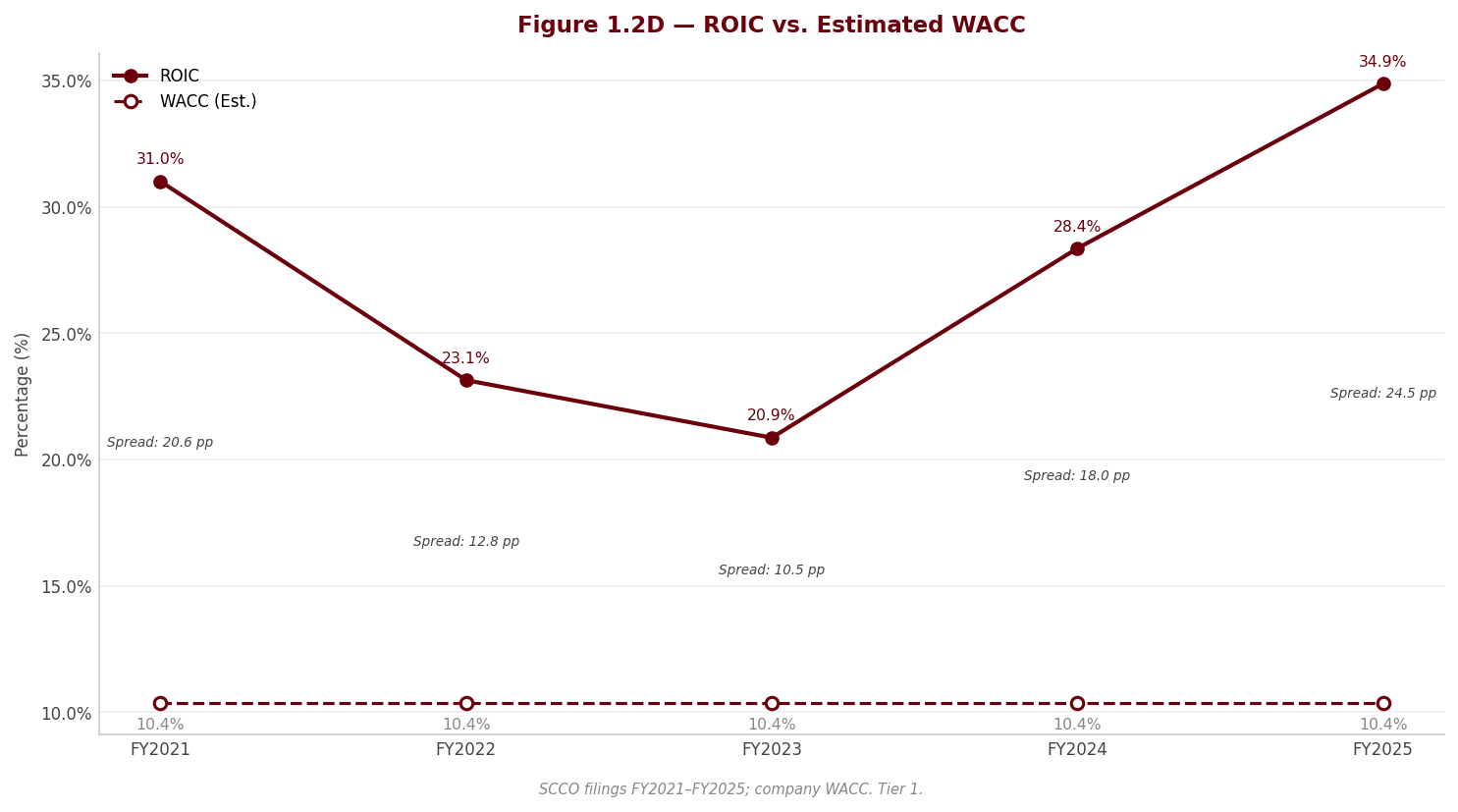
[Rating and price target withdrawn — see the note at the top.] The caution is that this is a cyclical high, and the whole of this section argues against extrapolating peak-cycle profitability. The same series tells the story plainly: ROIC troughed at 8.4% in FY2016 and 7.2% in FY2017 in the last downcycle, sat in the mid-teens (15.0%–15.3%) through the middle of the cycle, and only spiked toward its current level as copper and by-product prices climbed. Averaged across the cycle the return is far lower than the FY2025 reading, which means the durable spread over the cost of capital — the number that should drive a long-term valuation — is positive but considerably thinner than the current figure implies, and it narrows further as copper reverts toward mid-cycle. Interest coverage, expressed conservatively, is strong at 16.8x in FY2025 and has risen with earnings, confirming that the leverage concern is one of trajectory and cyclicality, not of near-term debt-service capacity.
DuPont: this is a margin machine, and margin is the swing factor. Decomposing FY2025 return on equity of 42.9% into its drivers, net margin of 32.3% multiplied by asset turnover of 0.67x and an equity multiplier of 1.98x. The composition is revealing. Asset turnover is structurally low — the signature of a capital-intensive miner with its balance sheet locked in long-life PP&E — and it is stable, so it explains the level of ROE but never its movement. The equity multiplier is modest at under 2x and has been falling, confirming that the elevated ROE is not a leverage illusion — this is a conservatively financed balance sheet, not a financially engineered return. That leaves net margin as both the dominant contributor and the swing factor, and net margin, as 3.1B established, is a copper-price variable. The conclusion closes the loop of the entire section: SCCO’s peer-leading return on equity is a high-margin, low-leverage, copper-price story, and it will swing with the price of copper — not with anything management can control on the cost or capital-structure side.
3.5 Altman Z-Score (Most Recent FY)
| Component | FY2023 | FY2024 | FY2025 |
|---|---|---|---|
| X1 (Working Capital / Total Assets) | 0.182 | 0.210 | 0.290 |
| X2 (Retained Earnings / Total Assets) | 0.421 | 0.365 | 0.271 |
| X3 (EBIT / Total Assets) | 0.251 | 0.297 | 0.327 |
| X4 (Equity / Total Liabilities) | 0.802 | 0.968 | 1.074 |
| X5 (Revenue / Total Assets) | 0.592 | 0.611 | 0.628 |
| Z-Score | 2.19 | 2.40 | 2.53 |
| Zone | Gray | Gray | Gray |
Source: Company SEC filings (10-K); figures per the FL model — see Appendix A.1–A.2.
A gray-zone score that understates a strong credit — but flags the right risk. The Z-Score has improved steadily, from 2.19 in FY2023 to 2.40 in FY2024 to 2.53 in FY2025, moving up through the gray zone (1.81–2.99) toward — but not into — the safe zone above 2.99. Taken at face value a gray-zone reading suggests moderate distress risk, which plainly overstates the near-term credit risk of an investment-grade producer with net-debt-to-EBITDA of 0.3x, interest coverage of 16.8x, no maturity wall and a clean, going-concern-free audit opinion. The model is simply ill-suited to this kind of business: the score is held down by the low revenue-to-assets ratio (X5) inherent to a capital-intensive miner and by a book-value-based equity term, neither of which reflects economic solvency here. The improving trend is driven by rising profitability (X3) and falling leverage — genuinely favourable. But the score is not to be dismissed entirely, and the reason is precisely the theme of this section: the retained-earnings-to-assets term (X2) is a real drag and would deteriorate further if the debt-funded distribution policy continues to draw retained earnings down. Credit implication: near-term default risk is low and well inside investment-grade parameters; the Z-Score’s mediocre absolute level is best read not as a solvency warning but as a quantified echo of the capital-structure trajectory — rising gross debt and a shrinking equity cushion — that is the section’s central balance-sheet concern.
4. Valuation withdrawn
This section stated what the shares were worth and what to do about them. It rested on an exit multiple set by hand — across the coverage it averaged 24% below where each company actually traded — so the conclusion largely restated that assumption instead of testing it. Rather than leave it standing, it has been withdrawn while the method is rebuilt.
Nothing else in this report depends on it: the financial analysis above and below is drawn from the company's own filings, and every figure links to the page it was verified against.
Section 5 — Financial Metrics & Peer Benchmarking
sources
5.1 Peer Selection
sources The peer set is built to answer one question: how good is Southern Copper’s business, and how much is the market charging for it, relative to the companies an institutional investor would actually hold instead. The four names below are the closest listed proxies — large, primary-copper producers with December fiscal year-ends, so every comparison is calendar-aligned and no period-mismatch adjustment is required. Each figure is read from the peer’s own primary filing, never from an aggregator.
Two structural weaknesses in the set must be stated up front rather than buried. First, three of the four peers report under IFRS while Southern Copper and Freeport report under US GAAP; IFRS differs on exploration-cost capitalisation, impairment reversal, and income-statement presentation, so every margin and return drawn from Teck, Antofagasta or First Quantum is directional, not precise. Second, no two copper miners account for by-products the same way — molybdenum, gold, silver and zinc are booked as gross revenue by some and as a cost credit by others — which makes cross-company margin and unit-cost rankings genuinely treacherous. These are not footnotes; they govern how far each table below can be trusted, and they are catalogued in full in 5.7.
The individual comparisons are also uneven. Freeport is the largest and most liquid comparable, but it is a copper-gold-molybdenum producer with a ~48.8% minority stake in its Grasberg operation, so its net-level metrics are distorted and it is best compared at the EBITDA/EV line. Teck reports in Canadian dollars and its leverage is genuinely ambiguous. Antofagasta is the cleanest quality comparable but discloses no gross margin and is deep in a growth-capex cycle. First Quantum is not a normalised business at all this year, with its largest mine idle. Each of these is a usable reference point; none is a clean like-for-like. The honest reading of this section is that the operating comparisons are directionally reliable and the valuation comparison — the heart of the thesis — is reliable at the EV/EBITDA level and noisier elsewhere.
| Peer | Ticker | Exchange | Filing Type | Accounting Standard | Fiscal Year End | Comparability Note |
|---|---|---|---|---|---|---|
| Freeport-McMoRan Inc. | FCX | NYSE | 10-K | US GAAP | December | Copper-gold-moly, not pure copper; large Grasberg minority distorts net metrics — compare at EBITDA/EV. |
| Teck Resources Limited | TECK | NYSE / TSX | 40-F | IFRS | December | Reports in CAD (translated to USD); leverage ambiguous — net cash on balance-sheet debt, net debt with partner advances. |
| Antofagasta plc | ANTO | LSE | FY2025 Results (IFRS) | IFRS | December | Single-step statement — no gross margin disclosed; heavy growth-capex cycle drives negative FCF. |
| First Quantum Minerals Ltd. | FM | TSX | Annual Report (IFRS) | IFRS | December | Distressed, non-normalised year — Cobre Panamá idle, net loss; P/E and ROIC not meaningful. |
Source: Peer-company SEC filings; comparability notes in 5.7 — see Appendix A.1.
5.2 Profitability Comparison
sources Comparative: Most Recent Full Fiscal Year
| Metric | Southern Copper Corporation | Freeport-McMoRan Inc. | Teck Resources Limited | Antofagasta plc | First Quantum Minerals Ltd. |
|---|---|---|---|---|---|
| Revenue ($M) | $13,420.0M | $25,915.0M | $7,697.7Mᶠ | $8,620.3Mᶠ | $5,237.0Mᶠ |
| Gross Margin | 60.1% | 28.2% | 24.7%ᶠ | — | 27.8%ᶠ |
| EBITDA Margin | 58.6% | 33.8% | 37.2%ᶠ | 58.2%ᶠ | 32.2%ᶠ |
| EBIT Margin | 52.2% | 25.2% | 20.9%ᶠ | 39.1%ᶠ | 18.4%ᶠ |
| Net Margin | 32.3% | 8.5% | 13.0%ᶠ | 15.4%ᶠ | -0.5%ᶠ |
| FCF Margin | 25.5% | 4.3% | -5.4%ᶠ | -7.1%ᶠ | 18.1%ᶠ |
Source: Peer-company SEC filings; comparability notes in 5.7 — see Appendix A.1.
Flag legend: ᶠ = IFRS reporter, comparison directional only (Teck additionally CAD-translated); ᵐ = market-sourced; ᶜ = computed from filing components.
Peer figures: Freeport-McMoRan Inc. (10-K, FY2025); Teck Resources Limited (40-F, FY2025); Antofagasta plc (FY2025 Results (IFRS), FY2025); First Quantum Minerals Ltd. (Annual Report (IFRS), FY2025).
Historical: Southern Copper Corporation Own 5-Year Progression
| Metric | FY2021 | FY2022 | FY2023 | FY2024 | FY2025 |
|---|---|---|---|---|---|
| Gross Margin | 64.4% | 53.7% | 52.6% | 57.7% | 60.1% |
| EBITDA Margin | 62.8% | 52.1% | 50.8% | 56.0% | 58.6% |
| EBIT Margin | 55.5% | 44.1% | 42.4% | 48.6% | 52.2% |
| Net Margin | 31.1% | 26.3% | 24.5% | 29.5% | 32.3% |
| FCF Margin | 31.1% | 18.5% | 25.9% | 29.7% | 25.5% |
Source: Peer-company SEC filings; comparability notes in 5.7 — see Appendix A.1.
On profitability, Southern Copper is the best business in the group, and the gap is wide enough to survive the accounting caveats. Its FY2025 EBITDA margin of 58.6% stands above every peer except Antofagasta, whose 58.2% is effectively level with it — and Antofagasta’s figure is a subsidiary-basis margin (its headline number, which includes its share of associates, is higher still). The remaining three peers cluster far below: Freeport at 33.8%, Teck at 37.2%, and First Quantum at 32.2% on a mine that is running well short of capacity. The pattern repeats one line up, where Southern Copper’s EBIT margin of 52.2% is the highest of the five outright. This is not a reporting artifact. It reflects genuinely high ore grades, a fully integrated smelting-and-refining chain the company owns rather than tolls out, low-cost Peruvian and Mexican operations, and rich by-product credits — a structural cost advantage documented in Section 1 and reinforced in Section 3, not an accounting flatter.
Two honest qualifications belong alongside that verdict. First, the by-product point cuts directly through this table: because Southern Copper books molybdenum, silver and zinc largely as gross revenue while some peers net comparable metals against cost, part of the raw margin spread reflects where each company parks its by-product economics, not pure copper cost efficiency — so the ranking should be read as “Southern Copper and Antofagasta lead, the rest trail,” not as a precise league table. Second, the IFRS peers’ margins are directional; the Teck and First Quantum figures in particular sit on top of a currency translation and an idled-mine distortion respectively. Even after discounting for both, the conclusion holds: Southern Copper’s own five-year history shows margins near the top of their decade range in FY2025, and the company earns its keep on the income statement. The margin story is the affirmative half of this section, and it is real.
5.3 Returns Comparison
sources Comparative: Most Recent Full Fiscal Year
| Metric | Southern Copper Corporation | Freeport-McMoRan Inc. | Teck Resources Limited | Antofagasta plc | First Quantum Minerals Ltd. |
|---|---|---|---|---|---|
| ROIC | 34.7% | 11.7% | 5.8%ᶠ | 12.9%ᶠ | — |
| ROE | 42.9% | 11.7% | 5.6%ᶠ | 12.8%ᶠ | -0.3%ᶠ |
| ROA | 21.6% | 7.1% | 2.4%ᶠ | 7.8%ᶠ | -0.3%ᶠ |
| Asset Turnover | 0.63x | 0.45x | 0.24xᶠ | 0.33xᶠ | 0.21xᶠ |
Source: Peer-company SEC filings; comparability notes in 5.7 — see Appendix A.1.
Historical: Southern Copper Corporation Own 5-Year Progression
| Metric | FY2021 | FY2022 | FY2023 | FY2024 | FY2025 |
|---|---|---|---|---|---|
| ROIC | 31.1% | 23.1% | 20.8% | 28.4% | 34.7% |
| ROE | 44.2% | 32.5% | 31.3% | 40.7% | 42.9% |
| ROA | 19.3% | 14.8% | 14.3% | 19.1% | 21.6% |
Source: Peer-company SEC filings; comparability notes in 5.7 — see Appendix A.1.
Returns tell the same story more emphatically. Southern Copper’s ROIC of 34.7% is the highest in the group by a distance — roughly triple Freeport’s 11.7% and Antofagasta’s 12.9%, and several times Teck’s 5.8%. First Quantum’s ROIC is shown as not-meaningful (its FY2025 tax charge exceeds pre-tax profit, so a NOPAT-based return is distorted), which is itself a marker of how far that business sits from a normal year. The same leadership shows up in ROE at 42.9% and in ROA at 21.6%, and in the asset-turnover line, where Southern Copper sweats its asset base harder (0.63x) than any peer — a direct consequence of high grades and integrated processing generating more revenue per dollar of capital deployed. A miner that earns a return on invested capital of this order — comfortably above the cost of capital and above every peer here — is creating durable economic value, and its own five-year history shows the return has been consistently high rather than a single-year spike.
The caveat that matters here is not accounting but capital structure and control, and it points forward to valuation. Part of the return differential is genuine asset quality; part reflects a balance sheet that carries relatively modest invested capital against a very high-margin revenue base. The returns are real and industry-leading — but a superb return on capital is a reason to admire the business, not automatically a reason to pay any price for the equity. That distinction is the whole tension of this report: Section 5.5 shows the market has already capitalised this quality, and then some.
5.4 Leverage & Liquidity Comparison
sources Comparative: Most Recent Full Fiscal Year
| Metric | Southern Copper Corporation | Freeport-McMoRan Inc. | Teck Resources Limited | Antofagasta plc | First Quantum Minerals Ltd. |
|---|---|---|---|---|---|
| Net Debt / EBITDA | 0.3x | 0.6x | -0.3xᶠ | 0.5xᶠ | 3.0xᶠ |
| Total Debt / Equity | 0.6x | 0.3x | 0.1xᶠ | 0.5xᶠ | 0.5xᶠ |
| Interest Coverage | 16.8x | 17.7x | 2.5xᶠ | 9.9xᶠ | 1.3xᶠ |
| Current Ratio | 3.9x | 2.3x | 2.5xᶠ | 2.9xᶠ | 1.4xᶠ |
| FCF Margin | 25.5% | 4.3% | -5.4%ᶠ | -7.1%ᶠ | 18.1%ᶠ |
Source: Peer-company SEC filings; comparability notes in 5.7 — see Appendix A.1.
Southern Copper carries the balance sheet of a low-risk operator. Net debt of 0.3x EBITDA is the lowest positive leverage in the group — below Freeport’s 0.6x and Antofagasta’s 0.5x, and far below First Quantum’s 3.0x. Interest coverage of 16.8x sits alongside Freeport’s 17.7x at the top of the group, dwarfing the thin coverage at Teck (2.5x) and First Quantum (1.3x), and the current ratio of 3.9x is the strongest liquidity position of the five. This is a genuinely conservatively financed company, consistent with the investment-grade profile and absence of any near-term maturity wall documented in Section 3.
Three caveats keep this from being a clean sweep. First, Teck’s headline net leverage of -0.3x — a net-cash position — is genuinely ambiguous: it is net cash only on a balance-sheet-debt definition, and swings to a net-debt position if the multi-billion-CAD partner advances on its Quebrada Blanca joint venture are treated as debt, which they arguably are. Read Teck as more leveraged than the table implies. Second, First Quantum’s 3.0x understates true leverage, because roughly $3.9bn of streaming and prepayment deferred revenue — economically debt-like — sits outside the reported debt figure, and the denominator is a mine-idled EBITDA. [Rating and price target withdrawn — see the note at the top.] The pristine balance-sheet ratios are real today but are being deliberately levered up into the capex peak, a point Section 3 carry into the forward view. Note also that Southern Copper’s leverage is the one metric where a controlling shareholder is drawing the balance sheet toward its own distribution preferences, not the minority’s.
5.5 Valuation Multiples Comparison
sources Comparative: Current Price
| Metric | Southern Copper Corporation | Freeport-McMoRan Inc. | Teck Resources Limited | Antofagasta plc | First Quantum Minerals Ltd. |
|---|---|---|---|---|---|
| EV/EBITDA | 20.9x | 13.4xᵐ | 11.3xᵐᶠ | 11.9xᵐᶠ | 17.5xᵐᶠ |
| P/E | 37.1x | 45.4xᵐ | 32.4xᵐᶠ | 39.9xᵐᶠ | — |
| FCF Yield | 2.1% | 1.1%ᵐ | -1.3%ᵐᶠ | -1.2%ᵐᶠ | 4.0%ᵐᶠ |
Source: Peer-company SEC filings; comparability notes in 5.7 — see Appendix A.1.
All valuation multiples are market-sourced (prices as of 2026-08-07) and subject to change with price movements. Enterprise value includes book noncontrolling interest, because EBITDA is consolidated — this materially raises EV for Freeport and Antofagasta.
Historical: Southern Copper Corporation EV/EBITDA (period-end price)
| FY2021 | FY2022 | FY2023 | FY2024 | FY2025 |
|---|---|---|---|---|
| 7.5x | 9.7x | 14.3x | 11.6x | 15.4x |
Source: Peer-company SEC filings; comparability notes in 5.7 — see Appendix A.1.
This is the single most important table in the report, and it is genuinely two-sided. The dominant fact is the EV/EBITDA premium: Southern Copper trades at 20.9x forward-year EBITDA against 13.4x for Freeport, 11.3x for Teck and 11.9x for Antofagasta — a premium of roughly 60% to 90% over the three comparable peers, and a premium even to First Quantum’s 17.5x, which is itself inflated because that company’s EBITDA is depressed by its idled mine. EV/EBITDA is the cleanest cross-peer valuation metric available here — it captures the whole enterprise, is neutral to capital structure, and (with book minority interest added to enterprise value) is the right lens for the minority-heavy peers. On that lens, Southern Copper is unambiguously the most expensive copper producer in the set, and its own history confirms the multiple is stretched against where it has traded in prior years. [Rating and price target withdrawn — see the note at the top.]
But intellectual honesty requires stating plainly that the premium shows up mainly on EV/EBITDA and does not appear uniformly across the other two multiples. On P/E, Southern Copper at 37.1x is not the most expensive name in the group: Freeport (45.4x) and Antofagasta (39.9x) both trade higher, and only Teck (32.4x) is cheaper — First Quantum’s P/E is not meaningful on a net loss. And on free-cash-flow yield, Southern Copper at 2.1% actually screens better than Freeport (1.1%), Teck (-1.3%) and Antofagasta (-1.2%), three of which are burning free cash in a sector-wide heavy capex cycle. Only First Quantum shows a higher yield at 4.0%, and that figure is not to be trusted: its reported operating cash flow is inflated by roughly $1.5bn of gold-streaming proceeds and copper prepayments, so its underlying free-cash yield is materially negative. [Rating and price target withdrawn — see the note at the top.]
Why does the same company look expensive on one multiple and mid-pack on the others? Because P/E and FCF yield are distorted for the peers, not for Southern Copper. Freeport’s P/E is inflated by the Grasberg minority that strips out roughly half its consolidated earnings; the peers’ negative FCF yields reflect deliberate growth capex, not operational weakness. Strip those distortions away and the EV/EBITDA premium is the honest signal: the market is paying a large premium for Southern Copper’s superior margins and returns — but a genuinely superior business bought at 20.9x enterprise value, against the 11.3x–13.4x of the comparable peers, is still an expensive stock. Finally, a portion of the premium is not a quality signal at all: with only ~11% of the shares in public float and Grupo México controlling the rest, scarcity and controlled-company dynamics inflate the multiple in a way that has nothing to do with copper economics — a point developed in 5.7 and one that should make a buyer more cautious about the premium, not less.
5.6 Efficiency Comparison
| Metric | Southern Copper Corporation | Freeport-McMoRan Inc. | Teck Resources Limited | Antofagasta plc | First Quantum Minerals Ltd. |
|---|---|---|---|---|---|
| Days Sales Outstanding | 43 days | 14 days | 87 daysᶠ | 62 daysᶠ | 102 daysᶠ |
| Days Inventory Outstanding | 72 days | 147 days | 124 daysᶠ | 52 daysᶠ | 148 daysᶠ |
| Days Payables Outstanding | 50 days | 90 days | 153 daysᶠ | 98 daysᶠ | 57 daysᶠ |
| Cash Conversion Cycle | 64 days | 71 days | 57 daysᶠ | 17 daysᶠ | 194 daysᶠ |
| CapEx / Revenue | 9.9% | 17.3% | 19.2%ᶠ | 42.7%ᶠ | 21.7%ᶠ |
Source: Peer-company SEC filings; comparability notes in 5.7 — see Appendix A.1.
Southern Copper runs the tightest operation in the group on cash conversion. Its cash conversion cycle of 64 days is shorter than Freeport’s 71 days and Teck’s 57 days, and dramatically better than First Quantum’s 194 days — a company whose working capital has ballooned as its largest mine sits idle. Only Antofagasta, at 17 days, converts faster, helped by its long payables terms. Southern Copper’s advantage is built on lean inventory: at 72 days of inventory outstanding it holds far less stock relative to cost than Freeport (147 days), Teck (124 days) or First Quantum (148 days), a direct benefit of high grades and integrated, close-coupled processing. Its receivables run a little longer than Freeport’s, but that reflects the provisional-pricing mechanics of concentrate sales rather than any collection weakness.
One caveat and one forward signal. The caveat: days-inventory comparisons are contaminated by the same by-product accounting that distorts margins — a miner that books more of its output as gross revenue carries a different inventory-to-cost ratio than one that nets by-products, so the DIO ranking is directional. The forward signal sits in the capex line. Southern Copper’s CapEx/Revenue of 9.9% is currently the lowest in the group — below Freeport (17.3%), Teck (19.2%), First Quantum (21.7%) and far below Antofagasta’s growth-cycle 42.7%. That low ratio is not a permanent feature: it is the calm before the Tía María spend, which Section 3 shows stepping capex up sharply into 2026. The company that looks the most capital-light in this table today is about to become materially less so — which is precisely why its current free-cash-flow superiority (5.5) should not be extrapolated forward unquestioned.
5.7 Comparability Caveats
sources This section’s credibility depends on stating exactly where the comparisons are and are not clean. Every material issue below is reflected in the superscripts and commentary above, not quarantined here.
IFRS vs US GAAP (Teck, Antofagasta, First Quantum — all operating metrics). These three peers report under IFRS while Southern Copper and Freeport report under US GAAP. IFRS differs on exploration and development cost capitalisation (broader), impairment testing and reversal (IFRS permits reversal — relevant given Teck’s Quebrada Blanca and First Quantum’s Cobre Panamá impairment histories), stripping-cost and lease treatment, and single- versus multi-step income-statement presentation. Every margin and return for these three (flagged ᶠ) is therefore directional, not a precise like-for-like against Southern Copper.
Currency translation (Teck). Teck reports in Canadian dollars. [Rating and price target withdrawn — see the note at the top.] Translation layers a second estimation on top of the IFRS difference. Teck’s ratios are currency-neutral and shown as reported; prefer its ratios to its translated absolutes.
By-product / co-product accounting (all five — MATERIAL). This is the most treacherous issue in the section. Copper miners treat molybdenum, gold, silver and zinc very differently: Southern Copper books molybdenum, silver and zinc largely as gross revenue; Freeport carries large gold and molybdenum streams; Antofagasta credits gold and molybdenum as by-products; Teck runs zinc as a co-product plus metal credits; First Quantum books gold through a streaming arrangement as deferred revenue rather than headline revenue. The same physical copper economics can therefore produce very different revenue, cost-of-sales and margin optics. Do not rank these miners on gross, EBIT or EBITDA margin alone without holding mine-mix differences in mind; C1 cash-cost figures are deliberately not used here for the same reason.
Freeport is not a pure copper play (net-level metrics). Freeport is a copper-gold-molybdenum producer, and it carries a ~48.8% noncontrolling interest in its Grasberg operation, so a large share of consolidated net income never reaches Freeport common holders. That depresses its net margin and ROE and inflates its P/E relative to Southern Copper, whose minority interest is immaterial. Freeport should be compared at the EBIT/EBITDA and EV/EBITDA level — which captures the whole entity — not on net margin, ROE or P/E.
Teck’s leverage is ambiguous (net debt, coverage). On a balance-sheet-debt basis Teck is in a net-cash position, but it also carries multi-billion-CAD partner advances on its Quebrada Blanca joint venture which, if treated as debt, swing it to a clear net-debt position with roughly 0.9x leverage. The net-cash figure shown keeps the debt definition consistent with Freeport’s; the reader should treat Teck as more leveraged than its headline ratio suggests. Its interest coverage uses total finance expense as an interest proxy and is therefore conservative.
Antofagasta discloses no gross margin and is in a growth-capex cycle. Antofagasta uses a single-step income statement with no cost-of-sales/gross-profit split, so its gross margin cannot be derived from the primary statements and is shown as unavailable. Its comparable EBITDA margin is on a subsidiary basis (~58.2%); its headline figure, which includes its proportional share of associates, is higher (~60.3%). Its negative FY2025 free cash flow reflects deliberate heavy growth capex — a second concentrator at Centinela and desalination at Los Pelambres, together ~43% of revenue — not operational distress.
First Quantum is a distressed, non-normalised year (returns, multiples, cash flow). First Quantum must be read as a stressed reference point, not a clean comp. Its largest asset, Cobre Panamá, has been in preservation since November 2023 and Ravensthorpe on care-and-maintenance since May 2024. The consequences run through every table: a net loss (so P/E and ROIC are shown as not meaningful), roughly $10bn of idled property depressing returns and asset turnover, reported operating cash flow inflated by ~$1.5bn of streaming and prepayment inflows (so its 4.0% FCF yield overstates a materially negative underlying figure), and ~$3.9bn of debt-like deferred revenue excluded from its reported debt. Do not take its FCF margin, FCF yield or EV/EBITDA at face value.
Southern Copper is a controlled company (valuation multiples — MATERIAL). Grupo México owns ~88.9% of Southern Copper, leaving only ~11% in public float. Its premium valuation — the highest EV/EBITDA in this set — therefore carries a scarcity and controlled-company element that is not a quality signal: a thin float can support a richer multiple independent of fundamentals, and minority holders have limited influence over the dividend policy the controller sets. When weighing the premium documented in 5.5, part of it is earned by genuinely superior margins and returns, and part is a low-float governance artifact. Both halves are real, and a buyer paying the premium should be clear which part they are paying for.
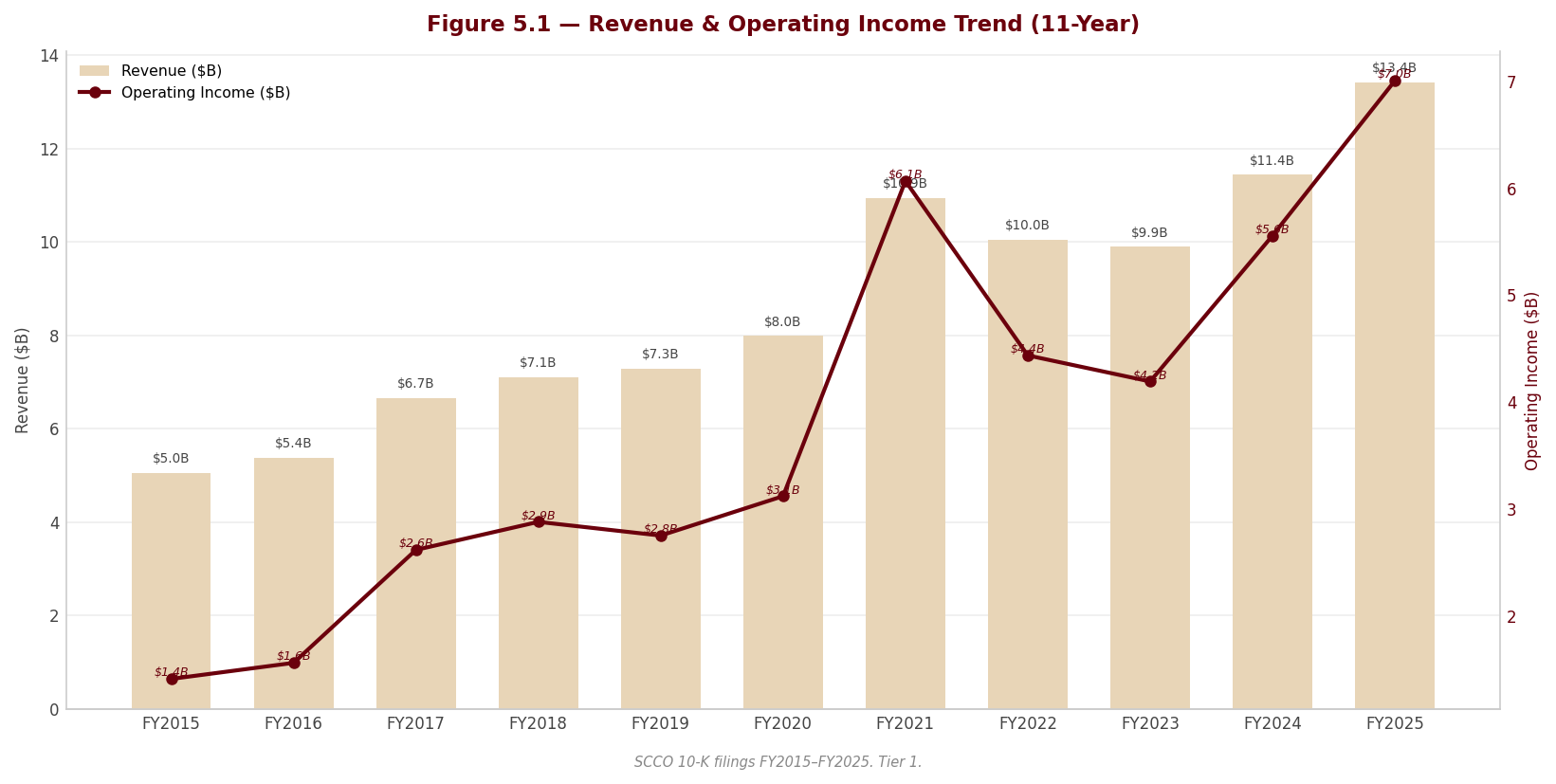
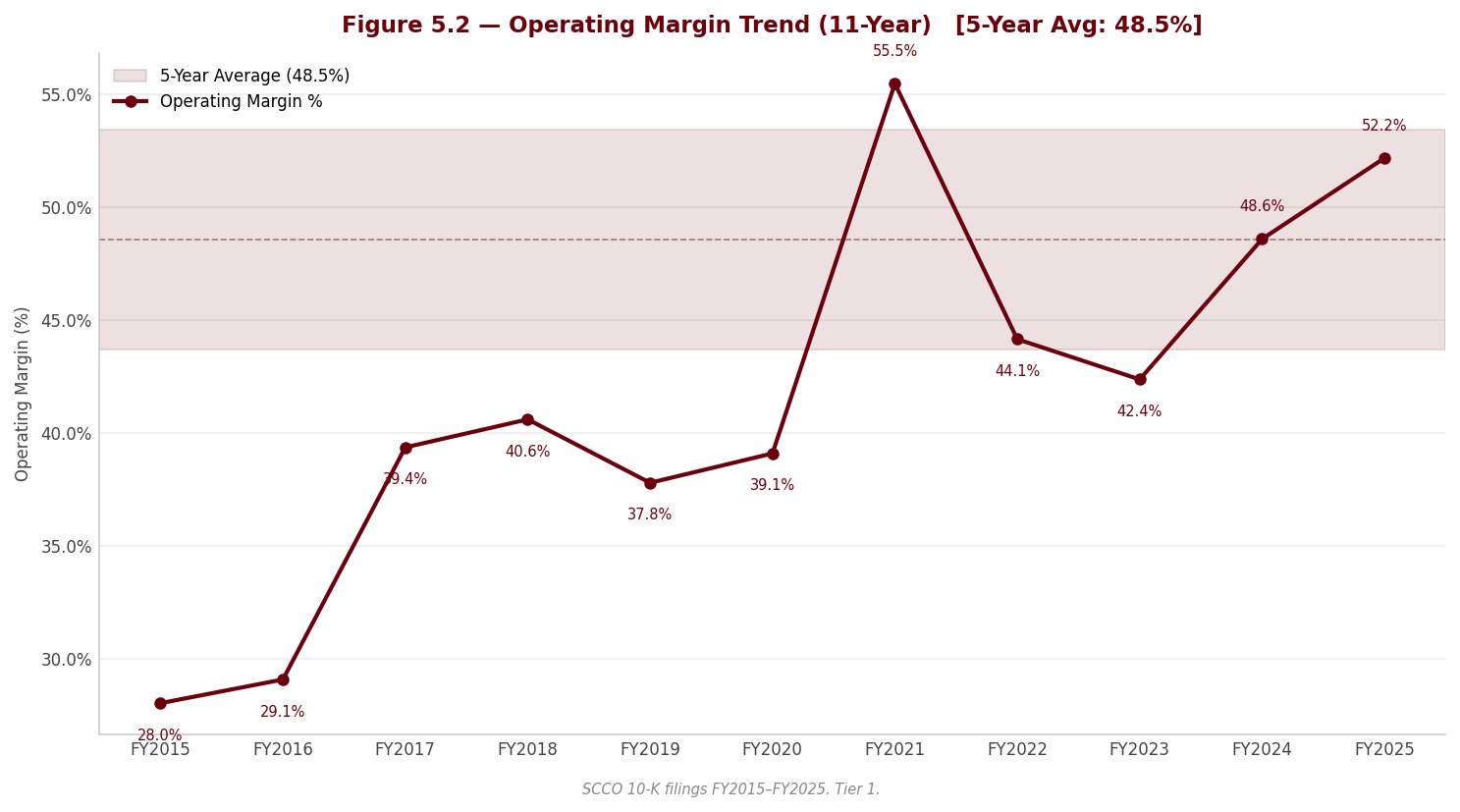
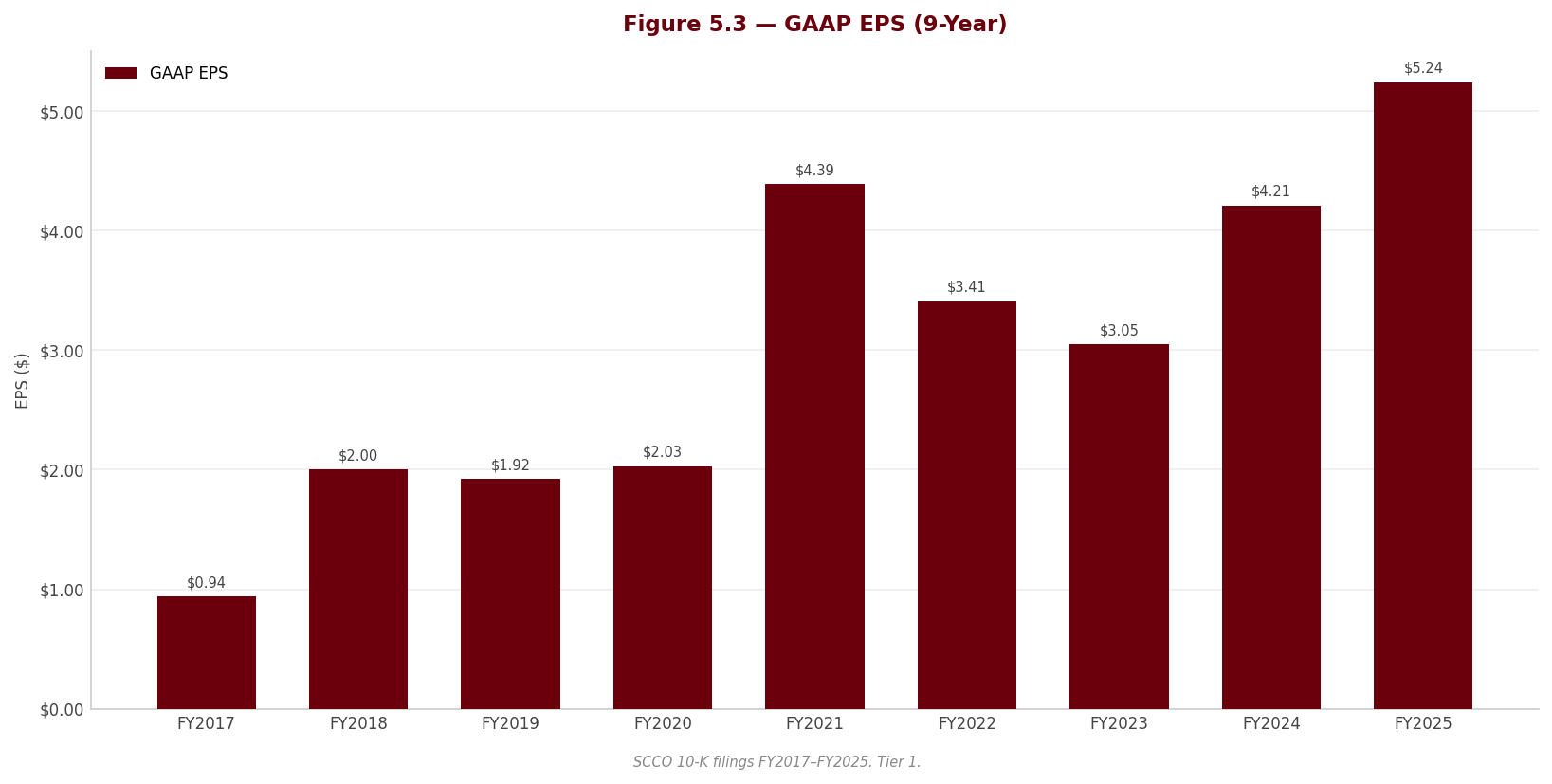
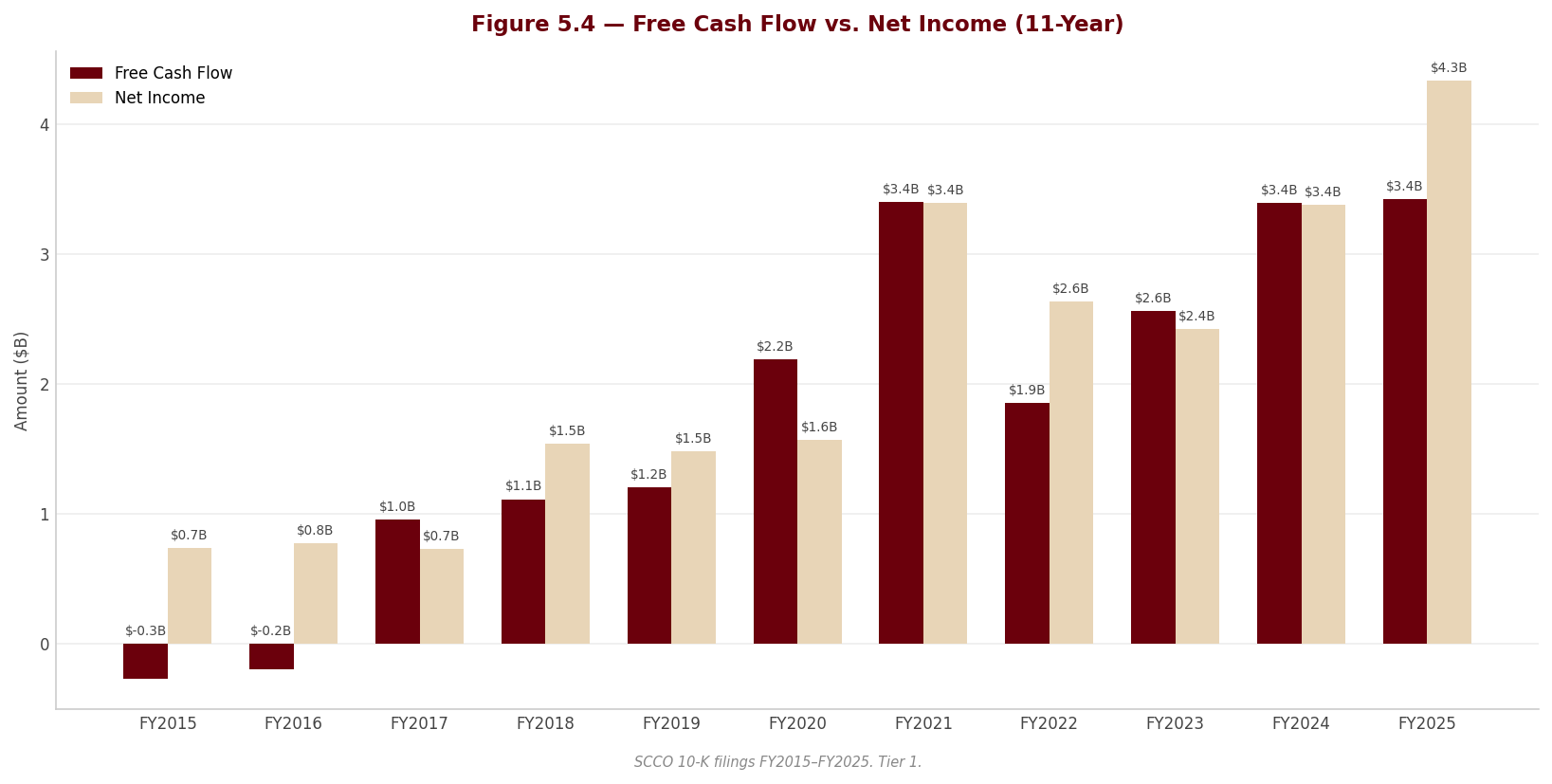
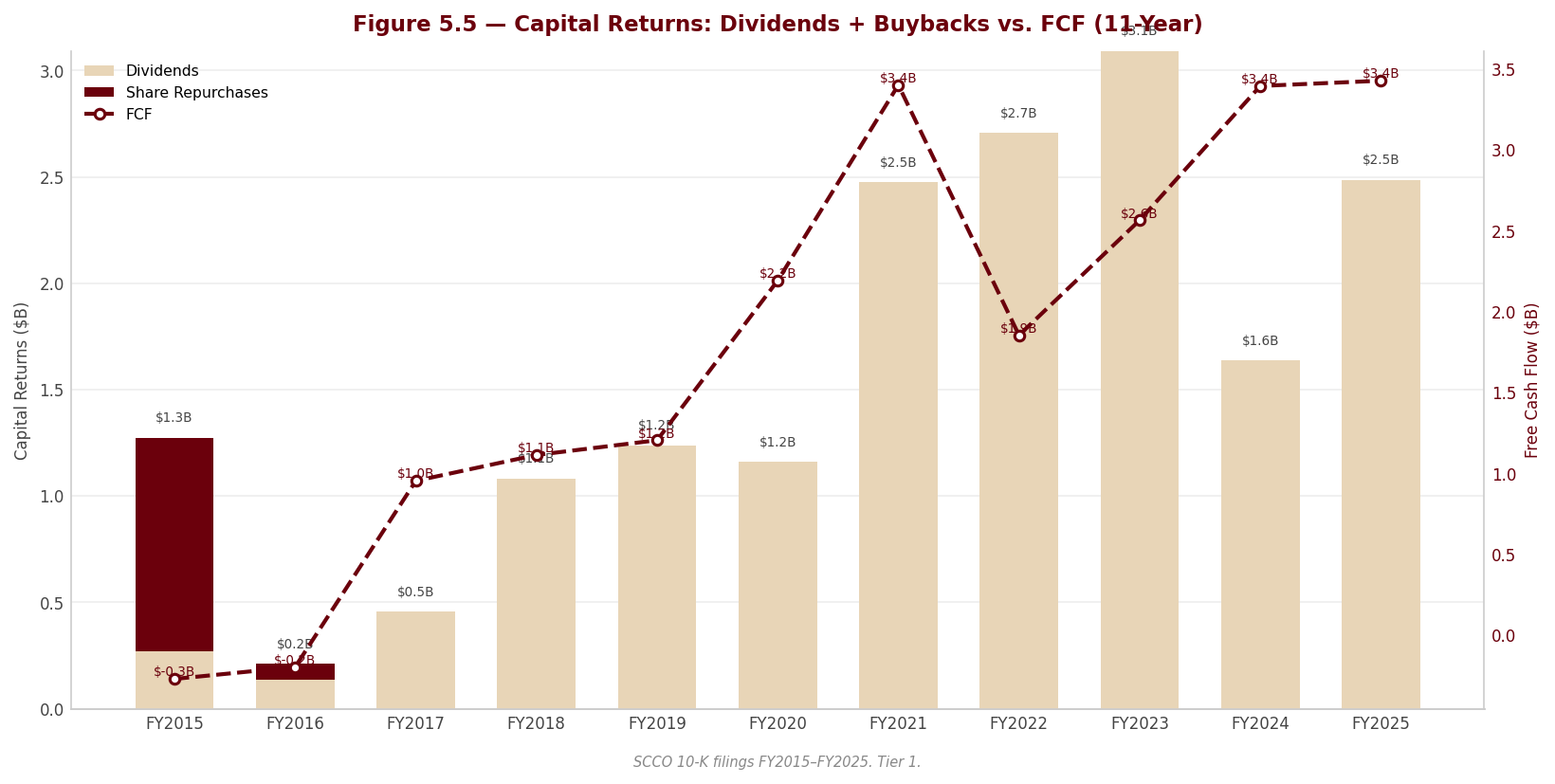
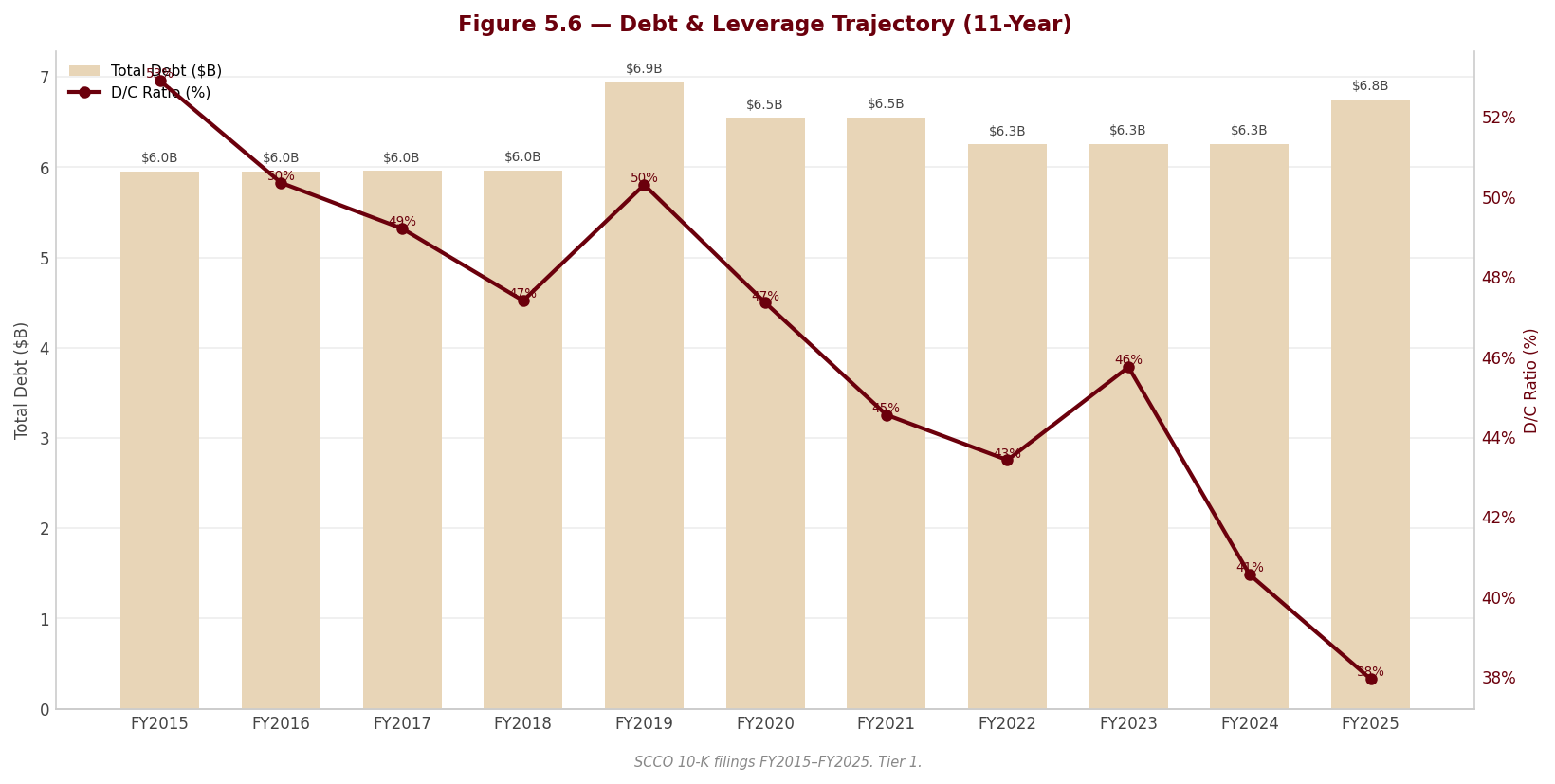
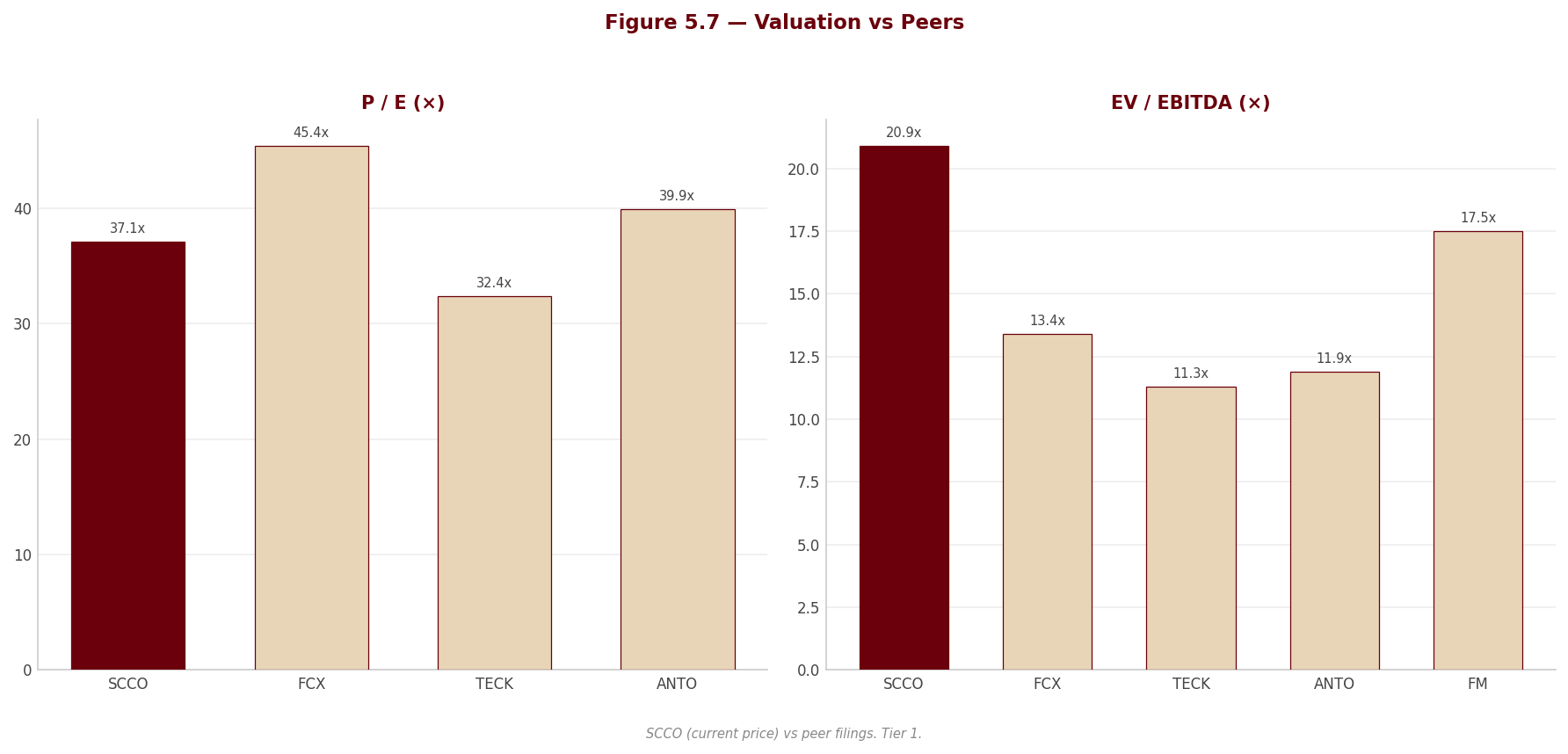
6. Valuation & Price Target withdrawn
This section stated what the shares were worth and what to do about them. It rested on an exit multiple set by hand — across the coverage it averaged 24% below where each company actually traded — so the conclusion largely restated that assumption instead of testing it. Rather than leave it standing, it has been withdrawn while the method is rebuilt.
Nothing else in this report depends on it: the financial analysis above and below is drawn from the company's own filings, and every figure links to the page it was verified against.
Section 7 — Quarterly Update: Q2 2026
Portfolio Action
sources [Rating and price target withdrawn — see the note at the top.]
| Assessment | |
|---|---|
| Action | [Rating and price target withdrawn — see the note at the top.] |
| Reason | [Rating and price target withdrawn — see the note at the top.] |
| Thesis intact? | YES — and evidenced twice over. Operating cash cost net of by-products collapsed to $0.05/lb from $0.63 only because by-product revenue rose to $1,106.2M from $755.9M (10-Q p. 44); on last year’s by-product revenue the same quarter’s cash cost would have been $0.76/lb. Nothing structural improved: Toquepala production fell 14.7% and Cuajone 7.8% on lower ore grades (10-Q p. 42). |
| Trigger to revisit | The 10-Q’s own sensitivity: a $0.10/lb change in copper moves net earnings by $59.6M over the remaining six months of 2026 (10-Q p. 45). [Rating and price target withdrawn — see the note at the top.] Conversely a fall to the ~$4.00/lb mid-cycle level would, on the filing’s own arithmetic, remove roughly $608M of quarterly net income at constant volumes. |
Source: Form 10-Q for the quarterly period ended 30 June 2026 (filed 31 July 2026); rating, target price and conviction from the FL valuation model (Valuation sheet, rows 173–175) — see Appendix A.1–A.2.
7.1 Results at a Glance
| Metric | Q2 2026 | Q2 2025 | YoY Δ | Q1 2026 | QoQ Δ |
|---|---|---|---|---|---|
| Revenue ($M) | $4,289.0M | $3,051.0M | +40.6% | $4,251.4M | +0.9% |
| Gross Profit ($M) ᵃ | $2,899.5M | $1,839.3M | +57.6% | $2,752.6M | +5.3% |
| Gross Margin | 67.6% | 60.3% | +7.3 pp | 64.7% | +2.9 pp |
| EBITDA ($M) | $2,849.2M | $1,793.2M | +58.9% | $2,706.1M | +5.3% |
| EBITDA Margin | 66.4% | 58.8% | +7.7 pp | 63.7% | +2.8 pp |
| EBIT ($M) | $2,623.2M | $1,587.0M | +65.3% | $2,480.4M | +5.8% |
| EBIT Margin | 61.2% | 52.0% | +9.1 pp | 58.3% | +2.8 pp |
| Net Income ($M) ᵇ | $1,670.0M | $973.4M | +71.6% | $1,576.9M | +5.9% |
| Net Margin | 38.9% | 31.9% | +7.0 pp | 37.1% | +1.8 pp |
| Diluted EPS ᶜ | $2.01 | $1.21 | +66.1% | $1.92 | +4.7% |
YoY Δ is computed as (CQ - PYSQ) / |PYSQ| × 100 — revenue: (4,289.0 - 3,051.0) / 3,051.0 × 100 = +40.6%. QoQ Δ is computed as (CQ - PQ) / |PQ| × 100 — revenue: (4,289.0 - 4,251.4) / 4,251.4 × 100 = +0.9%. Margins are computed as metric / revenue × 100 — gross margin CQ: 2,899.5 / 4,289.0 × 100 = 67.6%; EBITDA margin CQ: 2,849.2 / 4,289.0 × 100 = 66.4%; EBIT margin CQ: 2,623.2 / 4,289.0 × 100 = 61.2%; net margin CQ: 1,670.0 / 4,289.0 × 100 = 38.9%. Margin deltas are in percentage points (CQ margin - comparator margin).
ᵃ Southern Copper does not present a gross-profit line, and its cost of sales is stated exclusive of depreciation, amortisation and depletion, which is reported on a separate line (10-Q p. 3). Gross profit here is net sales less that exclusive cost of sales ($1,389.5M in Q2 2026), so the 67.6% gross margin is a pre-depreciation figure and is not comparable to a conventional gross margin. EBIT of $2,623.2M equals the reported operating income after D&A of $226.0M, SG&A of $35.3M and exploration of $14.9M. There is no goodwill on the balance sheet and therefore no impairment line in any period (10-Q p. 5).
ᵇ Net income is net income attributable to SCC. Consolidated net income was $1,674.6M, of which $4.6M is attributable to the non-controlling interest (10-Q p. 3).
ᶜ The Q2 2025 EPS of $1.21 is as originally reported. This 10-Q restates the prior-year comparative to $1.17 because earnings per share are retroactively adjusted for the stock dividends paid on 4 September 2025, 28 November 2025, 27 February 2026 and 29 May 2026 (10-Q p. 40). On the filing’s own restated basis EPS rose +71.6%, identical to net income, because the weighted average share count is 829.1M in both quarters. The +66.1% shown above is the arithmetically correct comparison of the two as-reported figures and understates the like-for-like growth by 5.5 pp.
Source: Form 10-Q for the quarterly period ended 30 June 2026 — Condensed Consolidated Statements of Earnings (10-Q p. 3); Q1 2026 column from the FL workbook standalone quarterly series (Data sheet, col. 22).
Segment results — three reportable segments
| Segment | Revenue Q2 2026 ($M) | Revenue Q2 2025 ($M) | YoY Δ | Revenue Q1 2026 ($M) ᵈ | QoQ Δ | Op. Income Q2 2026 ($M) | Op. Income Q2 2025 ($M) | YoY Δ | Op. Margin Q2 2026 | Op. Margin Q2 2025 | Δ pp |
|---|---|---|---|---|---|---|---|---|---|---|---|
| Peruvian Operations | 1,584.4 | 1,178.2 | +34.5% | 1,581.4 | +0.2% | 935.9 | 583.1 | +60.5% | 59.1% | 49.5% | +9.6 pp |
| Mexican Open-pit | 2,511.9 | 1,754.8 | +43.1% | 2,443.6 | +2.8% | 1,610.7 | 988.9 | +62.9% | 64.1% | 56.4% | +7.8 pp |
| IMMSA (Mexican underground) | 267.9 | 179.3 | +49.4% | 318.6 | -15.9% | 88.0 | 17.8 | +394.4% | 32.8% | 9.9% | +22.9 pp |
| Corporate, other & eliminations | (75.4) | (61.3) | +23.0% ᵉ | (91.9) | -17.9% ᵉ | (11.4) | (2.8) | +307.1% ᵉ | — | — | — |
| Total | $4,289.0M | $3,051.0M | +40.6% | $4,251.4M | +0.9% | $2,623.2M | $1,587.0M | +65.3% | 61.2% | 52.0% | +9.1 pp |
ᵈ Note 14 presents segment results for the three- and six-month periods only; the Q1 2026 column is the six-month figure less the three-month figure (Peruvian $3,165.8M - $1,584.4M = $1,581.4M; Mexican Open-pit $4,955.5M - $2,511.9M = $2,443.6M; IMMSA $586.5M - $267.9M = $318.6M). The derived segment revenues net of the derived $91.9M elimination sum to $4,251.7M against $4,251.4M, and the derived operating incomes sum to $2,480.3M against $2,480.4M — both differences are rounding in the filing’s own segment tables, which likewise sum to $4,364.2M against a stated segment total of $4,364.3M.
ᵉ Corporate is a net cost and eliminations a net deduction; both are shown in parentheses, so a positive Δ means a larger deduction, not an improvement.
Source: Form 10-Q for the quarterly period ended 30 June 2026 — Note 14, Segment and Related Information (10-Q pp. 37–39), and Segment Result Analysis (10-Q pp. 55–58).
Mexican Open-pit produced 60.0% of the $1,036.2M operating-income increase ($621.8M) and Peruvian Operations 34.0% ($352.8M). IMMSA’s 22.9 pp margin jump is real but small in dollars ($70.2M) and did not repeat sequentially — its revenue fell 15.9% and operating income 37.5% QoQ. Segment total assets show where the capital is going: Peruvian Operations rose to $7,198.4M from $5,260.0M (+36.9%) while Mexican Open-pit rose only to $9,287.6M from $9,072.7M (+2.4%), and quarterly capital investment in Peru was $246.9M against $61.9M a year ago (+298.9%) — the Tia Maria build (10-Q pp. 38–39). §
7.2 P&L Drivers
sources Revenue: Every dollar of the $1,237.9M revenue increase came from price, and volume worked against it. Realised market prices rose across the board — LME copper $6.04/lb from $4.32 (+39.8%), COMEX copper $6.16 from $4.72 (+30.5%), molybdenum $29.44/lb from $20.57 (+43.1%), silver $73.49/oz from $33.62 (+118.6%) and zinc +30.8% — while sales volumes fell for all four metals: copper -1.5% (486.6 million lb from 494.0), molybdenum -13.1%, silver -8.7% and zinc -8.8% (10-Q pp. 41, 46, 50). Mined copper production fell 3.5% to 508.5 million lb, driven by Toquepala -14.7% “due to a decrease in ore grades and mineral milled” and Cuajone -7.8% “due to lower ore grades”, partly offset by Buenavista +2.9% and La Caridad +3.9% on SX-EW output and recoveries (10-Q p. 42). Copper was 72.7% of sales against 74.1%, with silver rising to 8.8% from 6.6% — the mix shifted toward the by-product whose price nearly tripled (10-Q p. 50). Sales mix also moved toward higher-value forms: refined copper (including SX-EW) was 55.5% of copper volume against 47.4%, concentrates 26.6% against 35.1% (10-Q p. 51).
Cost and margin: COGS of $1,389.5M in Q2 2026 against $1,211.7M in Q2 2025 rose 14.7% on a 40.6% larger revenue base, and total operating costs and expenses rose 13.8% to $1,665.8M — the entire 9.1 pp of EBIT-margin expansion is operating leverage on price, not cost control. D&A of $226.0M against $206.2M rose 9.6%, so EBITDA margin expanded slightly less (+7.7 pp) than EBIT margin. On a unit basis costs deteriorated: cost of sales was $2.82 per pound of copper produced against $2.37, and operating cash cost before by-product revenues rose 8.3% to $2.29/lb from $2.11, “primarily attributable to the unit cost effect of lower copper production (-3.4%) and higher production costs (+4.7%)” — fuel rose to 18.0% of the production-cost mix from 14.4% and operating materials to 24.9% from 18.8% (10-Q pp. 44, 52). The headline $0.05/lb cash cost net of by-products, down from $0.63, is entirely a by-product-price artefact: by-product revenue of $1,106.2M against $755.9M covered 98.0% of the $1,128.5M cash cost, and at last year’s by-product revenue the same quarter would have shown $0.76/lb (10-Q pp. 44, 62). [Rating and price target withdrawn — see the note at the top.]
Below the line: Interest expense of $105.6M was identical to $105.6M in Q2 2025, but capitalised interest rose to $17.6M from $11.6M and interest income to $57.5M from $53.1M on higher cash balances, while other income swung to $6.8M from $(2.3)M and equity earnings of the Coimolache affiliate rose to $20.5M from $8.8M (+134.3%) — together a $19.3M reduction in net non-operating expense to $(23.8)M (10-Q pp. 3, 53). [Rating and price target withdrawn — see the note at the top.] Diluted EPS of $2.01 rose $0.80 (+66.1%) against the as-reported $1.21, or $0.84 (+71.6%) against the filing’s restated $1.17 — there is no buyback or dilution effect in either comparison because the weighted average share count is 829.1M in both quarters (10-Q p. 40).
7.3 Balance Sheet & Cash Flow
| Metric | Q2 2026 | Q2 2025 | YoY Δ | Q1 2026 | QoQ Δ |
|---|---|---|---|---|---|
| Cash ($M) | $5,665.0M | $3,334.9M | +69.9% | $4,915.4M | +15.3% |
| Net Debt ($M) ᶠ | $2,329.4M | $3,413.3M | -31.8% | $1,836.5M | +26.8% |
| Net Debt / LTM EBITDA | 0.24× | — | — | — | — |
| Total Assets ($M) | $24,127.7M | $19,554.7M | +23.4% | $21,929.9M | +10.0% |
| Equity ($M) | $12,632.2M | $9,984.8M | +26.5% | $11,787.6M | +7.2% |
| OCF ($M) | $1,988.5M | $976.8M | +103.6% | $1,694.5M | +17.3% |
| CapEx ($M) ᵍ | $422.8M | $235.7M | +79.4% | $441.9M | -4.3% |
| FCF ($M) | $1,565.7M | $741.1M | +111.3% | $1,252.6M | +25.0% |
| Dividends Paid ($M) ᵍ | $826.2M | $557.4M | +48.2% | $819.2M | +0.9% |
YoY and QoQ percentages use the same formulas as 7.1 — net debt YoY: (2,329.4 - 3,413.3) / |3,413.3| × 100 = -31.8%; net debt QoQ: (2,329.4 - 1,836.5) / |1,836.5| × 100 = +26.8%.
ᶠ Net debt is long-term debt of $7,994.4M less cash and cash equivalents of $5,665.0M (10-Q p. 5). It excludes the $1,664.9M of short-term investments — trading securities in publicly traded corporate bonds that management “had the intention to sell in the short-term” (10-Q p. 8). Including them, net debt at 30 June 2026 would be $664.5M, and the QoQ increase would be a decrease. There is no short-term debt line on the balance sheet in either period. §
ᵍ CapEx and dividends are stored as positive magnitudes in the workbook and shown as such here; both are cash outflows. A positive Δ therefore means a larger outflow.
Net Debt / LTM EBITDA: LTM EBITDA = Q3 2025 $1,976.5M + Q4 2025 $2,341.1M + Q1 2026 $2,706.1M + Q2 2026 $2,849.2M = $9,872.9M (the two 2025 quarters are taken from the workbook’s standalone quarterly series, Data sheet row 20, cols 20–21, because the section-7 data pack carries only the CQ/PYSQ/PQ columns). Net Debt $2,329.4M / $9,872.9M = 0.24×. Note that the denominator is itself a peak-cycle number: the same calculation on the four quarters ending Q2 2025 (EBITDA of $1,663.4M + $1,521.6M + $1,759.3M + $1,793.2M = $6,737.5M) gives 0.51× on that period’s net debt.
Source: Form 10-Q for the quarterly period ended 30 June 2026 — Condensed Consolidated Balance Sheets (10-Q p. 5) and Condensed Consolidated Statements of Cash Flows, three-month columns (10-Q p. 6).
Balance sheet note: The material change is a $1,250M debt raise into a quarter of record cash generation. On 24 June 2026 the Company issued $1,250M of 5.350% senior unsecured notes due 2036 for the exclusive benefit of its Peruvian branch, lifting long-term debt to $7,994.4M from $6,750.7M at 31 December 2025, and the proceeds were parked rather than spent — short-term investments rose to $1,664.9M from $604.6M, a $1,060.3M net purchase over six months of which $1,230.8M fell in this quarter (10-Q pp. 5, 6, 8, 14). That is why cash rose $749.6M while net debt as defined rose 26.8% QoQ. Elsewhere the balance sheet is quiet: inventories flat at $1,060.9M against $1,058.1M, long-term leach stockpiles down to $1,064.9M from $1,114.5M, accrued workers’ participation down to $279.4M from $404.6M on payment of the 2025 provision, and PP&E of $10,662.0M against $10,272.2M at year-end. Retained earnings fell to $4,588.1M from $5,797.2M despite $3,246.8M of six-month earnings — the mechanism is the $2,801.1M of stock dividends charged to retained earnings, an intra-equity transfer to additional paid-in capital and treasury stock, not a cash outflow; SCC stockholders’ equity rose to $12,632.2M, and total equity including the non-controlling interest to $12,708.6M (10-Q p. 7).
Cash flow note: FCF conversion = FCF / Net Income = $1,565.7M / $1,670.0M × 100 = 93.8%, with operating cash flow at 119.1% of net income. Cash tracked earnings closely and working capital was a modest source of $31.9M in the quarter — trade receivables released $20.6M and payables and accrued liabilities added $107.7M, against a $50.6M inventory build and $45.8M of other operating items (10-Q p. 6). This is a materially cleaner conversion than the prior-year quarter, where OCF of $976.8M was 100.4% of net income only after a $121.2M payables outflow; the six-month picture is starker still, with working capital costing $24.2M in 2026 against $742.7M in 2025 (10-Q p. 59). The gap between OCF and FCF is capital expenditure of $422.8M, up 79.4% YoY, of which $246.9M was Peruvian — $238.5M of the six-month total went to Tia Maria (10-Q p. 60).
7.4 Footnote Review
sources Page references are the printed page numbers of the Form 10-Q for the quarterly period ended 30 June 2026, filed 31 July 2026. All sixteen notes were read in full in this session, together with Items 2, 3 and 4 and Part II Items 1 through 6.
Note 1 — Description of the Business (10-Q p. 8) Southern Copper is a majority-owned indirect subsidiary of Grupo Mexico, which through Americas Mining Corporation owned 88.9% of the capital stock at 30 June 2026. Accounting policies are stated to be the same as those in the 2025 Form 10-K, and the interim adjustments are “consisting only of normal recurring adjustments”. Confirmed unchanged vs. Q2 2025 in substance (10-Q p. 8), with one caution the note itself states: “The results of operations for the six months ended June 30, 2026 are not necessarily indicative of the results to be expected for the full year.” The 88.9% control level is the governance fact that makes Note 5 the most important disclosure in this filing.
Note 2 — Short-term Investments (10-Q pp. 8–9) Trading securities rose to $1,664.9M from $604.5M at 31 December 2025 (+175.4%), with available-for-sale of $0.1M unchanged. [Rating and price target withdrawn — see the note at the top.] Changed materially vs. year-end: the portfolio nearly tripled and is the destination of the June bond proceeds. Analytically this is the reason the net-debt figure in 7.3 overstates the leverage — the Company is holding $1.66bn of publicly traded corporate bonds it intends to sell short-term while carrying $7,994.4M of its own debt at an average cost that the new tranche prices at 5.350%.
Note 3 — Inventories (10-Q p. 9) Total current inventory $1,060.9M against $1,058.1M at year-end (finished goods $61.4M, work-in-process $330.9M, leach-pad stockpiles $248.9M, supplies $419.7M); long-term ore stockpiles on leach pads $1,064.9M against $1,114.5M. Changed in a direction that supports earnings quality: leaching costs capitalised as non-current inventory were $100.2M for the six months against $128.2M, while leaching inventory recognised in cost of sales was $139.6M against $113.6M. The Company capitalised $39.4M less than it expensed this year, against a $14.6M net capitalisation last year — a $54.0M swing against reported margin. This quarter’s record margin is not being manufactured by deferring leach costs onto the balance sheet.
Note 4 — Income Taxes (10-Q pp. 9–10) [Rating and price target withdrawn — see the note at the top.] The composition matters: statutory income tax $1,505.1M against $930.0M, Peruvian royalty $69.7M against $33.3M, Mexican royalty $175.2M against $94.7M and the Peruvian special mining tax $86.3M against $50.7M — royalties and the mining tax total $331.2M against $178.7M, +85.3%, growing faster than pre-tax income (+66.9%) because they are levied on sales and operating margin. On uncertain tax positions: “In the second quarter of 2026, the Company made no payments for uncertain tax positions”, but the Peruvian current and non-current liabilities “increased the tax expense by approximately $15.4 million”, and there is a net current liability of $24.7M in Peru representing refunds or payments due within twelve months. The OBBBA (signed 4 July 2025) “did not materially affect the Company’s financial statements”, and Pillar Two has not been enacted in the jurisdictions where the Company has significant operations. Changed vs. [Rating and price target withdrawn — see the note at the top.]
Note 5 — Related Party Transactions (10-Q pp. 10–14) — see the dedicated entry below, which documents every transaction with dollar amounts.
Note 6 — Financing (10-Q p. 14) [Rating and price target withdrawn — see the note at the top.] The notes were issued with a $2.5M discount and $6.3M of deferred issuance costs, both amortised as interest expense. The Seventh Supplemental Indenture (dated 24 June 2026, under the April 2010 Indenture) contains covenants limiting liens securing indebtedness, sale-and-leaseback transactions, and consolidations, mergers, conveyances, transfers or leases of substantially all assets. There is no financial maintenance covenant and no leverage or coverage ratio disclosed anywhere in the filing — so no covenant headroom can be computed from this document; the constraints are incurrence-style only. Moody’s assigned Baa1 and Fitch and S&P BBB+ to the new notes in June 2026. Changed vs. Q2 2025 decisively: the prior-year six months saw $500.0M of debt repaid and $993.8M issued; this six months saw no repayments and $1,247.5M of net proceeds. [Rating and price target withdrawn — see the note at the top.]
Note 7 — Leases (10-Q pp. 14–15) Operating leases for power generating facilities, vehicles and properties; remaining terms under one year to seven years, no extension or purchase options, no material residual value guarantees and no material restrictive covenants. [Rating and price target withdrawn — see the note at the top.] Six-month lease expense $57.5M against $57.7M — effectively flat. Total undiscounted lease payments $732.5M less $102.4M of interest gives a $630.1M present value, reconciling to the $95.6M current and $534.4M non-current lease liabilities on the balance sheet. Confirmed substantively unchanged vs. Q2 2025 (10-Q pp. 14–15); immaterial to the thesis at 5.0% of total debt.
Note 8 — Asset Retirement Obligation (10-Q pp. 15–16) The obligation rose to $490.7M at 30 June 2026 from $471.1M at 1 January, via a $9.2M increase in estimates (the Q1 2026 Toquepala update, which also raised the retirement asset $6.0M and put the $3.2M difference into cost of goods sold), $2.4M of closure payments and $12.8M of accretion. The prior-year six months moved the other way — a $48.5M reduction in estimates. Two larger historical revisions are restated: a December 2025 update that cut the obligation $5.7M and credited $3.1M to cost of goods sold, and a 2025 Mexican revision that cut the obligation $106.7M and credited $57.9M to cost of goods sold. Peruvian guarantees total $110.3M through January 2026 (26% secured by the Lima office complex, 74% by standby letter of credit), and Peruvian Law 31347 now requires additional progressive-closure guarantees with a three-year period to update the guarantee table. Changed vs. Q2 2025 in a way that strengthens the read on margin quality: last year’s comparative benefited from ARO releases credited to cost of sales; this year carries a $3.2M charge instead. The record margin is not being flattered by closure-estimate revisions — if anything the comparative base was.
Note 9 — Benefit Plans (10-Q pp. 16–17) Six-month net periodic pension benefit of $(1.6)M against $(0.3)M (service cost $1.6M, interest $2.0M, expected return $(4.7)M) and post-retirement health care cost of $1.2M against $1.0M. The Expatriate Plan termination authorised in July 2025 and effective 1 December 2025 was settled by annuity purchase and completed on 30 April 2026 with no material impact. Amounts are immaterial — under 0.1% of operating income — and confirmed as such vs. Q2 2025 (10-Q pp. 16–17). No pension geography issue distorts operating income in either period.
Note 10 — Commitments and Contingencies (10-Q pp. 17–27) — litigation is broken out in the dedicated entry below. Non-litigation content: six-month environmental capital investment of $138.1M against $91.1M (+51.6%), of which Mexican operations $133.5M against $84.2M. Michiquillay: $375.0M of the $400M purchase price remains unpaid and is “not a present obligation” pending a development decision; in April 2025 the Company paid $21.0M cash to extend the preoperational period by three years and deferred the $375.0M payment term by three years, committing a further $15M of social investment in years four to six. Peruvian social commitments: S/445.0M (~$130.4M) committed in Tacna, of which a $29.9M liability is recorded as other liabilities; S/1,000M (~$293.0M) offered to a Moquegua development fund with S/258.9M (~$75.9M) already committed; a further S/279.0M (~$81.7M), S/122.7M (~$36.0M), S/308.7M (~$90.4M) and S/0.7M (~$0.2M) allocated in Moquegua, Apurimac, Arequipa and Cajamarca under the “Works for Taxes” programme. Sonora solidarity contribution: the Board approved up to MXN 1.5bn (~$87M) in January 2026, of which MXN 500M (~$29M) was paid to the Mexican Institute of Social Security on 9 February 2026, and $28.7M was charged to six-month cost of sales. Capital commitments of $1,634.7M at 30 June 2026. New this quarter: a May 2026 200MW power purchase agreement with Orygen Perú running 2027–2037, “projected to reduce power costs for the Peruvian operations by approximately 22%” (10-Q p. 61). Changed vs. Q2 2025: the discretionary social and environmental outflow is rising with the copper price — the Sonora contribution alone is a new $87M commitment that did not exist a year ago, and it lands in cost of sales, not below the line.
Note 11 — Stockholders’ Equity (10-Q pp. 28–31) Two stock dividends were paid in the six months: 0.0085 shares per share on 27 February 2026 at an average market price of $179.93 (6,961,959 shares, $1,079.9M to additional paid-in capital, $172.8M effect in treasury stock) and 0.0100 shares per share on 29 May 2026 at $187.45 (8,260,265 shares, $1,343.4M and $205.0M) — 15,222,224 shares and $2,423.3M in total. Treasury stock fell to 50,267,580 shares from 65,497,804 at year-end as those shares were reissued. Directors’ Stock Award Plan expense was $1.5M for the six months against $0.6M; the 2018 employee plan $0.3M against $0.3M; the 2025 employee plan $0.3M against nil, with $3.8M unrecognised. Non-controlling interest rose to $76.4M from $66.8M with no NCI dividend paid in 2026 against $4.4M in 2025. Changed vs. Q2 2025 and it is the governance point of the quarter: the stock dividend is 133.8% larger per share year on year ($1.87 of equivalent value against $0.80, 10-Q p. 41). It is a non-cash intra-equity transfer that dilutes nothing on a per-holder basis — every holder receives pro rata — but it is charged against retained earnings, and it is the sole reason retained earnings fell $1,209.1M over six months against $3,246.8M of earnings.
Note 12 — Fair Value Measurement (10-Q pp. 31–33) [Rating and price target withdrawn — see the note at the top.] Recurring fair-value assets total $3,301.4M, of which trading securities $1,664.9M and provisionally priced sales embedded derivatives — copper $1,112.9M, molybdenum $442.6M, zinc $81.0M — all Level 1 except $0.1M of mortgage-backed securities. [Rating and price target withdrawn — see the note at the top.] The provisionally priced receivables at $1,636.5M are 6.8% of total assets and are marked to forward metal prices every period — a direct transmission channel from the copper price to reported revenue with no volume or cost involved.
Note 13 — Revenue (10-Q pp. 34–37) Geographic disaggregation for the quarter: Mexico $1,141.2M, United States $579.4M, Switzerland $433.4M, Peru $340.9M, Japan $333.5M, China $314.7M, Spain $251.5M, Brazil $190.7M, Chile $174.5M, Italy $161.4M, other European $294.7M, other Asian $38.5M, other American $30.3M and Singapore $4.3M. Product mix: copper $3,116.8M, molybdenum $475.8M, silver $375.8M, zinc $152.2M, other $168.3M. Long-term contracts promise delivery in 2026 of 167,100 tonnes of copper in concentrates, 70,200 tonnes of cathodes, 20,878 tonnes of molybdenum concentrates and 362,103 tonnes of sulphuric acid. The thesis-critical disclosure is the open provisional book: at 30 June 2026 the Company held 188.7 million lb of copper priced at $6.07/lb settling July–December 2026, 14.1 million lb of molybdenum at $31.38 and 49.9 million lb of zinc at $1.62, and the provisional pricing adjustment already included in accounts receivable and in reported net sales was a positive $13.1M for copper, $50.1M for molybdenum and $2.9M for zinc — $66.1M, or 1.5% of the quarter’s revenue, that is a mark-to-market on unsettled tonnes rather than cash received. Every cent of copper below $6.07/lb between July and December reverses against that book. Changed vs. year-end: the copper embedded derivative fell to $1,112.9M from $1,297.5M while molybdenum rose to $442.6M from $383.8M.
Note 14 — Segment and Related Information (10-Q pp. 37–39) Three reportable segments — Peruvian operations, Mexican open-pit and IMMSA — unchanged in composition and measurement basis vs. Q2 2025, with the CODM (the Chief Executive Officer) focused on operating income and total assets. Confirmed unchanged (10-Q p. 37), so the year-on-year segment comparison in 7.1 is clean. Beyond the table in 7.1: quarterly capital investment was Peru $246.9M, Mexican open-pit $137.4M, IMMSA $37.0M and corporate $1.5M against $61.9M / $148.6M / $23.9M / $1.2M — Peru’s share of group capex rose to 58.4% from 26.3%. Corporate and other assets rose to $6,035.1M from $3,977.3M, which is the cash and short-term investment build.
Note 15 — Earnings per Share (10-Q p. 40) Weighted average common shares outstanding, basic and diluted, 829.1M for the quarter in both years and 825.4M for the six months in both years; there is no dilutive instrument reconciliation because basic and diluted are identical. EPS $2.01 against $1.17 for the quarter and $3.93 against $2.33 for the six months. The note states explicitly that “Earnings per share have been adjusted retroactively to reflect these changes in capital structure” for the four stock dividends paid on 4 September 2025 (0.0101), 28 November 2025 (0.0085), 27 February 2026 (0.0085) and 29 May 2026 (0.0100). Changed vs. Q2 2025 as originally reported: the restatement is the source of the $1.21 versus $1.17 discrepancy explained in footnote ᶜ. Analytically neutral — it changes the denominator identically in both periods — but it must be stated, because an unadjusted comparison of $2.01 to $1.21 understates growth by 5.5 pp.
Note 16 — Subsequent Events (10-Q p. 40) — see the dedicated entry below.
Related-party transactions (10-Q pp. 10–14) Grupo Mexico owns 88.9% through Americas Mining Corporation (10-Q p. 8), and the related-party note is the largest single disclosure in this filing. The governance framework is unchanged and is reproduced in full in the note: Article Nine of the Amended and Restated Certificate of Incorporation prohibits a Material Affiliate Transaction — defined as one exceeding $10.0 million in aggregate consideration — without prior review by a committee of at least three independent directors, and transactions between $8.0 million and $10.0 million require authorisation by the General Counsel and Chief Financial Officer. Confirmed unchanged vs. Q2 2025 (10-Q p. 10).
The filing discloses purchase and sale activity for the six-month periods only — there is no standalone-quarter related-party table — so the comparison below is six months 2026 against six months 2025, and balances are 30 June 2026 against 31 December 2025. Every disclosed line is listed.
| Grupo Mexico and affiliates — purchases ($M) | 6M 2026 | 6M 2025 | Δ |
|---|---|---|---|
| Mexico Generadora de Energia (MGE) — power | 80.9 | 109.8 | -26.3% |
| Ferrocarril Mexicano — rail freight | 23.6 | 21.3 | +10.8% |
| Parque Eolico de Fenicias — wind power | 22.7 | 20.3 | +11.8% |
| Mexico Compania Constructora — construction | 16.1 | 24.8 | -35.1% |
| Grupo Mexico Servicios — corporate services | 10.1 | 10.1 | 0.0% |
| Grupo Mexico Servicios de Ingenieria — engineering | 9.3 | 4.7 | +97.9% |
| AMMINCO — administrative services | 6.0 | 5.0 | +20.0% |
| Asarco LLC — cathodes, concentrate, starter sheets, freight | 3.0 | 28.0 | -89.3% |
| Eolica El Retiro — wind power | 0.3 | 1.0 | -70.0% |
| Total purchases | 171.9 | 225.0 | -23.6% |
| Grupo Mexico and affiliates — sales ($M) | 6M 2026 | 6M 2025 | Δ |
|---|---|---|---|
| Asarco LLC — starter sheets, lime, sulphuric acid, transport and admin fees | 24.6 | 27.4 | -10.2% |
| MGE — natural gas and services | (9.3) | 31.9 | -129.2% |
| AMMINCO — rental services | 0.1 | (*) | n/m |
| Ferrocarril Mexicano | (*) | — | n/m |
| Total sales | 15.5 | 59.3 | -73.9% |
| Larrea-family controlling-group companies ($M) | 6M 2026 | 6M 2025 |
|---|---|---|
| Purchases — Mextransport (aviation) | 1.3 | 1.2 |
| Purchases — Boutique Bowling de Mexico | 0.3 | 0.3 |
| Purchases — Operadora de Cinemas | 0.2 | 0.2 |
| Total purchases | 1.8 | 1.7 |
| Sales — Mextransport | 1.3 | 1.1 |
| Sales — Empresarios Industriales de Mexico (security services) | 0.4 | 0.2 |
| Sales — Boutique Bowling de Mexico | 0.1 | 0.1 |
| Sales — Operadora de Cinemas | 0.1 | 0.1 |
| Total sales | 1.8 | 1.5 |
Balances: related-party receivables fell to $10.9M from $16.2M (Asarco $7.6M against $7.1M, MGE $1.1M against $7.6M, Empresarios Industriales $1.9M against $1.5M, Mextransport $0.3M against nil, Operadora de Cinemas $0.1M against $0.1M), and related-party payables fell to $122.5M from $138.4M (MGE $44.7M against $30.2M, Asarco $38.9M against $61.1M, AMMINCO $10.1M against $15.9M, Mexico Compania Constructora $9.7M against $12.4M, Parque Eolico de Fenicias $8.4M against $7.5M, Ferrocarril Mexicano $4.4M against $4.0M, Grupo Mexico Servicios $2.3M against $3.3M, Grupo Mexico Servicios de Ingenieria $1.4M against $2.3M, Boutique Bowling $1.1M against $0.8M, Mextransport $0.5M against $0.4M, Operadora de Cinemas $0.5M against $0.3M). Before intersegment elimination the gross related-party receivable is $48.1M, of which $37.2M is eliminated (10-Q p. 36). §
Terms and three things that did change. (i) The MGE sales line turned negative: “In the second quarter of 2026, the price of natural gas sold to MGE experienced a significant decrease and turned negative due to market conditions, resulting in a net credit of $9.3 million” — a $41.2M swing from a $31.9M sale a year ago, and a related-party pricing outcome driven by a market price the Company does not set. (ii) MGE, the captive power supplier under a contract running to 2032, supplied approximately 18.3% of its power output to third-party energy users in the first six months of 2026 against 0.3% a year earlier — a sixty-fold reallocation of a Grupo Mexico affiliate’s output away from SCC and toward outside buyers, and the likely reason SCC’s power purchases from MGE fell 26.3% while power fell to 9.4% of the production-cost mix from 11.2%. No explanation is given in the note. (iii) Eolica El Retiro supplied 16.6% of output to IMMSA and Mexcobre against 11.7%, and Parque Eolico de Fenicias 98.0% to IMMSA against 85.5%. Total consideration flowing to Grupo Mexico affiliates fell 23.6% while SCC’s revenue rose 38.4% on a six-month basis, so related-party purchases fell to 2.0% of six-month revenue from 3.6% — the related-party channel got smaller relative to the business this period, which is the opposite of the direction the standing governance concern anticipates. Equity-method holdings are unchanged: 44.2% of Compañia Minera Coimolache (the Tantahuatay gold mine) and 30.0% of Apu Coropuna, where “the exploration results were not favorable” and the Company “is evaluating liquidating its participation”.
Contingencies and litigation (10-Q pp. 18–27, and Part II Item 1 at p. 67) 1. Peruvian labor shares (García Ataucuri and other former employees, filed 1996). Judgment-execution stage on a 1979-law claim to 10% of pre-tax profits distributed 40% cash / 60% equity. The Court has a registered lien over 10,501,857 investment shares held by the Peruvian Branch and Compañia Minera Los Tolmos, and Resolution No. 686 of 16 September 2025 ordered a transfer of ownership of 8,488,383 shares. This quarter’s development is favourable: on 11 February 2026 the Ninth Constitutional Court declared the Company’s amparo well-founded and voided Resolutions No. 505, No. 518 and No. 08; on 24 February 2026 it provisionally ordered the First Civil Court to refrain from any registration or transfer; and on 8 April 2026 Resolution No. 846 suspended implementation of Resolution No. 686 for as long as that order stands. The defendant has appealed and the case “was pending resolution” at 30 June 2026. The dispute turns on a conversion ratio the Company puts at 10,000,000 labor shares to one current investment share — a factor-of-ten-million disagreement on value. No amount is accrued and none is estimable. Changed favourably vs. the prior year, but not resolved. 2. Tia Maria — eight lawsuits. Seeking annulment of the Environmental Impact Assessment, cancellation of the project, annulment of the concession application and construction licence, and suspension of construction. Movement this quarter: the Torres Quispe case is closed in SPCC’s favour (Superior Court affirmed 24 April 2026); the Dean Valdivia case was dismissed on 19 May 2026 with the appeal deadline pending; and in the Gobierno Regional de Arequipa case the Superior Court affirmed dismissal on 5 May 2026, but the plaintiff filed an extraordinary appeal (recurso de casación) on 4 June 2026 and the file was forwarded to the Supreme Court on 16 June 2026. Mendoza Padilla, Guillen Lopez, Junta de Usuarios del Valle del Tambo, Meza Igme and Arocena Canazas remain pending. “The potential contingency amount for these cases cannot be reasonably estimated by management at this time.” This is the litigation attached to a project on which $1,101M is committed, $693M already invested and completion stands at 42% with start-up guided to the second half of 2027 (10-Q pp. 46–47). 3. Pasto Grande (filed 2012). Regional Government of Moquegua entity seeking demolition of the tailings dam serving Toquepala and Cuajone since 1995. Pending at 30 June 2026, no change disclosed this quarter, amount not estimable. 4. Buenavista 2014 spill. The PROFEPA criminal complaint dismissed in 2018 remains under appeal; the SEMARNAT criminal complaint of 12 October 2023 alleging incomplete remediation is open; three of six collective actions remain live; approximately 48 civil damages actions filed 2015–2024 against BVC in Sonora state courts are all pending; and several constitutional amparo actions continue, with SEMARNAT having completed the Supreme Court-ordered community consultation. “It is currently not possible to determine the extent of the damages sought.” Management believes none, individually or in aggregate, would be material. Stated as unchanged in stage vs. the prior period (10-Q p. 22). 5. Labor. 49.2% of the Company’s 5,643 Peruvian employees are unionised across six unions, with collective agreements expiring between 2027 and 2033 following the 2024–2025 extensions that cost approximately $62M and $6.3M in signing payments. In Mexico the San Martin and Taxco mines have been on strike since July 2007; the Taxco case remains with the Supreme Court “pending resolution without further developments”, and the Company concludes there is “a non-material impairment of the assets located at this mine”. Unchanged. 6. Michiquillay contingent consideration. $375.0M payable only on a development decision — “it is not a present obligation” — after a $21.0M cash payment in April 2025 to extend the preoperational period by three years. 7. Environmental compliance. The Company believes all facilities in Peru and Mexico are in material compliance; the Guaymas sulphuric acid terminal remains under a PROFEPA partial shutdown of acid storage and transport from the 2019 incident, with the Company stating it “has solved this issue and expects to restart operations in the future”. The May 2023 Mexican Mining Law amendments — concession terms cut from 50 to 30 years, new water-use restrictions, closure guarantees and a 5% contribution of net earnings to indigenous communities for new projects — are under Supreme Court review, and “the Company is not expecting any negative impacts on its operations”. Unchanged vs. Q2 2025 in substance, but this is the single largest unquantified jurisdictional exposure in the file and is exactly the country risk the report’s ~1.90% country risk premium is meant to price.
Subsequent events (10-Q p. 40, restated at p. 61) Two items, both disclosed. (i) Dividend: on 16 July 2026 the Board authorised a quarterly cash dividend of $1.10 per share — up from the $1.00 paid in this quarter — plus a stock dividend of 0.0120 shares per share, payable 27 August 2026 to holders of record on 11 August 2026, with fractional shares settled in cash at $177.32, the average of the high and low share price on 16 July 2026. The Company puts the total estimated dividend at $3.23 per share including $2.13 of stock-dividend value. Two observations follow. [Rating and price target withdrawn — see the note at the top.]
Part II — Other Information (10-Q p. 67) Item 1 incorporates Note 10 by reference and adds nothing. Item 1A does not state “no material changes” — it supplements the 2025 Form 10-K risk factors with a new one: “Geopolitical tensions and potential military conflicts may materially affect our business, financial condition and results of operations”, citing the Israel/Iran conflict and Eastern European instability, shipping disruption through routes such as the Strait of Hormuz, higher fuel and energy costs, restricted raw-material access, sanctions and export controls. That is a genuine addition to the risk register this quarter and it cuts both ways for a copper producer — supply disruption supports the price, input inflation compresses the margin, and fuel already rose to 18.0% of the production-cost mix from 14.4%. Item 2 (unregistered sales) is “None”; Item 4 (mine safety) “Not applicable”. Item 4 of Part I confirms disclosure controls were effective at 30 June 2026 and that there were no changes in internal control over financial reporting during the quarter (10-Q p. 65). The interim financial information was reviewed — not audited — by Galaz, Yamazaki, Ruiz Urquiza, S.C. (Deloitte affiliate), whose report dated 31 July 2026 states no awareness of any material modifications required (10-Q p. 66).
7.5 What Changed This Quarter
sources - The entire result is price. Volumes fell across every metal. Revenue rose $1,237.9M (+40.6%) while copper sales volume fell 1.5% to 486.6 million lb, molybdenum 13.1%, silver 8.7% and zinc 8.8%, and mined copper production fell 3.5% to 508.5 million lb on Toquepala -14.7% and Cuajone -7.8%, both attributed to lower ore grades (10-Q pp. 41–42, 46). The report’s thesis is that the market is capitalising a cyclical peak as a structural plateau; a quarter in which record earnings coincide with falling grades and falling volumes is the clearest possible illustration of that, not a refutation of it. - The near-zero cash cost is a by-product-price artefact with a documented arithmetic. Operating cash cost net of by-products fell to $0.05/lb from $0.63, but only because by-product revenue rose to $1,106.2M from $755.9M; cash cost before by-products rose 8.3% to $2.29/lb, and cost of sales per pound rose to $2.82 from $2.37 (10-Q pp. 44, 62). Hold by-product revenue at last year’s level and this quarter’s net cash cost is $0.76/lb. The “lowest-cost producer” evidence in Sections 3 and 5 is intact on the before-by-product measure and materially overstated on the after measure at these silver and molybdenum prices. - The 10-Q publishes the sensitivity that prices the thesis: $0.10/lb of copper is $59.6M of net earnings over the remaining six months of 2026 (10-Q p. 45). Applied to the gap between this quarter’s realised $6.04/lb LME and the ~$4.00/lb mid-cycle assumption behind $70.75, that is roughly $608M of quarterly net income at constant volumes — this quarter’s $1,670.0M would become approximately $1,062M, a 36% reduction, and the calculation holds molybdenum at $29.44/lb and silver at $73.49/oz, both of which would almost certainly normalise alongside copper. The company’s own disclosure quantifies the bear case. - $1,250M of ten-year debt was raised at 5.350% on 24 June 2026, at the top of the cycle, and parked in short-term investments (10-Q pp. 8, 14). Trading securities rose to $1,664.9M from $604.6M and net debt rose 26.8% sequentially to $2,329.4M even as free cash flow reached $1,565.7M. Leverage is negligible at 0.24× LTM EBITDA, but the denominator is a peak-cycle $9,872.9M — the same ratio on the four quarters to Q2 2025 is 0.51×, and on a mid-cycle EBITDA the multiple roughly doubles again. This is pre-funding for Tia Maria, where $246.9M of the quarter’s $422.8M of capital expenditure was Peruvian and the project stands at 42% complete against $1,101M committed (10-Q pp. 46–47, 60). - The related-party channel shrank, and the governance concern moved in the investor’s favour this period. Purchases from Grupo Mexico affiliates fell 23.6% to $171.9M for the six months while revenue rose 38.4%, taking related-party purchases to 2.0% of revenue from 3.6%; payables fell to $122.5M from $138.4M and receivables to $10.9M from $16.2M (10-Q pp. 11–12). The counter-observation is qualitative and worth watching: MGE, the affiliate supplying power under a contract to 2032, diverted 18.3% of its output to third-party users against 0.3% a year earlier (10-Q p. 12), with no explanation given. - Distributions did not exceed earnings on a cash basis this quarter — the standing concern needs restating precisely. Cash dividends of $826.2M were 49.5% of $1,670.0M of net income and 52.8% of free cash flow. Retained earnings nonetheless fell to $4,588.1M from $5,797.2M over six months, but the mechanism is the $2,801.1M of stock dividends charged to retained earnings and credited to paid-in capital and treasury stock — an intra-equity transfer, not a distribution of cash, and total equity rose 7.2% sequentially to $12,632.2M (10-Q pp. 7, 29). The forward commitment is what tightens: the 16 July 2026 declaration lifts the cash dividend 10.0% to $1.10 and the stock dividend to 0.0120 shares, a total the Company estimates at $3.23 per share (10-Q p. 40). - Earnings quality is clean on every accrual lever available in this filing. Leaching costs capitalised fell to $100.2M for the six months while leaching costs expensed rose to $139.6M — a $54.0M swing against reported margin (10-Q p. 9); the asset retirement obligation added a $3.2M charge to cost of goods sold this year against $57.9M and $3.1M of credits in 2025 (10-Q pp. 15–16); working capital was a $31.9M source rather than a drain; and FCF conversion was 93.8% with OCF at 119.1% of net income. The one soft edge is the $66.1M of positive provisional-pricing adjustment (copper $13.1M, molybdenum $50.1M, zinc $2.9M) embedded in reported net sales on 188.7 million lb of copper priced at $6.07/lb still to settle between July and December 2026 (10-Q pp. 36–37) — 1.5% of revenue that reverses if copper falls before settlement. - A new risk factor was added, not merely carried forward. Item 1A supplements the 10-K with geopolitical tensions and potential military conflicts, naming supply-chain disruption, higher fuel and energy costs and sanctions risk (10-Q p. 67). Fuel is already 18.0% of the production-cost mix against 14.4% a year ago (10-Q p. 52). [Rating and price target withdrawn — see the note at the top.] Resource rent is scaling faster than profit — a structural drag on any assumption that peak-price economics flow through to shareholders unchanged.
7.6 Portfolio Decision
sources [Rating and price target withdrawn — see the note at the top.] [Rating and price target withdrawn — see the note at the top.] Revenue of $4,289.0M (+40.6%), EBIT margin of 61.2% (+9.1 pp) and net income of $1,670.0M (+71.6%) were produced with copper sales volume down 1.5%, mined production down 3.5%, Toquepala grades down 14.7% and unit cash cost before by-products up 8.3% to $2.29/lb. Strip the price move and there is no growth in this quarter at all; the operating leverage is real, and it runs in both directions. The 10-Q makes the arithmetic explicit — $0.10/lb of copper is $59.6M of net earnings over six months (10-Q p. 45) — so the ~$2.04/lb distance from this quarter’s realised $6.04/lb to the ~$4.00/lb mid-cycle assumption behind $70.75 removes roughly $608M from a quarter like this one, before any normalisation of silver at $73.49/oz or molybdenum at $29.44/lb. The footnote review adds three supports and takes nothing away: the record margin is not manufactured — leach capitalisation ran $39.4M below the amount expensed, the asset retirement obligation added a charge rather than the $57.9M credit that flattered 2025, and working capital was a source of cash; the related-party channel with the 88.9% owner shrank to 2.0% of revenue from 3.6%, so the standing governance concern is quieter this period, not louder; and cash distributions were a well-covered 49.5% of earnings, with the “distributions exceed net income” flag properly attributable to a non-cash stock dividend charged against retained earnings rather than to cash leaving the business. Two facts argue for holding the line rather than softening it: the Company issued $1,250M of ten-year 5.350% debt at the top of the cycle and left it in short-term securities, and its own 16 July 2026 fractional-share reference price of $177.32 sits roughly 9% below $194.48. A blowout at peak prices is what this thesis predicts it will have to sit through. The honest caveat, already stated in the separate valuation and reinforced here, is that a sustained run of quarters like this one would refute it — four of them at $6.00/lb would make the mid-cycle assumption, not the market, the thing that needs revising. [Rating and price target withdrawn — see the note at the top.]
What would change this view: [Rating and price target withdrawn — see the note at the top.] That combination would mean the price level is structural and the grade decline is not compounding, which is the only evidence that would justify re-setting the ~$4.00/lb mid-cycle input and re-opening $70.75. [Rating and price target withdrawn — see the note at the top.] [Rating and price target withdrawn — see the note at the top.]
Report Versions
Every published version of this report, newest first — each one kept so a reader can see what changed and when.
| Version date | Files |
|---|---|
| 2026-08-12 Current | Model (Excel) |
| 2026-06-07-2 | Model (Excel) |
| 2026-06-07 | Model (Excel) |
| 2026-06-05 | Model (Excel) |